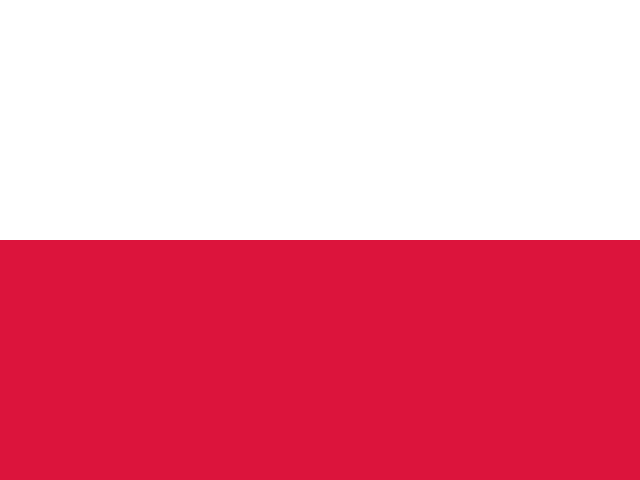
Flagpoles and national flag rules in Poland
Published Written by Flagpole Guides
This page is an English translation of the Polish original. Where the two versions differ, the Polish text is the original.
In Poland the white and red flag flies on government offices, schools, military units and local government buildings, and on state holidays also on many houses, balconies and business premises. The use of the flag is governed by law: it sets out who raises the state flag, when flying it is recommended, what the flag looks like and what happens to it during national mourning. This page brings together information on the flag and flagpoles in Poland, based on Polish law and the guidance of state institutions.
The essentials
- Holidays: Poland has no statutory list of flag days. Public offices raise the flag for ceremonies and for state holidays and anniversaries, and the law recommends the same to residents and businesses. All the dates are in the guide to flag days.
- Flag Day: 2 May is the Day of the Flag of the Republic of Poland, between the State Holiday on 1 May and the National Holiday of the Third of May. More is in the guide to flags on holidays.
- Mourning: During national mourning, declared by the President, the state flag is lowered to half-mast. The subject is covered in the guides to half-mast and flags in mourning.
- Size: The law sets the flag's proportions, 5:8, but does not link its size to the height of the pole. The flag size calculator shows common sizes.
- Price: The factors that affect the price are described in the guides to buying a flagpole and buying a flag.
- Permits: A free-standing flagpole up to 7 m needs neither a building permit nor a notification. The details are in the guide to flagpole installation.
Laws and institutions
Article 28 of the Constitution states that the emblem of the Republic of Poland is the image of a white eagle wearing a crown on a red field, that its colours are white and red, and that the emblem, colours and anthem are protected by law. The Act of 31 January 1980 on the emblem, colours and anthem of the Republic of Poland and on state seals sets out what the flag looks like, which institutions raise it, Flag Day and national mourning. Under article 1 of the Act, surrounding the symbols with reverence and respect is the right and duty of every citizen and of all state bodies, institutions and organisations.
Article 137 of the Criminal Code provides a penalty for publicly insulting, destroying, damaging or removing the flag, and article 49(2) of the Code of Petty Offences for breaching the rules on the emblem, colours and anthem. Practical guidance on displaying the flag was published by the National Security Bureau (Biuro Bezpieczeństwa Narodowego) together with the Ministry of National Defence in the booklet “Duma i szacunek” (Pride and respect). Voivodeships, districts and municipalities can adopt their own flags by resolution of their council, after the minister responsible for public administration has given an opinion on the design.
Flagpoles are governed above all by the Building Law, and also by the local zoning plan, the rules on historic monuments and, in housing communities, the Act on the ownership of premises.
The flagpole in Poland
On government offices and schools the flag often hangs from a staff set in a bracket by the entrance or on the façade. Many public buildings have flagpoles in front: one with the state flag, or several on which the flag of the European Union and the flag of the voivodeship, district or municipality fly beside it. At detached houses both staffs on balconies or windows and flagpoles in the garden are common. More is in the guides to types of flagpoles and flagpole heights.
White and red were adopted as the national colours by the insurgent Sejm on 7 February 1831, and the flag's proportions were already set by an act of 1919. The history is told in the guide to the history of the flagpole.
The guides
The guides are arranged by topic. Each guide covers one subject, ends with frequently asked questions, lists its sources and shows the date of its last update. The dates of movable holidays such as Easter and Corpus Christi are calculated for 2026 and 2027. The rules on the flags of voivodeships, districts and municipalities are covered where they apply, above all in the guides to flag types and flag protocol.
All guides
Flag flying and rules
When, how and why the flag is flown in Poland – from state holidays and Flag Day to national mourning, the order of flags and the flags of other countries.
- Flag daysWhen the flag is flown in Poland: national and state holidays, Flag Day on 2 May, days off work in 2026 and 2027 and what the Act on the flag says.
- Flag rulesThe rules on the Polish flag: who raises it, residents' rights, the flag with the emblem, respect for the colours, BBN guidance and criminal penalties.
- Half-mastWhen the flag is lowered to half-mast in Poland, how it is lowered, what happens to other flags, the black mourning ribbon and mourning in the armed forces.
- Flags in mourningWhat national mourning is in Poland, who declares it, what the President's regulations contain, examples from 2010 to 2025 and what happens to the flag.
- Flags on holidaysThe flag on Polish holidays: the May weekend with Flag Day, 3 May, 15 August, 11 November, days of remembrance, regional holidays and customs around the flag.
- Flag protocolThe order of flags in Poland according to BBN guidance: the place of honour, the EU flag, local government and foreign flags, even and odd numbers of flags.
- Foreign flagsFlags of other states in Poland: the right to fly them, precedence of the Polish flag, protection under the Criminal Code, embassies and the EU flag.
The flag
The proportions, colours, sizes and symbolism of the white and red flag, what affects the price of a flag, and a calculator that shows the size of flag for a given pole.
- Flag typesTypes of flags in Poland: the state flag, the flag with the emblem, the ensign, voivodeship, district and municipal flags, vertical flags, pennants and banners.
- Flag sizesSizes of the Polish flag: the statutory 5:8 proportions, the CIE colours, common sizes of 70×112, 100×160 and 150×240 cm and matching the flag to the flagpole.
- Flag size calculatorFor a flagpole height, the calculator shows the nearest standard Polish flag size in the 5:8 proportion, the one-quarter rule and a vertical flag size.
- Flag symbolismWhere Poland's colours come from: the white eagle and the red shield, the national cockade of 1831, white next to the pole and the flag among state symbols.
- Buying a flagWhat affects the price of a flag in Poland: size, fabric, sewn or printed, finishing, the 5:8 proportions, custom printing, VAT and consumer rights when buying.
The flagpole
Types, materials, heights, accessories, lighting and what affects the price of a flagpole – and the history of the flagpole in Poland.
- Types of flagpolesTypes of flagpoles: free-standing, a staff in a façade or balcony bracket, a flagpole with a crossarm, tilting, telescopic, on a roof and an indoor stand.
- Flagpole materialsWhat flagpoles are made of: aluminium, fibreglass, galvanised and stainless steel, wood. Pros and cons, wind and corrosion resistance and how long they last.
- Flagpole heightsHow tall flagpoles are in Poland: common heights from 5 to 12 m, the 7 m limit in the Building Law, proportion to the building, flag size and several flagpoles.
- Flagpole accessoriesFlagpole accessories: finial, pulley, halyard, cleat, snap hooks, crossarm, rotating ring, flag brackets, staffs, stands and the black ribbon used in mourning.
- Flagpole mechanicsHow a flagpole works: external and internal halyards, pulley, cleat, tilting flagpole, rotating crossarm, raising and lowering the flag and common faults.
- Flag lightingLighting a flag on a flagpole: whether the flag may fly at night, ground floodlights, lights at the top of the pole, solar power, neighbours and wiring.
- History of the flagpoleHistory of the white and red flag and flagpole in Poland: banners, the 1831 cockade, the 1919 act, the war, communist Poland, the 1980 act and Flag Day.
- Buying a flagpoleWhat affects the price of a flagpole in Poland: height, material, internal halyard, tilting pole, foundation, installation, transport, VAT and consumer rights.
Installation, safety and care
Building law, historic monuments, foundations, safety, maintenance and transport – for houses, housing communities, businesses and public bodies.
- Flagpole installationInstalling a flagpole in Poland: the 7 m exemption in the Building Law, historic monuments, airports, housing communities, the road lane, foundations and wind.
- Flagpole safetyFlagpole safety: strong wind and IMGW warnings, power lines, lightning, work at height, ice, children and the owner's liability under Polish law.
- Flagpole maintenanceMaintaining a flagpole and flag: checking the halyard, pulley and fixings, cleaning, inspections under the Building Law, washing and storing the flag.
- Flagpole repairCommon flagpole repairs: replacing an external or internal halyard, the pulley and finial, damaged coating, a bent pole, the foundation and consumer claims.
- Flagpole lifespanHow long a flagpole and flag last: lifespan by material, the effect of the coast, wind and sun, the parts that wear fastest, flag wear and consumer claims.
- Flagpole transportCarrying a flagpole: loads projecting up to 2 m at the rear, marking with a red flag, securing the load, sectional flagpoles, delivery and storage in Poland.
- Flagpoles for businessesFlagpoles at businesses in Poland: the Polish and company flags, order of flags, advertising flags, landscape resolution, advertising fee and road lane.
Frequently asked questions
Can a private individual fly the Polish flag without permission from an authority?
Yes. Under article 5(2) of the Act on the emblem, colours and anthem of the Republic of Poland, everyone has the right to use the colours of the Republic of Poland, in particular to mark the importance of ceremonies, holidays or other events. Article 7(3) recommends flying the flag on residential buildings and business premises on state holidays and anniversaries.
Which laws govern the Polish flag?
Article 28 of the Constitution states that the colours of the Republic of Poland are white and red and that the emblem, colours and anthem are protected by law. The details are set out in the Act of 31 January 1980 on the emblem, colours and anthem of the Republic of Poland and on state seals. Insulting the flag is an offence under article 137 of the Criminal Code.
When is Flag Day?
Under article 6a of the Act on the emblem, colours and anthem, 2 May is the Day of the Flag of the Republic of Poland. It is not a day off work. The Day of Poles Abroad is celebrated on the same day.
When is the flag flown at half-mast?
Under article 11 of the Act on the emblem, colours and anthem, the state flag is lowered to half-mast during national mourning, which the President of the Republic of Poland declares by regulation.
Does a flagpole need a building permit?
Since 7 January 2026, article 29(2)(37) of the Building Law exempts free-standing flagpoles no higher than 7 m from both the building permit and the notification, except in areas covered by the general plan of a public-use airport. Special rules apply at historic monuments, and the district office (starostwo) can clarify each individual case.
Sources
This guide is based on the following sources, most of them in Polish:
- Konstytucja Rzeczypospolitej Polskiej z dnia 2 kwietnia 1997 r. (art. 28) – Dziennik Ustaw
- Ustawa z dnia 31 stycznia 1980 r. o godle, barwach i hymnie Rzeczypospolitej Polskiej oraz o pieczęciach państwowych (tekst jednolity Dz.U. 2025 poz. 299) – Dziennik Ustaw
- Duma i szacunek. Zasady oraz dobre praktyki godnego postępowania wobec polskich symboli państwowych – Biuro Bezpieczeństwa Narodowego
- Ustawa z dnia 6 czerwca 1997 r. – Kodeks karny (art. 137, tekst jednolity Dz.U. 2025 poz. 383) – Dziennik Ustaw
- Ustawa z dnia 7 lipca 1994 r. – Prawo budowlane (tekst jednolity Dz.U. 2026 poz. 524) – Dziennik Ustaw
- Ustawa z dnia 18 stycznia 1951 r. o dniach wolnych od pracy (tekst jednolity Dz.U. 2025 poz. 296) – Dziennik Ustaw