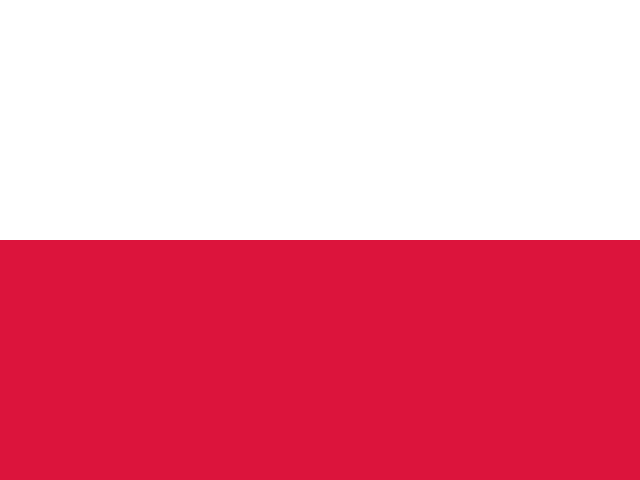
Foreign flags in Poland
Published Written by Flagpole Guides
This page is an English translation of the Polish original. Where the two versions differ, the Polish text is the original.
The flags of other states are seen in Poland in front of embassies and consulates, hotels and the offices of international companies, during visits by foreign guests and in stadiums. Polish law does not prohibit flying them. The principle applies, however, that in Poland the flag of the Republic of Poland takes precedence when it flies together with others. This guide describes what the rules and the guidance say. The order of flags is set out in the guide to flag protocol.
Private individuals and businesses
No provision requires permission to fly the flag of another state on a house, a balcony or in front of business premises. Residents from other countries fly the flags of their states on their national holidays, and fans do so during sporting events. A free-standing flagpole is subject to the same building rules as a flagpole with the Polish flag, described in the guide to flagpole installation.
In the booklet “Duma i szacunek”, the National Security Bureau points out that the symbols of other states are treated with respect, the way we would like others to treat our symbols.
Precedence of the Polish flag
According to the Bureau's guidance, when the flag of the Republic of Poland flies together with the flags of other states:
- the Polish flag takes precedence over any other and occupies the place of honour;
- the order of the other states' flags follows the alphabetical order of their names;
- all flags are the same size and fly at the same height;
- the Polish flag is hoisted first and lowered last;
- each flag flies on its own pole or staff.
Indoors, during joint appearances of a Polish representative and a representative of another state, diplomatic protocol allows, according to the Bureau, the place of honour to be courteously ceded to the guest's flag.
Protection under the Criminal Code
Article 137(2) of the Criminal Code provides a fine, restriction of liberty or imprisonment of up to one year for anyone who in Poland insults, destroys, damages or removes the emblem, a banner, a standard, an ensign, a flag or another sign of a foreign state. The provision applies only to signs publicly displayed by that state's mission or by order of a Polish authority, for example flags in front of an embassy or flags put up by an authority during a visit by a foreign delegation.
Under article 138(1), this provision applies if the foreign state ensures reciprocity. The flag of another state flown by a private individual is not covered by this provision but is protected like any other property.
Embassies and consulates
Article 20 of the Vienna Convention on Diplomatic Relations of 1961 gives a diplomatic mission and its head the right to use the flag and emblem of the sending state on the premises of the mission, including the residence of the head of mission, and on his means of transport. A similar right for consular posts is provided by article 29 of the Vienna Convention on Consular Relations of 1963. Poland is a party to both conventions.
Polish missions abroad, in turn, raise the state flag with the emblem (article 8(1)(1) of the Act on the emblem, colours and anthem). A regulation of the Minister of Foreign Affairs of 7 March 2002 provides that it is raised in the morning, no later than 8:00 local time, and lowered after sunset, unless different rules or customs apply in the receiving state.
The flag of the European Union
The flag of the European Union, twelve gold stars on a blue background, often flies in front of public offices beside the Polish flag. Polish law does not regulate flying it. In the order given by the Bureau, the flag of the European Union is eighth, after the flag of the host state, the voivodeship, district and municipal flags, the flags of Polish services, organisations and institutions and after the flags of other states. During national mourning it is taken down together with the other flags.
Companies with foreign capital
The offices of international companies often have several flagpoles: with the Polish flag, the flag of the company's home country, the flag of the European Union and the company flag. The order according to the Bureau and the requirements for flagpoles in front of business premises are described in the guide to flagpoles for businesses.
Frequently asked questions
Can the flag of another state be flown in Poland?
Polish law does not prohibit private individuals or businesses from flying the flags of other states and requires no permission. According to the guidance of the National Security Bureau, in Poland the flag of the Republic of Poland takes precedence over any other when flown together with them.
Is a foreign state's flag protected by law?
Under article 137(2) of the Criminal Code, anyone who in Poland insults, destroys, damages or removes the flag or another sign of a foreign state, publicly displayed by that state's mission or by order of a Polish authority, is liable to a penalty. Article 138(1) applies this provision if the foreign state ensures reciprocity.
Can an embassy fly the flag of its country?
Yes. Article 20 of the 1961 Vienna Convention on Diplomatic Relations gives the mission and its head the right to use the flag and emblem of the sending state on the premises of the mission, including the residence of the head of mission, and on his means of transport.
Where does the flag of the European Union rank?
Polish law does not regulate flying the flag of the European Union. In the order given by the National Security Bureau, the flag of the European Union comes after the flag of the host state, the flags of local governments, Polish services and institutions and after the flags of other states.
Sources
This guide is based on the following sources, most of them in Polish:
- Ustawa z dnia 6 czerwca 1997 r. – Kodeks karny (art. 137 i 138) – Dziennik Ustaw
- Konwencja wiedeńska o stosunkach dyplomatycznych, sporządzona w Wiedniu dnia 18 kwietnia 1961 r. (art. 20) – Dziennik Ustaw
- Konwencja wiedeńska o stosunkach konsularnych, sporządzona w Wiedniu dnia 24 kwietnia 1963 r. (art. 29) – Dziennik Ustaw
- Duma i szacunek. Zasady oraz dobre praktyki godnego postępowania wobec polskich symboli państwowych – Biuro Bezpieczeństwa Narodowego
- Rozporządzenie Ministra Spraw Zagranicznych z dnia 7 marca 2002 r. w sprawie szczegółowych zasad podnoszenia flagi państwowej z godłem przez polskie przedstawicielstwa za granicą – Dziennik Ustaw
Related guides
- Flag protocolThe order of flags in Poland according to BBN guidance: the place of honour, the EU flag, local government and foreign flags, even and odd numbers of flags.
- Flag rulesThe rules on the Polish flag: who raises it, residents' rights, the flag with the emblem, respect for the colours, BBN guidance and criminal penalties.
- Flag typesTypes of flags in Poland: the state flag, the flag with the emblem, the ensign, voivodeship, district and municipal flags, vertical flags, pennants and banners.
- Flagpoles for businessesFlagpoles at businesses in Poland: the Polish and company flags, order of flags, advertising flags, landscape resolution, advertising fee and road lane.