Types of flags in Poland
Published Written by Flagpole Guides
This page is an English translation of the Polish original. Where the two versions differ, the Polish text is the original.
Several types of flags are found in Poland. The Act on the emblem, colours and anthem knows two state flags: without and with the emblem. Beside them are the flags of voivodeships, districts and municipalities, the flags of services, company flags and occasional flags, as well as different forms of the same flag: horizontal on a flagpole, vertical, on a staff or as a small pennant. This guide describes the main types. The meaning of the colours is explained in the guide to flag symbolism.
The state flag
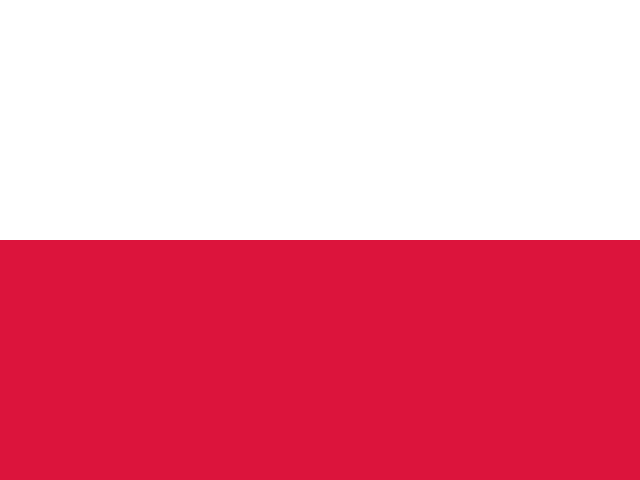
Under article 6(1) of the Act, the state flag of the Republic of Poland is a rectangular piece of fabric in the colours of the Republic of Poland, placed on a pole. White and red form two horizontal stripes of equal width, white on top. The ratio of the flag's width to its length is 5:8 (annex 3). This is the flag used by public offices, schools, local governments and residents.
The flag with the emblem
The state flag with the emblem has the emblem of the Republic of Poland in the middle of the white stripe: a white eagle with a golden crown on a red shield (article 6(2)). The ratio of the emblem's height to the flag's width is 2:5. Under article 8 it is raised by:
- diplomatic missions, consular posts and other official missions abroad;
- civil airports and landing sites;
- civil passenger aircraft on flights abroad;
- harbour masters' offices.
Polish seagoing ships fly the flag with the emblem as their ensign (article 9). According to the guidance of the National Security Bureau, the flag with the emblem should not be used by citizens.
Voivodeship, district and municipal flags
Under article 3 of the Act on badges and uniforms, local government units may adopt their own coats of arms, flags, emblems, insignia and other symbols by resolution of their council – the voivodeship assembly, the district council or the municipal council. The designs are drawn up in accordance with the principles of heraldry, vexillology and local historical tradition, and before adoption the minister responsible for public administration gives an opinion on them.
Local government flags fly in front of their offices beside the state flag. In the Bureau's order, the voivodeship flag comes directly after the state flag, before the district and municipal flags. More is in the guide to flag protocol.
The vertical flag
A vertical flag is longer vertically than horizontally and hangs from a flagpole with a crossarm or from a staff. Under article 4(2) of the Act, when hung vertically white is on the left as seen from the front. According to the Bureau, when the flag is attached vertically to a pole, the white stripe is next to the pole. Vertical flags are popular in front of public offices and businesses because they look good even in light wind.
The flag on a staff
Many private individuals and institutions fly the flag on a short staff set in a bracket on the façade, by a window or on a balcony during holidays. According to the Bureau, the most dignified way of displaying the flag is on a staff or flagpole. Brackets and staffs are described in the guide to flagpole accessories.
Banners and pennants
- A banner (sztandar) is a piece of fabric permanently attached to a staff, with embroidered symbols and inscriptions, belonging to a military unit, school, organisation or local government. Colour parties pay honours during the anthem by dipping the banner (article 14(1) of the Act).
- A pennant (proporzec) is a small, usually triangular flag, used on boats, cars and as decoration.
The flag of the European Union and others
In front of many public offices the flag of the European Union flies beside the Polish flag. There are also flags of international organisations, occasional flags, for example for a town's anniversary, and company flags. The rules on the flags of other states are described in the guide to foreign flags in Poland.
Advertising flags
Advertising flags, for example flags with a company logo or beach flags, are not flags within the meaning of the Act on the emblem, colours and anthem. They can, however, be advertising devices within the meaning of the Act on spatial planning. More is in the guide to flagpoles for businesses.
Materials and make-up
Flags for flagpoles are most often made of polyester, printed or dyed. On the back of a printed flag the colours are usually slightly lighter. Flags sewn from two strips of fabric last longer in the wind. Materials and the factors that affect the price are described in the guide to buying a flag.
Frequently asked questions
What is the difference between the state flag and the flag with the emblem?
Under article 6 of the Act on the emblem, colours and anthem, the state flag is a rectangular piece of fabric in the colours of the Republic of Poland placed on a pole. The flag with the emblem additionally has the emblem in the middle of the white stripe. It is raised by the bodies listed in article 8, including diplomatic missions, civil airports and harbour masters' offices.
Do voivodeships and municipalities have their own flags?
Yes. Under article 3 of the Act on badges and uniforms, local government units may adopt their own coats of arms, flags, emblems, insignia and other symbols by resolution. The designs require an opinion from the minister responsible for public administration.
What does the Polish flag look like when hung vertically?
Under article 4(2) of the Act, when the colours are displayed vertically, white is placed on the left of the surface seen from the front. According to the National Security Bureau, when the flag is attached vertically to a pole, the white stripe is next to the pole.
How does the flag of Poland differ from those of Indonesia and Monaco?
The flag of Poland has the white stripe at the top and the red at the bottom, in the proportions 5:8. The flags of Indonesia and Monaco have red at the top and white at the bottom, so a Polish flag hung upside down resembles the flags of those states.
Sources
This guide is based on the following sources, most of them in Polish:
- Ustawa z dnia 31 stycznia 1980 r. o godle, barwach i hymnie Rzeczypospolitej Polskiej oraz o pieczęciach państwowych (art. 4–9 i załącznik nr 3) – Dziennik Ustaw
- Ustawa z dnia 21 grudnia 1978 r. o odznakach i mundurach (art. 3) – Dziennik Ustaw
- Duma i szacunek. Zasady oraz dobre praktyki godnego postępowania wobec polskich symboli państwowych – Biuro Bezpieczeństwa Narodowego
- Rozporządzenie Ministra Spraw Zagranicznych z dnia 7 marca 2002 r. w sprawie szczegółowych zasad podnoszenia flagi państwowej z godłem – Dziennik Ustaw
Related guides
- Flag symbolismWhere Poland's colours come from: the white eagle and the red shield, the national cockade of 1831, white next to the pole and the flag among state symbols.
- Flag sizesSizes of the Polish flag: the statutory 5:8 proportions, the CIE colours, common sizes of 70×112, 100×160 and 150×240 cm and matching the flag to the flagpole.
- Flag protocolThe order of flags in Poland according to BBN guidance: the place of honour, the EU flag, local government and foreign flags, even and odd numbers of flags.
- Flag rulesThe rules on the Polish flag: who raises it, residents' rights, the flag with the emblem, respect for the colours, BBN guidance and criminal penalties.
- Buying a flagWhat affects the price of a flag in Poland: size, fabric, sewn or printed, finishing, the 5:8 proportions, custom printing, VAT and consumer rights when buying.