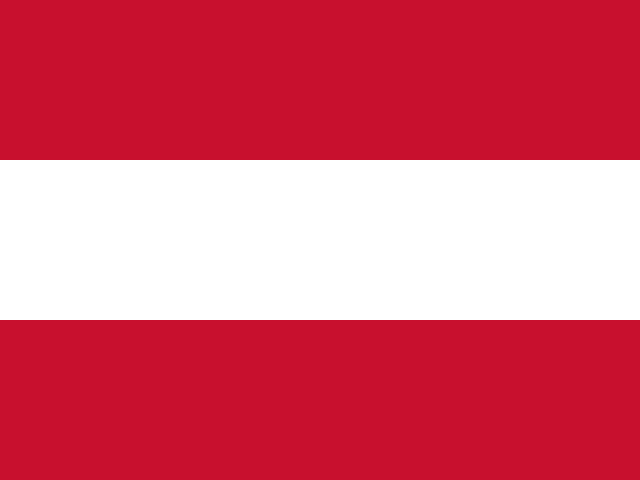
Flagpoles and flag flying in Austria
Published Written by Flagpole Guides
This page is an English translation of the German original. Where the two versions differ, the German text is the original.
In Austria anyone may show the red-white-red flag – at a family home, on a farm, at a club house, at a business or at the municipal office, on single days or all year round. The Coat of Arms Act is deliberately liberal. Even so, many questions arise: on which days do authorities fly flags, what does state mourning mean, when is a flag at half-mast, which flag is reserved for the authorities, and does a flagpole in the garden need a building permit? This page brings together the essentials of flag flying and flagpoles in Austria, with sources from federal law, the laws of the nine federal states and the publications of the responsible bodies.
The essentials in brief
- Flag days: there is no statutory list. The Austrian Armed Forces’ flag order lists 1 May, Europe Day, National Day on 26 October and the respective state holiday for official buildings. All dates are in the guide to flag days.
- Which flag: anyone may use the flag of the Republic; the service flag with the federal coat of arms is reserved for the authorities. More in the guide to flag rules.
- Half-mast and state mourning: the flag is first raised fully and then lowered to half-mast. State mourning is ordered by the Federal Government case by case. More in the guides to half-mast and flags in mourning.
- Federal states: each state has its own colours, from the blue-yellow of Lower Austria to the white-green of Styria. More in the guide to the flags of the federal states.
- Size: the Armed Forces give an ideal ratio of 1 to 5 between flag and pole. Retailers’ tables and the ratio are shown in the flag size calculator.
- Buying: what affects the price is described in the guides to buying a flagpole and buying a flag.
- Building law: nine federal states, nine building codes – from “does not apply to flagpoles” to a building permit. The overview is in the guide to flagpole installation.
Laws, decrees and responsible bodies
The national colours are set out in the Federal Constitution: under Article 8a(1) B-VG, the colours of the Republic of Austria are red-white-red, and the flag consists of three horizontal stripes of equal width, the middle one white and the upper and lower ones red. The Coat of Arms Act (Wappengesetz) of 1984 repeats this and also describes the federal service flag with the federal coat of arms in the middle, in a ratio of two to three. It governs who may use the service flag, and section 7 permits use of the flag itself as long as it does not feign a public authority or harm the reputation of the Republic.
There is no law on flag days, times or half-mast. Flag flying on official buildings is governed by government decisions and decrees. The most detailed published version is the flag order of the Austrian Armed Forces (VBl. I Nr. 63/2018). It states expressly that Austria has no statutory rules on the correct use of the state symbols and sums up the proven rules on order of precedence, hoisting, half-mast and flag size. The federal states govern their own symbols – state colours, coats of arms and in some cases the state flag – in their constitutions and state laws; Styria has also published an illustrated flag guide.
The symbols are protected by criminal law: section 248 of the Criminal Code (StGB) makes it an offence to disparage a flag of the Republic or of a federal state displayed on a public occasion or at an event open to the public, and section 317 StGB protects flags of foreign states displayed by an authority or a mission.
The flagpole in Austria
There are no nationwide rules for the flagpole itself. Building law is a matter for the federal states, and the nine building codes treat flagpoles differently. Tyrol and Upper Austria exclude them from their scope, Carinthia and Burgenland up to 8 metres in height, and Styria makes them subject to notification. In Vienna, the Supreme Administrative Court (Verwaltungsgerichtshof) ruled in 2009 that a pole about 5 metres high and firmly connected to the ground needs a building permit. For stability, the manufacturers’ specifications are decisive; they follow the wind loads under ÖNORM EN 1991-1-4 and the Austrian ÖNORM B 1991-1-4, which gives the basic wind speed by location rather than in large zones as in Germany.
According to the Salzburg flag maker Fahnen Gärtner, the most common pole height in Austria is 7 metres and the most common flag size is 100 × 400 cm in portrait format. The tall, narrow vertical flag (Knatterfahne) is a familiar sight in Austria. More in the guides to types of flagpoles and flag types.
About the guides
The guides below are arranged by topic. Each covers one subject, ends with frequently asked questions, lists its sources and shows when it was last updated. The flag days are listed for 2026 and 2027, including the state holidays of the nine federal states.
All guides
Flag flying and rules
When and how flags are flown in Austria – from National Day to state mourning and half-mast, the order of several flags and flags of other countries.
- Flag daysFlag days in Austria in 2026 and 2027: 1 May, Europe Day, National Day and the state holidays of the federal states – with dates, weekdays and the flag flown.
- Flag rulesWho may fly which flag in Austria, what the Coat of Arms Act prohibits, when the flag is taken down and which customs are usual when hoisting it.
- Half-mastHow flags fly at half-mast in Austria: raising to the top, the height of the flag, duration, mourning ribbons and who orders state mourning.
- Flags in mourningState mourning and mourning flags in Austria: half-mast, mourning ribbon and black flag, who orders them, how long they fly and the mourning flag on a coffin.
- Flags on holidaysWhich of Austria’s 13 public holidays are flag days, why Christmas is not one of them and what applies on the state holidays of the federal states.
- Flag protocolIn what order national, state, European and municipal flags are flown in Austria, where the place of honour is and how flags stand at a lectern.
- Foreign flagsForeign flags in Austria: who may display them, their order next to red-white-red, embassies under the Vienna Conventions and protection under section 317 StGB.
The flag
Red-white-red, the flags of the federal states, flag types from landscape flags to tall vertical flags, flag sizes and what affects the price – and a calculator for the right size.
- Flag typesFahne or Flagge? Landscape flags, vertical Knatterfahnen, banners, hanging flags, the service flag, the maritime flag and the mourning flag in Austria.
- Flag sizesWhich flag size suits which pole height in Austria: the Armed Forces’ 1:5 ratio and a retailer’s tables for landscape and vertical flags from 5 to 9 metres.
- Flag size calculatorThe flag size calculator for Austria shows the flag size for a pole height under the Armed Forces’ 1:5 ratio and a retailer’s size table.
- Red-white-redWhere red-white-red comes from: the Babenberg shield, the seal of 1230, the legend of Acre, the naval flag of 1786, the Republic in 1918 and Article 8a B-VG.
- Flags of the federal statesThe colours of Austria’s nine federal states under state law, who may use the state flag and coat of arms, and how the state flag hangs next to red-white-red.
- Buying a flagBuying a flag in Austria: what affects the price of an Austrian flag – size, fabric, finishing, coat of arms and shipping – and what rights buyers have.
The flagpole
Types of pole, materials, heights, accessories, lighting and what affects the price of a flagpole – and the history of flag and pole in Austria.
- Types of flagpolesGround poles, two-piece poles, poles with a rotating arm, wall and roof poles and mobile poles: the types of flagpoles used in Austria.
- Flagpole materialsWhich material for a flagpole in Austria? Aluminium, galvanised steel, fibreglass and wood compared – weight, corrosion, care and typical uses.
- Flagpole heightsHow tall a flagpole in Austria usually is, which height limits the building codes of the federal states mention and how pole height and flag size are linked.
- Flagpole accessoriesTruck, pulley, halyard, snap hooks, cleat, arm, ground sleeve, finial and lighting: the accessories of a flagpole in Austria and what each part is for.
- Flagpole mechanicsHow a flagpole works: external and internal halyard, pulley and truck, crank, rotating arm and why a flag sometimes hangs too low – as described in Austria.
- Flag lightingWhen a flag is taken down in Austria, why it is lit overnight, which lights are usual and what neighbour law says about light from a flagpole.
- History of the flagpoleFrom field sign to hoisted flag: the history of flag and flagpole in Austria – military banners, the naval flag of 1786, 1918 and the Day of the Flag.
- Buying a flagpoleBuying a flagpole in Austria: what affects the price – height, material, halyard, arm, foundation, shipping and installation – and what rights buyers have.
Installation, safety and care
The building codes of the nine federal states, foundations, wind, liability, maintenance and transport – for homes, condominiums, businesses and municipalities.
- Flagpole installationDoes a flagpole need a building permit in Austria? The rules of all nine building codes, plus foundation, underground lines, neighbours and condominiums.
- Flagpole safetyFlagpoles and safety in Austria: GeoSphere Austria wind warnings, wind load under ÖNORM, liability under section 1319 ABGB and work at height.
- Flagpole maintenanceHow flagpole and flag are looked after in Austria: checks after storms, line and pulley, snap hooks, cleaning, a spare flag and why checks matter for liability.
- Flagpole repairTypical damage to a flagpole and its causes: broken line, sticking pulley, tangled flag, half-mast effect, loose base and corrosion – and who repairs it.
- Lifespan and sustainabilityHow long flagpole and flag last in Austria: lifespans of flag fabrics, what extends them, repair instead of replacement and what happens to old flags.
- Transport and shippingHow long flagpoles are transported in Austria: overhang under section 101 KFG, marking from 1 metre, load securing, two-piece poles and freight delivery.
- Flagpoles for businessesCompany flags in Austria: when a pole counts as advertising, the roadside advertising ban in section 84 StVO, the federal coat of arms and liability.
Frequently asked questions
May anyone fly the red-white-red flag in Austria?
Yes. Under section 7 of the Coat of Arms Act (Wappengesetz), use of the flag of the Republic of Austria is permitted as long as it is not likely to feign a public authority or to harm the reputation of the Republic. No permit is required, and there is no restriction to particular days.
Which flag is reserved for the authorities in Austria?
The federal service flag, red-white-red with the federal coat of arms in the middle. Who may use it is set out in sections 4 and 6 of the Coat of Arms Act. Unauthorised use of the service flag is an administrative offence under section 8, punishable by the district administrative authority with a fine of up to 3,600 euros.
Does Austria have statutory flag days?
No. There is no legal duty to fly a flag. The Austrian Armed Forces’ flag order lists 1 May, Europe Day on 5 May, National Day on 26 October and the respective state holiday for official buildings. According to an article by the Ministry of the Interior, many private houses also fly flags on 1 May and 26 October.
Does a flagpole need a building permit in Austria?
It depends on the federal state. In Tyrol and Upper Austria the building codes do not apply to flagpoles, in Carinthia and Burgenland not to flagpoles up to 8 metres, and in Styria flagpoles must be notified. In Vienna, the Supreme Administrative Court required a building permit for a firmly anchored pole about 5 metres high. The municipal building authority can give information in the individual case.
Which flag size suits which flagpole in Austria?
There is no statutory rule. The Austrian Armed Forces’ flag order gives an ideal ratio of 1 to 5 between flag height and pole height, such as a 2 × 3 metre flag on a 10 metre pole. An Austrian flag maker lists 120 × 200 cm in landscape format or 100 × 400 cm in portrait format for a 7 metre pole.
Sources
This guide is based on the following sources, most of them in German:
- Bundes-Verfassungsgesetz, Art. 8a – Bundeskanzleramt, Rechtsinformationssystem des Bundes (RIS)
- Wappengesetz, BGBl. Nr. 159/1984 – Bundeskanzleramt, Rechtsinformationssystem des Bundes (RIS)
- Grundsätzliche Bestimmungen über Verwendung des Hoheitszeichens sowie über die Fahnenordnung des Österreichischen Bundesheeres, VBl. I Nr. 63/2018 – Bundesministerium für Landesverteidigung
- Die Symbole der Republik, Öffentliche Sicherheit 11-12/2006 – Bundesministerium für Inneres
- Strafgesetzbuch, § 248 Herabwürdigung des Staates und seiner Symbole – Bundeskanzleramt, Rechtsinformationssystem des Bundes (RIS)
- Bauordnung für Wien, § 60 – VwGH 20.10.2009, 2008/05/0020 – Verwaltungsgerichtshof (RIS)
- FAQ: Welche Höhe des Fahnenmastes ist empfehlenswert? / Was sind Ihre gängigsten Fahnengrößen? – Fahnen Gärtner, Mittersill
- Fahnen und Flaggen – empfohlene Größen – Erste Österreichische Fahnenfabrik Paul Löb GmbH
- ÖNORM B 1991-1-4: Eurocode 1 – Windlasten, nationale Festlegungen – Austrian Standards International