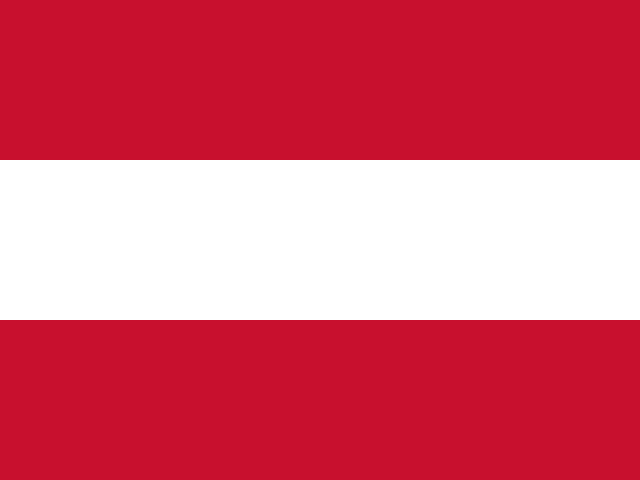
Flags of Austria’s nine federal states: colours and rules
Published Written by Flagpole Guides
This page is an English translation of the German original. Where the two versions differ, the German text is the original.
Austria is a federal state of nine states (Länder), and each has its own colours, coat of arms and flag. On state holidays, at state events and on many private houses they hang next to red-white-red. Unlike the national flag, the state symbols are governed by state law, usually in the state constitution and in a separate state symbols act.
The colours of the federal states
| Federal state | State colours | Legal basis |
|---|---|---|
| Burgenland | red-gold | Art. 8(1) Burgenland Constitution |
| Carinthia | yellow-red-white | s. 1 Carinthian State Symbols Act |
| Lower Austria | blue-yellow | Art. 7(2) Lower Austrian Constitution |
| Upper Austria | white-red | s. 2 Upper Austrian State Symbols Act |
| Salzburg | red-white | Art. 8(2) Salzburg Constitution |
| Styria | white-green | Art. 6 Styrian Constitution 2010, s. 3 Styrian State Symbols Act |
| Tyrol | white-red | Art. 6(2) Tyrolean Constitution |
| Vorarlberg | red-white | Art. 6(2) Vorarlberg Constitution |
| Vienna | red-white | s. 3 Vienna Symbols Act |
The colours are read from top to bottom. Upper Austria states expressly that the white faces the top of the staff and, on vertically hanging flags, is on the left as seen by the viewer.
Flags described in state law
Some states describe their flag in more detail:
- Upper Austria: two horizontal stripes of equal width, white above and red below, in a ratio of 2:3.
- Styria: two horizontal stripes of equal width, white above and green below, with the state coat of arms in the middle, in a ratio of 2:3. The state anthem is the Dachstein song.
- Vienna: two horizontal stripes of equal width, red above and white below, in a ratio of 2:3. Under section 3(3) of the Vienna Symbols Act, anyone may use the flag.
Who may use the state colours
Several states expressly allow use of the state colours:
- Lower Austria: under section 5 of the act on the protection of the Lower Austrian state symbols, anyone may use the state colours, in particular on flags, as long as this does not disparage them or harm the state’s reputation.
- Vienna: anyone may use the flag.
- Burgenland and Salzburg: the state laws allow dignified use of the state coat of arms on flags in the state colours, for example as decoration at local festivals.
Bearing the state coat of arms – using it as the sign of an authority or entitlement – is reserved for the state authorities and specially authorised persons. In Styria, under Article 6(3) of the state constitution, it is for the state’s authorities and offices and for persons who have acquired the right lawfully; new authorisations are granted by the state government.
The state coats of arms
| Federal state | Coat of arms (short description) |
|---|---|
| Burgenland | red eagle crowned in gold on a black rock, on a golden shield |
| Lower Austria | five golden eagles on a blue shield under a mural crown |
| Salzburg | divided shield: black lion on gold, silver bar on red |
| Styria | silver panther on a green shield with the historic ducal hat |
| Tyrol | red eagle with golden wing clasps and a green wreath on a silver shield |
| Vorarlberg | red banner of the Counts of Montfort on a silver shield |
The descriptions follow the state constitutions. Carinthia, Upper Austria and Vienna govern their coats of arms in separate state laws.
State flag and Austrian flag side by side
Under the Austrian Armed Forces’ flag order, the place of honour belongs in principle to the flag of the Republic; the flags of the federal states follow in alphabetical order and come before the flags of international organisations such as the EU. Under the Styrian flag guide, the state flag can take the place of honour on state buildings and at state events. On state holidays, official buildings in the respective state fly flags. The dates are in the guide to flag days, the arrangement of several flags in the guide to flag protocol.
Protection of the state flags
Criminal law protects the state flags like the national flag: section 248(2) StGB makes it an offence to publicly and maliciously insult, scorn or otherwise disparage a flag of a federal state displayed on a public occasion or at an event open to the public.
Frequently asked questions
What colours do Austria’s federal states have?
Under the state constitutions and state laws: Burgenland red-gold, Carinthia yellow-red-white, Lower Austria blue-yellow, Upper Austria white-red, Salzburg red-white, Styria white-green, Tyrol white-red, Vorarlberg red-white and Vienna red-white.
May anyone fly an Austrian state flag?
Several states expressly allow anyone to use a flag in the state colours, for example Lower Austria, as long as it does not disparage the state colours or harm the state’s reputation, and Vienna under its act on the symbols of the federal capital. Using the state coat of arms as an official sign is reserved for the state authorities and specially authorised persons.
How do the flags of Vienna, Salzburg and Vorarlberg differ?
All three states have the colours red-white. Under Vienna’s symbols act, the Viennese flag consists of two stripes of equal width, red above and white below. The coats of arms differ clearly: Salzburg bears a black lion and a silver bar, Vorarlberg the red banner of the Counts of Montfort.
Where does the state flag hang next to the Austrian flag?
Under the Austrian Armed Forces’ flag order, the place of honour belongs in principle to the flag of the Republic; the flags of the federal states follow and come before the flags of international organisations. Under the Styrian flag guide, the state flag can take the place of honour on state buildings and at state events.
Is disparaging a state flag an offence in Austria?
Yes, under the conditions of section 248(2) StGB: if a flag of a federal state displayed on a public occasion or at an event open to the public is publicly and maliciously insulted, scorned or otherwise disparaged.
Sources
This guide is based on the following sources, most of them in German:
- Landes-Verfassungsgesetz Burgenland, Art. 8 – Bundeskanzleramt, Rechtsinformationssystem des Bundes (RIS)
- Kärntner Landessymbolegesetz (K-LSG 2002), § 1 – Bundeskanzleramt, Rechtsinformationssystem des Bundes (RIS)
- NÖ Landesverfassung 1979, Art. 7 – Bundeskanzleramt, Rechtsinformationssystem des Bundes (RIS)
- Gesetz über den Schutz der NÖ Landessymbole, § 5 – Bundeskanzleramt, Rechtsinformationssystem des Bundes (RIS)
- Landesgesetz über die oberösterreichischen Landessymbole, § 2 – Bundeskanzleramt, Rechtsinformationssystem des Bundes (RIS)
- Salzburger Landes-Verfassungsgesetz 1999, Art. 8 – Bundeskanzleramt, Rechtsinformationssystem des Bundes (RIS)
- Steiermärkisches Landessymbolegesetz, § 3 – Bundeskanzleramt, Rechtsinformationssystem des Bundes (RIS)
- Tiroler Landesordnung 1989, Art. 6 – Bundeskanzleramt, Rechtsinformationssystem des Bundes (RIS)
- Vorarlberger Landesverfassung, Art. 6 – Bundeskanzleramt, Rechtsinformationssystem des Bundes (RIS)
- Gesetz über die Symbole der Bundeshauptstadt Wien, § 3 – Bundeskanzleramt, Rechtsinformationssystem des Bundes (RIS)
- Burgenländisches Landessymbolegesetz, § 9 – Bundeskanzleramt, Rechtsinformationssystem des Bundes (RIS)
- Salzburger Landeswappengesetz 1989, § 5 – Bundeskanzleramt, Rechtsinformationssystem des Bundes (RIS)
- Steiermärkisches Landes-Verfassungsgesetz 2010, Art. 6 – Bundeskanzleramt, Rechtsinformationssystem des Bundes (RIS)
- Fahnenordnung des Österreichischen Bundesheeres, VBl. I Nr. 63/2018 – Bundesministerium für Landesverteidigung
- Flaggenkunde – Amt der Steiermärkischen Landesregierung, Referat Protokoll und Auszeichnungen
- Strafgesetzbuch, § 248 – Bundeskanzleramt, Rechtsinformationssystem des Bundes (RIS)
Related guides
- Red-white-redWhere red-white-red comes from: the Babenberg shield, the seal of 1230, the legend of Acre, the naval flag of 1786, the Republic in 1918 and Article 8a B-VG.
- Flag protocolIn what order national, state, European and municipal flags are flown in Austria, where the place of honour is and how flags stand at a lectern.
- Flag daysFlag days in Austria in 2026 and 2027: 1 May, Europe Day, National Day and the state holidays of the federal states – with dates, weekdays and the flag flown.
- Buying a flagBuying a flag in Austria: what affects the price of an Austrian flag – size, fabric, finishing, coat of arms and shipping – and what rights buyers have.