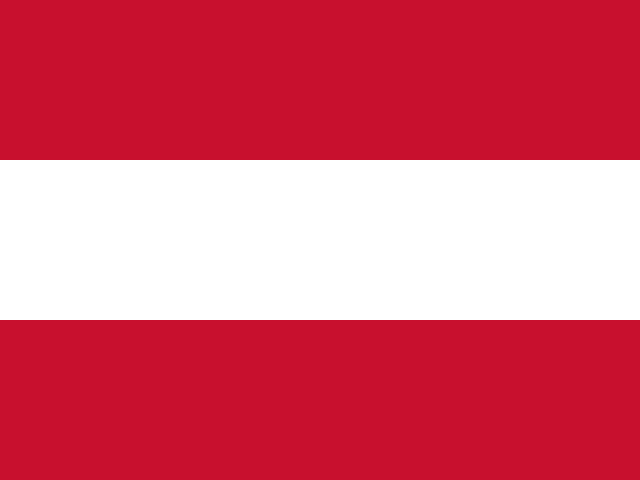
Red-white-red: meaning and history of the Austrian flag
Published Written by Flagpole Guides
This page is an English translation of the German original. Where the two versions differ, the German text is the original.
Red-white-red has a long history. The colours go back to the Middle Ages, were for a long time the sign of the Duchy of Austria and only became the flag of the whole state in 1918. Today they are set out in Article 8a of the Federal Constitution. The account below draws mainly on an article by the Ministry of the Interior on the symbols of the Republic.
The Babenberg shield
The colours are derived from the last Babenbergs. The oldest depiction of the Austrian Bindenschild – a white bar on a red field – is on an equestrian seal of Duke Frederick II (“the Quarrelsome”), attached to a charter for Lilienfeld Abbey dated 30 November 1230. The Babenbergs most probably took over the shield from the Counts of Hohenburg-Wildberg, lords of the county of Poigen in the Waldviertel. From the seal of 1230 onwards, the dukes of Austria bore the Bindenschild as their coat of arms.
The colours are first mentioned in 1232: the “Fürstenbuch” of Jans Enikel describes how Frederick II dressed 200 young noblemen in red-white-red for his knighting.
The legend of Acre
Better known than the seal is the legend: Duke Leopold V is said to have fought so fiercely at the siege of Acre in 1191 that his white tunic was soaked red with blood – except for the strip under his sword belt. According to the Ministry of the Interior, this story cannot be verified historically. There is no official interpretation of the colours in Austria.
From duchy to naval flag
As a military banner, red-white-red can be traced several times in the 14th, 15th and 16th centuries. In the centuries when the Habsburgs were emperors of the Holy Roman Empire, the black-yellow imperial banner largely displaced it. It appeared mainly at homage ceremonies, parades and on triumphal arches.
On 20 March 1786, Emperor Joseph II introduced a red-white-red war, national and naval flag, with the Bindenschild under a crown in the front part of the white stripe. It served as the merchant flag until 1869 and as the war flag until 1918.
1918: the flag of the Republic
On 31 October 1918, before the Republic was proclaimed, the State Council adopted red-white-red as the state colours on the proposal of the later Federal President Wilhelm Miklas. When the Republic was proclaimed outside Parliament on 12 November 1918, red-white-red flags were to be hoisted. Members of the communist “Red Guards”, however, tore out the white middle stripe and hoisted the knotted red cloths.
The flag was laid down in law in the Act on the Form of State of 21 October 1919: the flag of the Republic consists of three horizontal stripes of equal width, the middle one white, the upper and lower ones red.
Corporate state, Nazi era and Second Republic
- 1934–1938: the 1934 constitution recorded the colours red-white-red. A flag act of 1936 gave the Kruckenkreuz flag, with a crutch cross and a green chevron, equal status with the state flag.
- 1938–1945: under Nazi rule the red-white-red flag was banned.
- 1945: the Coat of Arms Act of 1 May 1945 reintroduced red-white-red.
- 1955/1956: after the State Treaty, 26 October was marked as the “Day of the Austrian Flag”; in 1965 it became National Day.
- 1981: an amendment to the Federal Constitution inserted Article 8a, anchoring colours, flag and coat of arms in the constitution.
- 1984: today’s Coat of Arms Act describes flag, service flag, coat of arms and seal and governs their use.
The coat of arms on the service flag
The federal service flag bears the federal coat of arms: under Article 8a(2) B-VG, a free-standing, single-headed black eagle with a red breast shield crossed by a silver bar, a golden mural crown, a golden sickle in its right talon and a golden hammer in its left, and a broken iron chain. According to the Ministry of the Interior, the National Assembly adopted the single-headed eagle on 8 May 1919. Hammer, sickle and mural crown stand for workers, farmers and the middle classes; they have nothing to do with the communist symbol. The broken chain was added in 1945 as a sign of liberation.
The colour red
The Constitution sets no shade. The Austrian Armed Forces’ flag order specifies for its area that the red of the national colours has the characteristic Pantone 186 C.
Risk of confusion
The Ministry of the Interior’s article names three other countries with red-white-red flags: Peru with vertical stripes, Latvia with carmine stripes and a white middle stripe only about half as wide, and Lebanon with a broad white middle stripe and a cedar. The colours of the federal states are described in the guide to the flags of the federal states, the history of flag and pole in the guide to the history of the flagpole.
Frequently asked questions
What do the colours of the Austrian flag mean?
There is no official interpretation of the colours. Red-white-red goes back to the Bindenschild of the Babenberg dynasty, the coat of arms of the dukes of Austria. The well-known legend of Duke Leopold V’s blood-soaked tunic at Acre cannot be verified historically, according to an article by the Ministry of the Interior.
How old is the Austrian flag?
The oldest depiction of the Bindenschild is on an equestrian seal of Duke Frederick II on a charter for Lilienfeld Abbey dated 30 November 1230. The colours red-white-red are first mentioned in 1232. As the flag of the state, red-white-red was adopted as the state colours on 31 October 1918.
Is the red of the Austrian flag defined?
The Constitution only names the colours. The Austrian Armed Forces’ flag order specifies for its area that the red of the national colours has the characteristic Pantone 186 C.
What does the Austrian federal coat of arms show?
Under Article 8a(2) B-VG, a free-standing, single-headed black eagle with a red-white-red breast shield, a golden mural crown, sickle and hammer and a broken iron chain. According to the Ministry of the Interior, hammer, sickle and mural crown stand for workers, farmers and the middle classes, and the broken chain for liberation in 1945.
Which other countries have red-white-red flags?
The Ministry of the Interior’s article names Peru with vertical stripes, Latvia with carmine stripes and a narrower white middle stripe, and Lebanon with a cedar in its broad white middle stripe.
Sources
This guide is based on the following sources, most of them in German:
- Die Symbole der Republik, Öffentliche Sicherheit 11-12/2006 – Bundesministerium für Inneres
- Bundes-Verfassungsgesetz, Art. 8a – Bundeskanzleramt, Rechtsinformationssystem des Bundes (RIS)
- Wappengesetz, BGBl. Nr. 159/1984 – Bundeskanzleramt, Rechtsinformationssystem des Bundes (RIS)
- Fahnenordnung des Österreichischen Bundesheeres, VBl. I Nr. 63/2018 – Bundesministerium für Landesverteidigung
- Tag der Fahne – Universität Wien, Themendossiers zur historisch-politischen Bildung
Related guides
- History of the flagpoleFrom field sign to hoisted flag: the history of flag and flagpole in Austria – military banners, the naval flag of 1786, 1918 and the Day of the Flag.
- Flags of the federal statesThe colours of Austria’s nine federal states under state law, who may use the state flag and coat of arms, and how the state flag hangs next to red-white-red.
- Flag typesFahne or Flagge? Landscape flags, vertical Knatterfahnen, banners, hanging flags, the service flag, the maritime flag and the mourning flag in Austria.
- Flag daysFlag days in Austria in 2026 and 2027: 1 May, Europe Day, National Day and the state holidays of the federal states – with dates, weekdays and the flag flown.