History of the flag and flagpole in Austria
Published Written by Flagpole Guides
This page is an English translation of the German original. Where the two versions differ, the German text is the original.
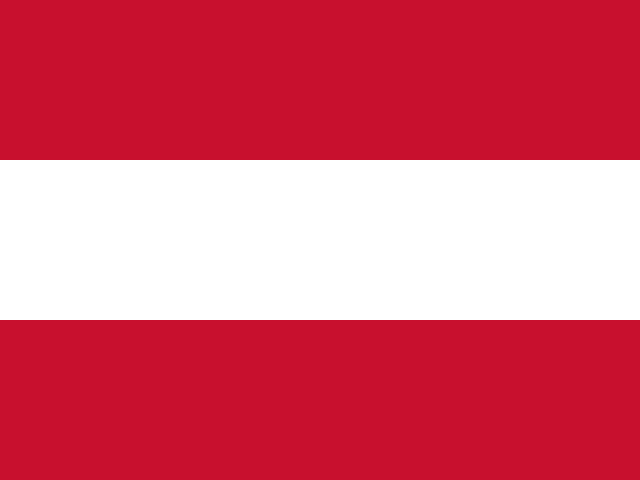
Flags have a long history as signs of rule, belonging and community. In Austria the history of flag and pole mirrors the history of the country: from the Babenberg shield via military banners and the naval flag to the Republic, which made red-white-red the state flag in 1918.
From field sign to flag
According to the Ministry of the Interior’s article on the symbols of the Republic, flags developed from field signs via pennons and the banners of military units. The flag was a sign of battle, victory and rule, and for soldiers also a sign for direction and rallying. It showed belonging to a unit, a dynasty or a community.
The flag hung on a staff that was carried or set up, often with a finial – the “Krönlein”, a point, an eagle or a badge. This form lives on in traditional, club and church flags, which can also be blessed and are kept for as long as possible.
From staff flag to flag on a pole
The flag without its own staff, hoisted on a pole, comes from seafaring: according to the Ministry of the Interior, that is where national flags originated. Ships showed their origin with flags. The pole with line and pulley, on which a flag is hoisted and lowered, is today widespread on official buildings, businesses and homes.
Red-white-red through the ages
- 13th century: the red-white-red Bindenschild is documented from 1230 on a seal of Duke Frederick II.
- 14th to 16th century: red-white-red can be traced several times as a military banner, but loses importance as mercenary troops replace the knightly armies.
- Habsburg era: the black-yellow imperial banner largely displaces the red-white-red flag; it appears mainly at homage ceremonies and parades.
- 1786: Emperor Joseph II introduces a red-white-red war, national and naval flag. It serves as the merchant flag until 1869 and as the war flag until 1918.
- 12 November 1918: when the Republic is proclaimed outside Parliament, red-white-red flags are to be hoisted. Members of the “Red Guards” tear out the white stripe and hoist the red cloths.
More on the origin of the colours is in the guide to red-white-red.
The Day of the Flag
After the State Treaty of 1955, politicians looked for a suitable state holiday. They agreed on 26 October, the day on which the National Council decided on neutrality in 1955. On this day the Austrian flag was to be hoisted every year and schools were to hold a ceremony – the “Day of the Austrian Flag”. In 1965 it was renamed National Day, and two years later it became a day off work and school.
Flagpoles in the Armed Forces
The Austrian Armed Forces’ flag order shows how closely flag and pole are tied to ritual. In barracks, a flagpole stands free and clearly visible at ground level, its location highlighted for example by a fence or planting. At the flag parade at the start of the working week, the flag is hoisted with dignity. Flags of high traditional value, such as the flag of a contingent abroad, are handed to the Museum of Military History after use.
Maypole and flagpole
Besides the flagpole, Austria has a second tradition of the tall pole: the maypole. The building codes treat both similarly. The Tyrolean Building Code names flagpoles and maypoles among the structures to which the act does not apply; the Upper Austrian Building Code excludes summit crosses, wayside shrines and flagpoles.
From wood to aluminium
Flagpoles were long made of wood. Today, according to the maker Fahnen Gärtner, aluminium is the most common material, with steel or fibreglass for special poles. More in the guide to flagpole materials.
Frequently asked questions
Where do flags come from?
According to an article by the Austrian Ministry of the Interior, flags developed from field signs via pennons and the banners of military units. The flag was a sign of battle, victory and rule and, for soldiers, a sign for direction and rallying. National flags have their origin in seafaring.
Since when has the red-white-red flag flown on poles?
Red-white-red can be traced as a military banner from the 14th to the 16th century. In 1786 Emperor Joseph II introduced a red-white-red war, national and naval flag. Red-white-red became the flag of the state on 31 October 1918.
What was Austria’s Day of the Flag?
After the State Treaty, 26 October, the day of the 1955 neutrality decision, was marked as the Day of the Austrian Flag: the flag was to be hoisted every year and schools were to hold a ceremony. In 1965 the day was renamed National Day.
What happens to old flags of the Austrian Armed Forces?
Under the Armed Forces’ flag order, worn-out flags are taken out of use and destroyed. Flags of high traditional value, such as the flag of a contingent abroad or of a closed site, are handed to the Museum of Military History.
Sources
This guide is based on the following sources, most of them in German:
- Die Symbole der Republik, Öffentliche Sicherheit 11-12/2006 – Bundesministerium für Inneres
- Fahnenordnung des Österreichischen Bundesheeres, VBl. I Nr. 63/2018 – Bundesministerium für Landesverteidigung
- Tag der Fahne – Universität Wien, Themendossiers zur historisch-politischen Bildung
- Tiroler Bauordnung 2022, § 1 Geltungsbereich – Bundeskanzleramt, Rechtsinformationssystem des Bundes (RIS)
- Oö. Bauordnung 1994, § 1 – Bundeskanzleramt, Rechtsinformationssystem des Bundes (RIS)
- FAQ: Aus welchem Material besteht der Fahnenmast? – Fahnen Gärtner, Mittersill
Related guides
- Red-white-redWhere red-white-red comes from: the Babenberg shield, the seal of 1230, the legend of Acre, the naval flag of 1786, the Republic in 1918 and Article 8a B-VG.
- Flag daysFlag days in Austria in 2026 and 2027: 1 May, Europe Day, National Day and the state holidays of the federal states – with dates, weekdays and the flag flown.
- Flag typesFahne or Flagge? Landscape flags, vertical Knatterfahnen, banners, hanging flags, the service flag, the maritime flag and the mourning flag in Austria.
- Flagpole materialsWhich material for a flagpole in Austria? Aluminium, galvanised steel, fibreglass and wood compared – weight, corrosion, care and typical uses.