Flagpoles and flag rules in Finland
Published Written by Flagpole Guides
This page is an English translation of the Finnish original. Where the two versions differ, the Finnish text is the original.
In Finland everyone has the right to fly the flag, and the blue-and-white flag flies from the poles of detached houses, summer cottages, housing companies, businesses and public offices. Flag flying nevertheless follows clear provisions and established customs: when the flag is raised and lowered, which days are flag days, how mourning is shown with the flag and how large the flag usually is compared with the pole. This page brings together information on flag flying and flagpoles in Finland, based on Finnish legislation and the authorities responsible.
The essentials in brief
- Flag days: The Decree on Flying the Flag of Finland lists seven official flag days each year. Election days and the day the President of the Republic takes office are also official flag days. Fifteen established flag days are marked in the almanac. All dates are in the guide to flag days.
- Flying times: Flag flying begins at 8.00 and ends at sunset, no later than 21.00. At Midsummer the flag flies through the night. More information is in the guide to flag rules.
- Half-mast: The flag is first raised to the top and then lowered so that its lower edge is at the middle of the pole. The practice is described in the guide to half-mast.
- Size: According to the Ministry of the Interior, the flag’s height is about one sixth of the pole’s length. The size can be worked out with the flag size calculator.
- Price: What affects the price of a flagpole and a flag is described in the guides to buying a flagpole and buying a flag.
- Building permit: Under the Building Act, a permit is required for a mast at least 30 metres high. The municipal building ordinance may contain further provisions. More information is in the guide to flagpole installation.
Laws and authorities
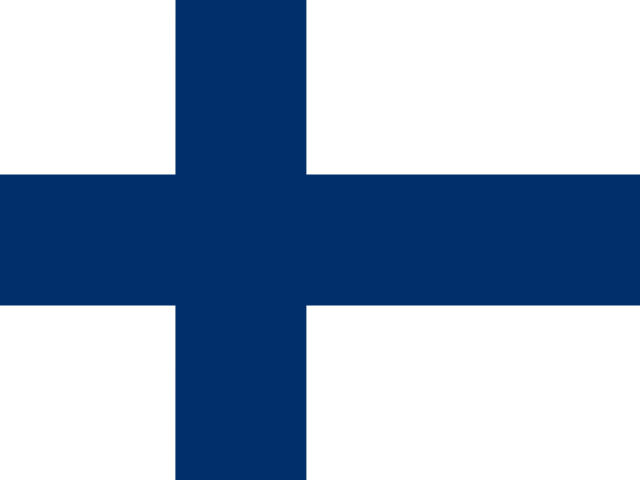
The Finnish flag is governed by three instruments. The Act on the Flag of Finland (380/1978) defines the flag’s design: a blue cross on a white background, proportions of 11 : 18 and the difference between the national flag and the state flag. The Act also provides that everyone has the right to fly the national flag, and that desecrating the flag or selling an incorrect flag can be punished with a fine. Government Decision 827/1993 on the colours of the Finnish flag defines the shade of blue. The Decree on Flying the Flag of Finland (383/1978) lists the official flag days and flying times.
Flag matters fall to the Ministry of the Interior (sisäministeriö), which issues flag recommendations and orders, for example during state visits and national mourning. Practical guidance is also given by Suomalaisuuden Liitto (the Finnish Heritage Association), whose flag guidance is based on its handbook Liputustieto. The Ministry of the Interior points out that there is no need to be shy about flying the flag, and that the flag can be raised for smaller occasions too.
There is no separate law on flagpoles. Putting up a flagpole is governed by the Building Act (751/2023), the municipality’s building ordinance and the local detailed plan, while the manufacturer’s instructions cover the foundation and installation.
The flagpole in Finland
According to Suomalaisuuden Liitto, a pole set in the ground in a garden is also called a field pole (kenttäsalko). Poles used to be made of wood; today the most common material is glass-fibre reinforced plastic, because it is light, durable and easy to care for. By the Association’s rule of thumb, the pole is taller than a one- or two-storey building, so that the flag shows above the ridge even in calm weather. At blocks of flats, the pole usually reaches the height of the third floor, according to the Association. More information is in the guides to types of flagpoles and flagpole heights.
When the flag is not flying, many gardens fly a house pennant (isännänviiri). The flying times do not apply to the pennant, so it can stay up day and night. On official and established flag days it is good flag etiquette to lower the pennant and raise the Finnish flag.
About the guides
The guides are grouped by subject. Each guide covers one subject, ends with frequently asked questions, lists its sources and shows when it was last updated. The dates of movable flag days, such as Mother’s Day and Midsummer, have been calculated for 2026 and 2027. Åland has its own regional flag and its own flag days, which are described in the guide to flag types.
All guides
Flag flying and rules
When, how and why flags are flown in Finland – from the official flag days to mourning, celebrations and flags of other countries.
- Flag daysFinland’s official, established and recommended flag days in 2026 and 2027 with dates and weekdays, under Decree 383/1978 and the Ministry of the Interior.
- Flag rulesFlag rules in Finland: flying times, the Midsummer and Independence Day exceptions, the polar night, raising and lowering the flag, and respect for the flag.
- Half-mastHalf-mast in Finland: how the flag is first raised to the top and lowered so that its lower edge is at the middle of the pole, and half-mast on a wall pole.
- Flags in mourningMourning flags in Finland: half-mast after a death, the flag on the day of a funeral, mourning on flag days and general mourning ordered by the Ministry.
- Flags on holidaysFlying the flag on holidays in Finland: May Day, Midsummer, Independence Day, birthdays, weddings and graduations, and the house pennant outside celebrations.
- Flag protocol at ceremoniesFlag protocol in Finland: order of flags in a row of poles, carried flags and colour guards in processions, ceremonial sashes and flags at funeral services.
- Foreign flags in FinlandFlying a foreign state’s flag, the EU flag, the Åland flag and the Sámi flag in Finland: order of rank, flag days and the Ministry of the Interior’s guidance.
The flag
The flag’s proportions, sizes and symbolism, what affects the price of a flag, and a calculator that shows the size of flag and pennant for a given pole.
- Flag typesFinnish flag types: the national flag, the state flags, the President’s flag, the house pennant, the facade flag, and the flags of Åland and the Sámi.
- Flag sizesFinnish flag sizes: the 11 : 18 proportions, flag numbers by pole length, the Ministry of the Interior’s size table and the sizes of pennants.
- Flag size calculatorFlag size calculator for Finland: the size of the Finnish flag and house pennant by pole length, from the Ministry of the Interior’s size table.
- Flag symbolismThe symbolism of the Finnish flag: the blue cross, blue and white, the official colours in PMS and NCS, the coat of arms on the state flag and respect.
- Buying a flagThe price of a Finnish flag: how size, material, sewing and fittings affect the price, what the flag law says about selling flags and what consumer law says.
The flagpole
Types, materials, heights, accessories, lighting and what affects the price of a flagpole – and the history of the flagpole in Finland.
- Types of flagpolesFlagpole types in Finland: the field pole, tilting pole, internal halyard pole, telescopic pole, wall and balcony poles, the omalippu and poles for businesses.
- Flagpole materialsFlagpole materials in Finland: fibreglass, aluminium, steel and wood – properties, care and durability in Finnish weather, and the effect on price.
- Flagpole heightsFlagpole heights in Finland: the Ministry of the Interior’s table of ridge height and pole length, flag size and the Building Act’s 30 metre limit.
- Flagpole accessoriesFlagpole accessories in Finland: finial, pulley, halyard, snap hooks, cleat, the hatch of an internal halyard pole, pennant, base and lighting.
- Flagpole mechanicsFlagpole mechanics in Finland: how the halyard runs over the pulley, external and internal halyards, the tilting base, the revolving top and the wind.
- Flag lightingFlag lighting in Finland: can a lit flag stay up in the evening, flying the flag at Midsummer and in the polar night, and electrical work according to Tukes.
- History of the flagpoleHistory of the Finnish flag and flagpole: the lion flag, the blue-cross flag of 1918, Midsummer as the Day of the Finnish Flag and the 1978 flag law.
- Buying a flagpoleThe price of a flagpole in Finland: how height, material, halyard, base, delivery and installation affect it, and what consumer law and the Building Act say.
Installation, safety and care
Building permits, foundations, safety, maintenance and transport – for homeowners, housing companies, businesses and municipalities.
- Flagpole installationInstalling a flagpole in Finland: the Building Act’s permit threshold, the building ordinance, location, cable checks before digging and the foundation.
- Flagpole safetyFlagpole safety in Finland: the Building Act’s requirements, wind load and storms, power lines and electrical work, buried cables and lowering the pole.
- Flagpole maintenanceFlagpole maintenance in Finland: the spring check, washing the pole, halyard and pulley, and washing, drying, repairing and storing the flag.
- Flagpole repairFlagpole repair in Finland: a broken halyard, stiff pulley, a flag wrapping round the pole, a loose tilting base, a leaning pole and surface damage.
- Flagpole lifespanFlagpole lifespan in Finland: how material, weather, ground frost, care and flag size affect durability, the life of a flag and disposing of it.
- Flagpole transportTransporting a flagpole in Finland: the Road Traffic Act on load overhang, the marker flag and securing the load, trailers, roof loads and delivery as freight.
- Flagpoles for businessesFlagpoles for businesses and housing companies in Finland: company flags on flag days, rows of poles, the flag in trademarks, flag orders and lighting.
Frequently asked questions
Is a permit needed to fly the flag in Finland?
No. Under section 4 of the Act on the Flag of Finland, everyone has the right to fly the national flag. The duty to fly the flag on official flag days applies only to state authorities and institutions. The flying times, however, apply to everyone who flies the flag.
Which laws govern the Finnish flag?
The flag’s design and proportions are set out in the Act on the Flag of Finland (380/1978), its colours in Government Decision 827/1993 and the flag days and flying times in the Decree on Flying the Flag of Finland (383/1978). Flag matters are handled by the Ministry of the Interior.
At what time is the flag raised and lowered in Finland?
Under the decree, flag flying begins at 8.00 and ends at sunset, but no later than 21.00. On Midsummer Eve flag flying begins at 18.00 and continues through the night until 21.00 on Midsummer Day. On Independence Day the flag is lowered at 20.00.
Does a flagpole in Finland need a building permit?
Under section 42 of the Building Act, a building permit is required for a mast at least 30 metres high. An ordinary flagpole is well below that, but the municipality’s building ordinance and local detailed plan may contain their own provisions. The municipal building control authority can give information on individual cases.
How large a flag suits a flagpole in Finland?
According to the Ministry of the Interior, the flag’s height is about one sixth of the pole’s length. The flag’s number matches the pole’s length in metres, so a 10 metre pole, for example, carries flag number 10, which measures 165 × 269 centimetres.
Sources
This guide is based on the following sources, most of them in Finnish:
- Laki Suomen lipusta (380/1978) – Finlex (oikeusministeriö)
- Asetus liputuksesta Suomen lipulla (383/1978) – Finlex (oikeusministeriö)
- Suomen lippu ja vaakuna – Sisäministeriö
- Liputuspäivät ja -ajat – Sisäministeriö
- Rakentamislaki – Ympäristöministeriö