Flag types and their use in Finland
Published Written by Flagpole Guides
This page is an English translation of the Finnish original. Where the two versions differ, the Finnish text is the original.
Under the Act on the Flag of Finland, the Finnish flag is either the national flag or the state flag. According to Suomalaisuuden Liitto there are thus four official flags: the national flag, the rectangular state flag, the Defence Forces’ swallow-tailed state flag and the flag of the President of the Republic. Pennants, regional flags and other flags are also seen on poles. This guide describes the flag types and who uses which flag.
The national flag
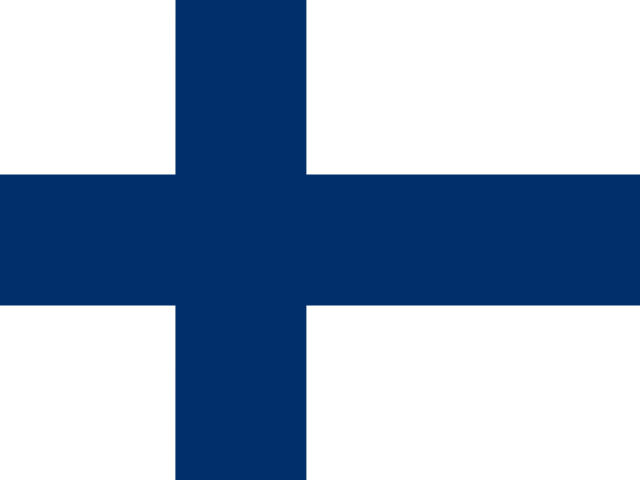
The national flag (kansallislippu) is the most common and most widely used Finnish flag. Under the Act it has a blue cross on a white background, it is rectangular and the ratio of its height to its length is 11 : 18. Under section 4 of the Act, everyone has the right to fly the national flag. The proportions are described in the guide to flag sizes.
The state flag
The rectangular state flag (valtiolippu) carries the coat of arms of Finland in the square formed by the arms of the cross, and the square has a yellow border 1/40 of the width of the cross. Its proportions are the same as those of the national flag. Under section 5 of the Act, the rectangular state flag is used by Parliament, the ministries and their subordinate central agencies, the supreme courts, the courts of appeal, the Bank of Finland, the Social Insurance Institution, the public-law universities, the Border Guard, state vessels and Finland’s missions abroad, among others.
According to the Ministry of the Interior, the state flag is a symbol of state authority, and a private person cannot be given permission to use it.
The swallow-tailed state flag and the President’s flag
Under the Act, the swallow-tailed state flag is one unit longer than the rectangular one and has three tails at the fly. It is used by the Defence Forces’ headquarters, units, establishments and vessels. The flag of the President of the Republic, a swallow-tailed state flag, carries the blue and yellow Cross of Liberty in the upper hoist. The Minister of Defence and the Commander of the Defence Forces have their own command flags.
The house pennant and the blue-cross pennant
According to Suomalaisuuden Liitto, the house pennant (isännänviiri) is the general name for a pennant kept on the pole of a detached house or summer cottage to show that the family is at home. Pennants are long and narrow and taper towards the tip. A house pennant can be, for example,
- the blue-cross pennant (siniristiviiri), derived from the Finnish national flag
- a municipal, town or regional pennant, often after one’s birthplace or home municipality
- a family or clan pennant.
The Association notes that the blue and white of the Uusimaa pennant come from the region’s coat of arms, not from the national flag. House pennants became common in Finland in the 1950s, following the example of the other Nordic countries.
The flying times do not apply to the pennant, so it can fly day and night. On official and established flag days the pennant is lowered and the Finnish flag raised. The house pennant is not used for mourning. According to the Association, the pennant is about half as long as the pole. The sizes are shown in the guide to the flag size calculator.
The omalippu or facade flag
According to Suomalaisuuden Liitto, an omalippu or facade flag is a Finnish flag on a staff about 130 centimetres long, which can be mounted on a balcony or on the wall of a house or cottage. The Association says the omalippu has become more common in Finland with small building plots. According to the Ministry of the Interior, the same flying times apply to a facade flag as to other flags, so it is taken in in the evening and put out in the morning.
Carried flags and table flags
A carried flag is a flag attached to a portable staff about three metres long, used in processions and parades. A carried flag always has a colour guard. The practice is described in the guide to flag protocol at ceremonies. Decorative flags, small flags seen for example in hotels, are decorations according to Suomalaisuuden Liitto, and the flag rules and flying times do not apply to them.
The Åland and Sámi flags
The Åland flag has a yellow cross with a red cross inside it on a blue background. It is governed by the regional Act of Åland (1992:41), and the region has its own flag days. The Sámi flag is a tribal flag whose red circle represents the sun and blue circle the moon, according to Suomalaisuuden Liitto. These flags are described in the guide to foreign flags in Finland.
Organisation and company flags
Organisation and company flags come last in the order of rank. According to the Ministry of the Interior, only the Finnish flag is flown on official and established flag days, and the company flag is lowered. Under section 6 of the Act, no additional patterns may be placed on the Finnish flag, so an association’s or company’s emblem is not added to it. Flag flying at businesses is described in the guide to flagpoles for businesses.
Frequently asked questions
What is the difference between the Finnish national flag and the state flag?
The national flag has a blue cross on a white background. The state flag additionally carries the coat of arms of Finland in a yellow-bordered square at the centre of the cross. Under the Act on the Flag of Finland, the state flag is used only by the authorities listed in the Act, and according to the Ministry of the Interior a private person cannot be given permission to use it.
What is a house pennant (isännänviiri)?
According to Suomalaisuuden Liitto, the house pennant is a long, narrow pennant tapering towards the tip, showing that the family is at home. It can be, for example, the blue-cross pennant, a municipal or regional pennant or a family pennant. The flying times do not apply to the pennant.
What is an omalippu?
According to Suomalaisuuden Liitto, an omalippu or facade flag is a Finnish flag on a staff about 130 centimetres long, attached for example to a balcony or house wall. According to the Ministry of the Interior, the same flying times apply to a facade flag as to other flags.
Can a private person use a swallow-tailed Finnish flag?
Not as a Finnish flag. Under the Act, the swallow-tailed state flag is used by the Defence Forces and the President of the Republic. Using the state flag without the right to do so can be punished with a fine under section 8 of the Act.
Sources
This guide is based on the following sources, most of them in Finnish:
- Laki Suomen lipusta (380/1978) – Finlex (oikeusministeriö)
- Tietoa Suomen lipusta – Sisäministeriö
- Suomen lippu – usein kysytyt kysymykset – Sisäministeriö
- Liputus – Suomalaisuuden Liitto
- Ålands flagga – Ålands landskapsregering
Related guides
- Flag sizesFinnish flag sizes: the 11 : 18 proportions, flag numbers by pole length, the Ministry of the Interior’s size table and the sizes of pennants.
- Flag symbolismThe symbolism of the Finnish flag: the blue cross, blue and white, the official colours in PMS and NCS, the coat of arms on the state flag and respect.
- Flag rulesFlag rules in Finland: flying times, the Midsummer and Independence Day exceptions, the polar night, raising and lowering the flag, and respect for the flag.
- Flag size calculatorFlag size calculator for Finland: the size of the Finnish flag and house pennant by pole length, from the Ministry of the Interior’s size table.
- Buying a flagThe price of a Finnish flag: how size, material, sewing and fittings affect the price, what the flag law says about selling flags and what consumer law says.