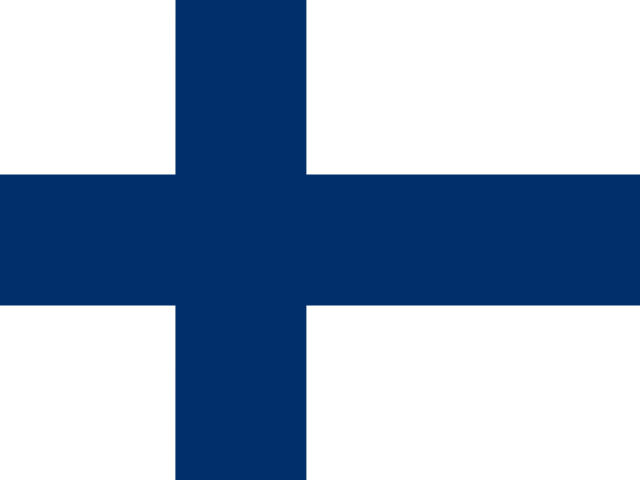
Flying the flags of other countries in Finland
Published Written by Flagpole Guides
This page is an English translation of the Finnish original. Where the two versions differ, the Finnish text is the original.
In Finland, the flags of other countries and organisations can be flown as well. Under the Decree on Flying the Flag of Finland, the Finnish flag is then always in the position of highest honour. The Ministry of the Interior and Suomalaisuuden Liitto describe the international flag etiquette followed in Finland. This guide covers the flag of a foreign state, the EU flag, the Åland flag and the Sámi flag.
The flag of a foreign state
According to the Ministry of the Interior, a foreign state’s national flag can be raised on the pole in honour of a guest. According to Suomalaisuuden Liitto, it is ideal to fly both the Finnish flag and the guest’s flag when there are two poles. Two flags are not raised on the same pole. The Association also mentions that foreign nationals living in Finland can fly their own country’s national flag on its flag days and anniversaries.
When foreign guests arrive on an official or other flag day, they are greeted with both the Finnish flag and the guest’s national flag, according to the Association.
A foreign state’s flag is shown the same respect as one’s own flag, according to the Ministry: the flags are of the same size, the poles of the same height and the hoists at the same height. Suomalaisuuden Liitto adds that all the flags are best national flags of the same size class. If there are more flags than poles, extra poles can be hired for the event.
State visits
By established practice, state authorities and institutions fly the flag during an official state visit in the places the foreign head of state visits. The Ministry of the Interior usually also recommends general flag flying in those places. In 2026, for example, flags were flown in Helsinki during the state visits of the presidents of Estonia and Kenya.
Order of the flags
According to the Ministry of the Interior, international custom is followed when several national flags are flown. First comes the Finnish flag, then the flags of other independent states in alphabetical order of the countries’ names in French. For the Nordic flags, the alphabetical order of the Scandinavian names can also be used. If a Nordic Council event is held in Finland, the order is, according to the Ministry, Finland, Denmark, Iceland, Norway, Sweden, Åland, the Faroe Islands and Greenland, with any Nordic Council flag last.
In Suomalaisuuden Liitto’s example of a row of six poles, the flags are flown from the viewer’s left as follows: Finland – Germany – Denmark – Sweden – EU flag – company flag. Germany (Allemagne), Denmark (Danemark) and Sweden (Suède) are in the order of their French names. The order in rows of poles is described in the guide to flag protocol at ceremonies.
The EU flag
According to the Ministry of the Interior, there are no national provisions or regulations on the use of the EU flag. The Ministry has nevertheless recommended flying the EU flag alongside the national flag, for example on Europe Day, 9 May. Flying two flags requires two poles. Under the Ministry’s guidance, state authorities and institutions fly the EU flag during state visits and high-profile visits, and the EU flag is also used alongside the Finnish flag at border crossings on the EU’s external border, at international airports and at ports.
When the Finnish flag, another state’s flag and the EU flag are flown together, the order according to the Ministry is the Finnish flag, the other state’s flag and the EU flag. In a row of three poles, the Finnish flag is in the middle, the other state’s flag on the left pole as seen from the main direction of approach and the EU flag on the right. According to Suomalaisuuden Liitto, the EU flag is not recommended for flying around the clock.
The Åland flag
Åland has extensive autonomy and its own blue, yellow and red regional flag, governed by the regional Act on the Åland flag (1992:41). According to the Government of Åland, the flag is flown in particular on 30 March (Demilitarisation and Neutralisation Day), the last Sunday of April (Åland Flag Day) and 9 June (Autonomy Day). According to Suomalaisuuden Liitto, the Åland flag is used in the region instead of or alongside the Finnish flag. In the order of rank, the flags of autonomous regions come after the flags of independent states.
The Sámi flag
According to the Ministry of the Interior, the Sámi have their own annual flag days on which they fly the Sámi flag, and on Sámi National Day, 6 February, the Ministry recommends general flag flying. According to Suomalaisuuden Liitto, the Sámi flag is a tribal flag used like a national flag, and in a row of flags its place is after the state flags but before organisation and company flags. If there is only one pole, the Association recommends flying the Finnish flag at Midsummer, the Day of the Finnish Flag.
Frequently asked questions
Can another country’s flag be flown in Finland?
Yes. According to the Ministry of the Interior, a foreign state’s national flag can be raised on the pole in honour of a guest. According to Suomalaisuuden Liitto, foreign nationals living in Finland can also fly their own country’s flag on its flag days and anniversaries.
In what order are the Finnish flag, a foreign flag and the EU flag placed?
According to the Ministry of the Interior, the Finnish flag takes the position of highest honour, the other state’s flag the second and the EU flag the third. In a row of three poles the Finnish flag is in the middle, the other state’s flag on the viewer’s left and the EU flag on the right.
Are there rules in Finland on the EU flag?
No. According to the Ministry of the Interior, there are no national provisions or regulations on the use of the EU flag. The Ministry has recommended flying the EU flag alongside the Finnish flag, for example on Europe Day, 9 May.
What are Åland’s flag days?
According to the Government of Åland, the Åland flag is flown in particular on 30 March, on the last Sunday of April and on 9 June. The Åland flag is governed by the regional Act 1992:41.
Sources
This guide is based on the following sources, most of them in Finnish:
- Asetus liputuksesta Suomen lipulla (383/1978) – Finlex (oikeusministeriö)
- Lippujen arvojärjestys – Sisäministeriö
- Liputus EU-lipulla – Sisäministeriö
- Suomen lippu – usein kysytyt kysymykset – Sisäministeriö
- Ålands flagga – Ålands landskapsregering
- Liputus – Suomalaisuuden Liitto
Related guides
- Flag protocol at ceremoniesFlag protocol in Finland: order of flags in a row of poles, carried flags and colour guards in processions, ceremonial sashes and flags at funeral services.
- Flagpoles for businessesFlagpoles for businesses and housing companies in Finland: company flags on flag days, rows of poles, the flag in trademarks, flag orders and lighting.
- Flag daysFinland’s official, established and recommended flag days in 2026 and 2027 with dates and weekdays, under Decree 383/1978 and the Ministry of the Interior.
- Flag rulesFlag rules in Finland: flying times, the Midsummer and Independence Day exceptions, the polar night, raising and lowering the flag, and respect for the flag.