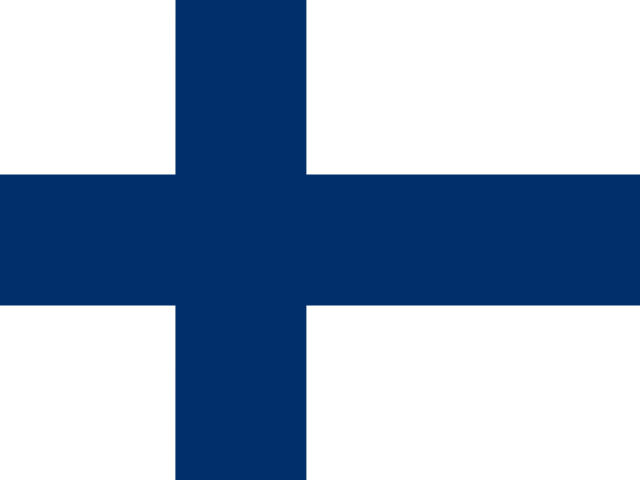
The symbolism, colours and blue cross of the Finnish flag
Published Written by Flagpole Guides
This page is an English translation of the Finnish original. Where the two versions differ, the Finnish text is the original.
According to Suomalaisuuden Liitto, the Finnish flag is the most important national symbol of the Finns, and it reflects various patriotic values for many. The law defines the flag’s design and colours precisely, but not the meaning of the colours. This guide describes the flag’s structure, its colours and the meanings attached to them.
A blue cross on a white background
Under section 1 of the Act on the Flag of Finland, the Finnish flag has a blue cross on a white background. The cross is offset towards the hoist, as in the other Nordic flags. Suomalaisuuden Liitto notes that the flags of all five independent Nordic countries are cross flags. According to the Ministry of the Interior, Parliament adopted the blue-and-white cross flag on the proposal of the Constitutional Law Committee on 28 May 1918, and the design was drawn up by the artists Eero Snellman and Bruno Tuukkanen. The Act has since been amended slightly, but the flag has remained the same.
Blue and white
According to the Ministry of the Interior, blue and white emerged as Finland’s national colours in the debate of the 1850s and 1860s. By the end of the 19th century, blue and white were common in the flags and pennants of sailing clubs. According to Suomalaisuuden Liitto, the white represents freedom to some and snow to others, and the blue is often thought of as the colour of the sky. These interpretations are not based on law; they are established ways of thinking about the flag.
The flag’s colours defined precisely
The colour shades of the flag are defined in Government Decision 827/1993 on the colours of the Finnish flag. The decision gives the shades as values in the CIE system, and the following colours can be used as approximations:
| Colour | PMS | NCS |
|---|---|---|
| Blue | 294C | 4060-R90B |
| Red (coat of arms) | 186C | 1090-Y90R |
| Yellow (coat of arms) | 123C | 0080-Y20R |
Under the decision, the permitted deviation is at most 4 ΔE*ab units. The decision applies to flags and flag fabrics made or imported after 1995. Red and yellow appear in the coat of arms on the state flag.
The lion coat of arms on the state flag
At the centre of the cross, the state flag carries the lion coat of arms of Finland in a yellow-bordered square. According to the Ministry of the Interior, the lion coat of arms was already used unofficially as a flag in the era of the Grand Duchy, to the extent that its red and yellow became a kind of national colours. Around independence a red lion flag was used, which was raised on the pole of the Senate House on 6 December 1917. The coat of arms is governed by the Act on the Coat of Arms of Finland (381/1978).
Respect for the flag
The flag’s status as a national symbol is also reflected in the law. Under section 6 of the Act, no additional patterns may be placed on the flag, and under section 8, publicly desecrating the flag or using it disrespectfully can be punished with a fine. According to Suomalaisuuden Liitto, using the flag for anything other than flying it on a pole or staff is not desirable, and using the national flag as curtains, for example, does not befit its dignity. Separate cheering and hand-waving flags are available for events.
A flag taken out of use is disposed of with dignity, according to the Association, for example by burning it or cutting it into pieces so small that the flag cannot be recognised. The flag is not reused.
The flag in the celebrations of the year
The symbolism of the flag is especially visible at Midsummer, the Day of the Finnish Flag, and on Independence Day. The flag days are described in the guide to flag days and the flag’s history in the guide to the history of the flagpole.
Frequently asked questions
What do the colours of the Finnish flag mean?
The meaning of the colours is not defined in law. According to Suomalaisuuden Liitto, the white represents freedom to some and snow to others, and the blue is often thought of as the colour of the sky. According to the Ministry of the Interior, blue and white came to be seen as Finland’s national colours as early as the mid-19th century.
What is the exact shade of blue in the Finnish flag?
Under Government Decision 827/1993, PMS 294C or NCS 4060-R90B can be used as an approximation of the blue. The decision defines the colours precisely as values in the CIE system.
Why is there a cross on the Finnish flag?
The Finnish flag is a cross flag like the flags of the other Nordic countries. According to the Ministry of the Interior, Parliament adopted the blue-and-white cross flag in May 1918, and the design was drawn up by the artists Eero Snellman and Bruno Tuukkanen.
Is a picture or sticker of the flag also a Finnish flag?
According to the Ministry of the Interior, the flag law defines the flag in the abstract, so any figure that meets the provisions on the flag’s proportions and colours is a Finnish flag. A flag printed on a sticker or fabric is therefore also a Finnish flag.
Sources
This guide is based on the following sources, most of them in Finnish:
- Laki Suomen lipusta (380/1978) – Finlex (oikeusministeriö)
- Valtioneuvoston päätös Suomen lipun väreistä (827/1993) – Finlex (oikeusministeriö)
- Tietoa Suomen lipusta – Sisäministeriö
- Suomen lipun historia – Sisäministeriö
- Liputus – Suomalaisuuden Liitto
Related guides
- History of the flagpoleHistory of the Finnish flag and flagpole: the lion flag, the blue-cross flag of 1918, Midsummer as the Day of the Finnish Flag and the 1978 flag law.
- Flag typesFinnish flag types: the national flag, the state flags, the President’s flag, the house pennant, the facade flag, and the flags of Åland and the Sámi.
- Flag sizesFinnish flag sizes: the 11 : 18 proportions, flag numbers by pole length, the Ministry of the Interior’s size table and the sizes of pennants.
- Flag daysFinland’s official, established and recommended flag days in 2026 and 2027 with dates and weekdays, under Decree 383/1978 and the Ministry of the Interior.