Flag rules in Brazil: what Law 5,700 says
Published Written by Flagpole Guides
This page is an English translation of the Portuguese original. Where the two versions differ, the Portuguese text is the original.
In Brazil, the use of the flag is regulated by a law of its own, Law 5,700 of 1 September 1971 (Lei nº 5.700), on the form and presentation of the national symbols. It replaced Law 5,443 of 1968 and has been amended several times, among others by Law 6,913 of 1981, which changed the penalties, and Law 8,421 of 1992, which updated the design. The law is not limited to public buildings: it also covers private use, the respect due to the flag, the sale of flags and sanctions. This guide summarises what it says.
The national symbols
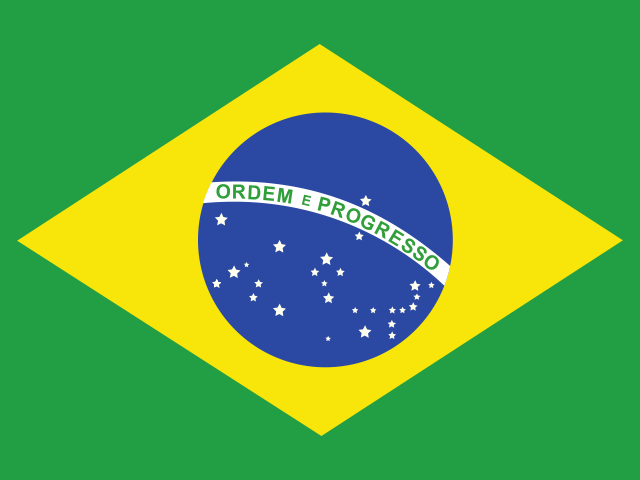
Under article 13 of the Constitution, the symbols of the Republic are the national flag, anthem, arms and seal, and article 1 of Law 5,700 repeats the list. Article 3 says the flag is the one adopted by Decree No. 4 of 19 November 1889, with the changes of Law 5,443 of 1968, as altered by Annex I of Law 8,421 of 1992, and that it is updated whenever a state is created or abolished. Article 5 describes the design in modules: the width is divided into 14 equal parts and the length measures 20. The guide to flag sizes sets out these measurements.
Under article 28, the national colours are green and yellow, which may be used without any restriction, including together with blue and white (article 29).
Who may use the flag
Article 10 is broad: the flag may be used in all expressions of Brazilians’ patriotic feeling, whether official or private. Article 11 lists the forms of display:
- raised on a pole or halyards, on public or private buildings, places of worship, sports grounds, offices, classrooms, auditoriums, vessels, streets and squares, and anywhere it is shown due respect;
- spread out without a pole, carried by aircraft or balloons, applied to a wall or hung from a horizontal cable between buildings, trees, posts or poles;
- reproduced on walls, ceilings, windows, vehicles and aircraft;
- forming, with other flags, panóplias, shields or similar arrangements;
- carried in formations, parades or individually;
- spread over coffins until burial.
When it is spread out without a pole, the flag hangs with the longer side horizontal and the single star at the top, without being hidden, even partly, by people sitting nearby (article 22). When not in use, it is kept in a dignified place (article 20).
Expressions of disrespect
Article 31 considers the following expressions of disrespect for the flag, and therefore prohibited:
- displaying it in poor condition;
- changing its shape, colours, proportions or motto, or adding other inscriptions;
- using it as clothing, drapery, a stage curtain, a table cover, a covering for a rostrum, or as a cover for plaques, portraits, panels or monuments to be unveiled;
- reproducing it on labels or wrappers of products on sale.
Under article 23, the flag is never dipped in salute. The attitude during the raising and the anthem is set out in article 30; the guide to flag protocol covers it.
Old flags
Under article 32, flags in poor condition are handed in to any military unit, to be burned on Flag Day, 19 November, according to the proper ceremonial. The wear of flags outdoors is covered in the guide on flagpole lifespan.
Sale and manufacture
Under article 38, copies of the flag may not be put on sale or given away unless they carry on the hoist the mark and address of the maker or publisher and the date of manufacture. Article 37 provides for collections of standard copies of the national symbols at military headquarters, the Mint, museums, harbour offices, customs and town halls, which serve as the compulsory model and the reference for approving copies, whether produced publicly or privately. The guide on the price of a flag covers buying one.
Penalties
Under article 35, as worded by Law 6,913 of 27 May 1981, any breach of the law is a misdemeanour (contravenção), punishable by a fine of one to four times the highest reference value in force in the country, doubled for repeat offences. These cases follow the procedure for misdemeanours in general (article 36).
Schools, public service and the Armed Forces
Article 39 makes teaching the design and meaning of the flag and the singing and interpretation of the national anthem compulsory at all public and private schools; since Law 12,031 of 2009, the anthem is performed once a week in primary and lower secondary education. Under article 44, the use of the flag in the Armed Forces follows their own regulations, insofar as they do not conflict with the law, and article 43 leaves the details of ceremonial to the executive, which regulates them in Decree 70,274 of 1972.
Frequently asked questions
Can I put the Brazilian flag on my car?
Article 11 of Law 5,700 provides that the flag may be reproduced on walls, ceilings, windows, vehicles and aircraft, and carried individually. The limit is in article 31, which prohibits, among other things, displaying it in poor condition or changing its shape, colours or proportions.
May one write on the national flag or add a logo?
No. Under article 31(II), changing the shape, colours, proportions or motto of the flag, or adding other inscriptions to it, is an expression of disrespect and therefore prohibited.
May the flag be used as clothing or a tablecloth?
Under article 31(III), it is prohibited to use it as clothing, drapery, a stage curtain, a table cover, a covering for a rostrum, or as a cover for plaques, portraits, panels or monuments to be unveiled. The national colours, green and yellow, may be used without restriction (article 29).
What happens to an old flag?
Under article 32 of the law, flags in poor condition are handed in to any military unit, to be burned on Flag Day, 19 November, according to the proper ceremonial.
What is the penalty for breaching the law?
Under article 35, as worded by Law 6,913 of 1981, any breach of the law is a misdemeanour (contravenção), punishable by a fine of one to four times the highest reference value in force in the country, doubled for repeat offences. The procedure follows that for misdemeanours (article 36).
Sources
This guide is based on the following sources, most of them in Portuguese:
- Lei nº 5.700, de 1º de setembro de 1971 – Presidência da República
- Lei nº 6.913, de 27 de maio de 1981 – Presidência da República
- Decreto nº 70.274, de 9 de março de 1972 (artigos 22 a 35) – Presidência da República
- Constituição da República Federativa do Brasil de 1988 (artigo 13) – Presidência da República
Related guides
- Flag daysThe days of national celebration on which Brazil’s national flag is raised in 2026 and 2027, with Flag Day, the time of raising and the weekday.
- Flag protocolThe ceremonial of Brazil’s national flag: the place of honour, order with other flags, the attitude of respect, the anthem and the Presidential Standard.
- Half-mastWhen Brazil’s national flag flies at half-mast, who decides, how it is raised and lowered in mourning and what happens on days of national celebration.
- Foreign flagsHow a flag of another country may be used in Brazil: the national flag on its right, of equal size, and the exception for embassies and consulates.