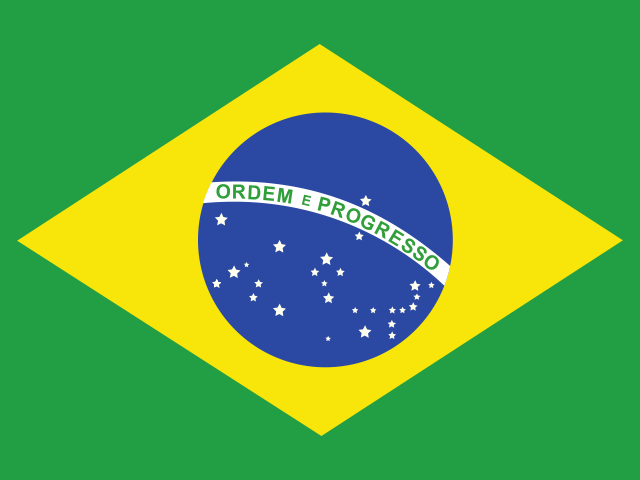
History of the Brazilian flag: from the Empire to 27 stars
Published Written by Flagpole Guides
This page is an English translation of the Portuguese original. Where the two versions differ, the Portuguese text is the original.
The Brazilian flag has more than two centuries of history, but it has changed little: the green rectangle with the yellow rhombus comes from the flag of the Empire of 1822, and the blue circle with the starry sky from the Republic of 1889. Since then, the changes have centred on the stars, added as new states were created, and on details of the design. This guide follows that development through the decrees and laws.
The flag of the Kingdom and Empire, 1822
Shortly after independence, a decree of the Prince Regent Dom Pedro of 18 September 1822, countersigned by José Bonifácio de Andrada e Silva, created the coat of arms and the flag of the Kingdom of Brazil. According to the text, the shield bore on a green field a gold armillary sphere crossed by a Cross of the Order of Christ, surrounded by 19 silver stars on a blue border, one for each province, with the royal crown and two branches of coffee and tobacco, emblems of commercial wealth. The flag consisted of a green parallelogram with a gold-coloured rhomboid inscribed in it, with the shield in the centre.
According to a text published by the Legislative Assembly of São Paulo, the flag was designed by the French painter Jean-Baptiste Debret, with the collaboration of José Bonifácio. The green, the yellow and the rhombus remain on today’s flag.
The provisional flag of November 1889
With the Proclamation of the Republic on 15 November 1889, the symbols of the Empire no longer suited the new regime. According to the same text by the Legislative Assembly of São Paulo, a provisional flag was used in the first days, inspired by that of the United States, with thirteen green and yellow stripes and a canton with 21 stars. It was criticised by republicans such as Miguel Lemos, director of the Positivist Apostolate of Brazil, who called it a "servile copy" of the American flag, and it lasted only four days.
Decree No. 4 of 19 November 1889
On 19 November 1889, the Provisional Government, headed by Marshal Deodoro da Fonseca, signed Decree No. 4, which set the distinctive features of the national flag and arms and of the seals of the Republic. Under article 1, the flag kept the tradition of the old national colours, green and yellow, with a yellow rhombus on a green field and, in the middle, the blue celestial sphere, crossed by a white band running obliquely downwards from left to right, with the motto Ordem e Progresso and 21 stars, among them those of the Southern Cross, representing the twenty states and the Neutral Municipality. The recitals explain the choice of colours, covered in the guide to flag symbolism.
According to the text by the Legislative Assembly of São Paulo, the design was conceived by the positivist philosopher and mathematician Raimundo Teixeira Mendes, with Miguel Lemos, the astronomy professor Manoel Pereira Reis and the painter Décio Villares, who made the final drawing, and it was defended before Deodoro by the future minister Demétrio Ribeiro. The date of the decree is now Flag Day, 19 November.
Law 5,443 of 1968
Law 5,443 of 28 May 1968 regulated the form and presentation of the national symbols. It set that the constellations correspond to the sky over Rio de Janeiro at 8.30 a.m. on 15 November 1889, seen from outside the celestial sphere, provided for updating the flag when new states are created and set the official types in panos of 45 centimetres, from one to seven panos wide.
Law 5,700 of 1971
Three years later, Law 5,700 of 1 September 1971 repealed Law 5,443 and took over the regulation of the national symbols. It is the law in force, with the rules on raising, half-mast, the place of honour and respect for the flag. The guide to the flag rules summarises its content.
The 27 stars, 1992
As new states were created, the number of stars no longer matched the federal units. Law 8,421 of 11 May 1992 reworded article 3 of Law 5,700 and replaced the annexes: the flag now has 27 stars, one for each state and the Federal District, and it is updated whenever a state is created or abolished. New states receive stars from the same sky of 1889, without affecting the original aesthetic arrangement, and the stars of abolished states are removed. The correspondence of each star is in the guide to flag symbolism.
More recent changes
Later amendments to Law 5,700 did not change the design. Law 12,031 of 2009 made the weekly performance of the national anthem compulsory in primary and lower secondary education, Law 12,157 of 2009 added the daily raising of the Mercosur flag, and Law 13,413 of 2016 dealt with performing the anthem at sports competitions. The guide to flag types presents the flags in use today.
Frequently asked questions
When was Brazil’s present flag created?
On 19 November 1889, by Decree No. 4 of the Provisional Government of the Republic, signed by Marshal Deodoro da Fonseca four days after the Proclamation of the Republic. The date is now Flag Day.
Who designed the flag of Brazil?
According to a text published by the Legislative Assembly of São Paulo, the flag was conceived by the positivist Raimundo Teixeira Mendes, with Miguel Lemos, the astronomy professor Manoel Pereira Reis and the painter Décio Villares, who made the final drawing.
What did the flag of the Empire look like?
Under the decree of 18 September 1822, the flag consisted of a green parallelogram with a gold-coloured rhombus and, in the centre, the coat of arms of Brazil: a gold armillary sphere on the Cross of the Order of Christ, surrounded by 19 silver stars on a blue border, with the crown and branches of coffee and tobacco.
How many stars did the first republican flag have?
Twenty-one. Decree No. 4 of 1889 provided for 21 stars, representing the twenty states of the Republic and the Neutral Municipality, the capital. Today there are 27, since the update made by Law 8,421 of 1992.
Was there another flag before the present one?
According to the text by the Legislative Assembly of São Paulo, a provisional flag inspired by that of the United States, with green and yellow stripes and a canton with 21 stars, was used between 15 and 19 November 1889. It lasted only four days.
Sources
This guide is based on the following sources, most of them in Portuguese:
- Decreto de 18 de setembro de 1822 (escudo de armas e bandeira do Reino do Brasil) – Câmara dos Deputados
- Decreto nº 4, de 19 de novembro de 1889 – Presidência da República
- Lei nº 5.443, de 28 de maio de 1968 – Presidência da República
- Lei nº 5.700, de 1º de setembro de 1971 – Presidência da República
- Lei nº 8.421, de 11 de maio de 1992 – Presidência da República
- Dia da Bandeira – Assembleia Legislativa do Estado de São Paulo
Related guides
- Flag symbolismWhat the colours, the starry sky and the motto Ordem e Progresso on Brazil’s flag represent, with the star of each state under the annex of Law 8,421.
- Flag typesThe flags used in Brazil: the national flag and its official types, the flags of the states and municipalities, Mercosur and the Presidential Standard.
- Flag daysThe days of national celebration on which Brazil’s national flag is raised in 2026 and 2027, with Flag Day, the time of raising and the weekday.
- Flag rulesThe rules for the national flag of Brazil: private use, forms of display, disrespect, worn-out flags, sale and penalties under Law 5,700 of 1971.