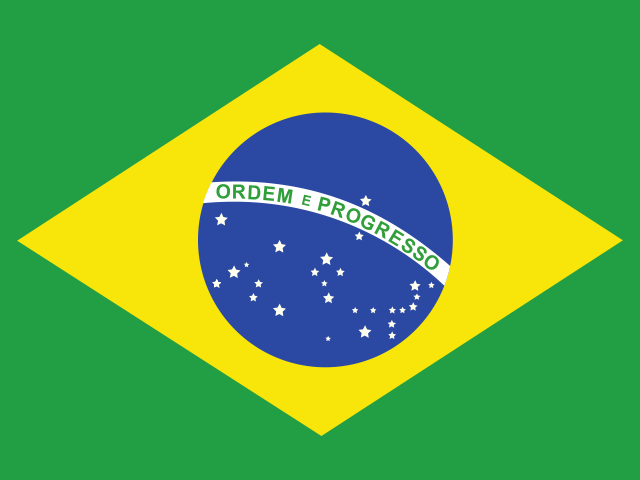
Symbolism of the Brazilian flag: colours, stars and motto
Published Written by Flagpole Guides
This page is an English translation of the Portuguese original. Where the two versions differ, the Portuguese text is the original.
Brazil’s flag is one of the few in the world to show a real sky. The blue circle reproduces the stars over Rio de Janeiro on the morning the Republic was proclaimed, and each star corresponds, by law, to a state or the Federal District. The colours come from the flag of the Empire, and the motto from a nineteenth-century philosophical formula. This guide brings together what the laws and official sources say about the meaning of each element.
The colours
Decree No. 4 of 19 November 1889, which adopted the republican flag, explains in its recitals why the Republic kept green and yellow: the colours of the old flag recall the struggles and glorious victories of the army and navy in defence of the homeland and, regardless of the form of government, symbolise the perpetuity and integrity of the homeland among the other nations. Article 1 of the decree says the republican flag keeps the tradition of the old national colours.
Today, under article 28 of Law 5,700, green and yellow are the national colours, which may be used without any restriction, including together with blue and white (article 29). The law does not give a meaning of its own to each colour.
The sky of 15 November 1889
Under article 3(1) of Law 5,700, the constellations on the flag correspond to the sky over the city of Rio de Janeiro at 8.30 a.m. on 15 November 1889 (twelve sidereal hours), the day of the Proclamation of the Republic, and are considered as seen by an observer outside the celestial sphere. That is why the sky on the flag appears mirrored compared with what is seen from the ground. The Southern Cross is in the centre of the circle.
Law 5,443 of 1968, now repealed, gave reference points for the design: Spica, in the constellation Virgo, above the white band, corresponds to the third letter of PROGRESSO, and the stars Sigma Octantis, Alpha and Gamma Crucis and the letter P of PROGRESSO lie on the vertical diameter of the circle.
One star for each state
The 1889 decree provided for 21 stars, representing the twenty states and the Neutral Municipality, the capital. Under article 3 of Law 5,700, as worded by Law 8,421 of 1992, the flag is updated whenever a state is created or abolished: new states receive stars from the same sky, without affecting the original arrangement, and the stars of abolished states are removed. Today there are 27 stars, in nine constellations. The appendix to Annex No. 2 of Law 8,421 sets the correspondence:
| Federal unit | Star |
|---|---|
| Acre | Gamma Hydrae |
| Alagoas | Theta Scorpii |
| Amapá | Beta Canis Majoris |
| Amazonas | Procyon (Alpha Canis Minoris) |
| Bahia | Gamma Crucis |
| Ceará | Epsilon Scorpii |
| Federal District | Sigma Octantis |
| Espírito Santo | Epsilon Crucis |
| Goiás | Canopus (Alpha of Argo) |
| Maranhão | Beta Scorpii |
| Mato Grosso | Sirius (Alpha Canis Majoris) |
| Mato Grosso do Sul | Alphard (Alpha Hydrae) |
| Minas Gerais | Delta Crucis |
| Pará | Spica (Alpha Virginis) |
| Paraíba | Kappa Scorpii |
| Paraná | Gamma Trianguli Australis |
| Pernambuco | Mu Scorpii |
| Piauí | Antares (Alpha Scorpii) |
| Rio de Janeiro | Beta Crucis |
| Rio Grande do Norte | Lambda Scorpii |
| Rio Grande do Sul | Alpha Trianguli Australis |
| Rondônia | Gamma Canis Majoris |
| Roraima | Delta Canis Majoris |
| Santa Catarina | Beta Trianguli Australis |
| São Paulo | Alpha Crucis |
| Sergipe | Iota Scorpii |
| Tocantins | Epsilon Canis Majoris |
Spica, for Pará, is the only star above the white band. The Federal District is represented by Sigma Octantis, which lies on the vertical diameter of the circle, according to Law 5,443 of 1968. Under article 5(IX), the stars come in five magnitudes, and the annex gives the magnitude of each.
Ordem e Progresso
The motto ORDEM E PROGRESSO (Order and Progress) is written in green letters in the middle of the white band (article 5(VIII)). According to a text published by the Legislative Assembly of São Paulo on Flag Day 2013, it is a shortened form of the formula of the French philosopher Auguste Comte, founder of positivism: "Love as the principle and order as the basis; progress as the goal". The same text attributes the flag design to positivists such as Raimundo Teixeira Mendes and Miguel Lemos. The guide to the history of the Brazilian flag covers its authors.
The national arms
The national arms, another national symbol, repeat elements of the flag. Under article 8 of Law 5,700, the round shield has a sky-blue field with five silver stars in the shape of the Southern Cross and a border with as many stars as there are on the flag. The whole rests on a ten-piece star in green and gold and a wreath of a fruiting coffee branch and a flowering tobacco branch. The national seal uses the circle from the flag, with the words República Federativa do Brasil around it (article 9).
Frequently asked questions
What do the stars on Brazil’s flag represent?
The states and the Federal District. Under article 3 of Law 5,700, the constellations correspond to the sky over the city of Rio de Janeiro at 8.30 a.m. on 15 November 1889, and the appendix to Annex No. 2 of Law 8,421 of 1992 gives the star of each of the 27 federal units.
Which state is the star above the white band?
Pará. Under the appendix to Annex No. 2 of Law 8,421, the star Spica, alpha of the constellation Virgo, corresponds to Pará. It is the only star above the band with the motto Ordem e Progresso.
What do green and yellow mean?
Decree No. 4 of 1889, which adopted the republican flag, kept the colours of the previous flag because, according to its recitals, they recall the struggles and glorious victories of the army and navy in defence of the homeland and, regardless of the form of government, symbolise the perpetuity and integrity of the homeland among the other nations.
Where does the motto Ordem e Progresso come from?
According to a text published by the Legislative Assembly of São Paulo, the motto is a shortened form of the formula of the French philosopher Auguste Comte, founder of positivism: love as the principle and order as the basis; progress as the goal. According to the same text, the authors of the flag design were positivists.
Why does the sky on the flag look reversed?
Because the law treats the constellations as seen by an observer outside the celestial sphere. Article 3(1) of Law 5,700 says they correspond to the sky over Rio de Janeiro on 15 November 1889 and are considered as seen from outside the sphere.
Sources
This guide is based on the following sources, most of them in Portuguese:
- Lei nº 5.700, de 1º de setembro de 1971 (artigos 3º, 5º, 8º e 28) – Presidência da República
- Anexos da Lei nº 8.421, de 11 de maio de 1992 (correspondência das estrelas da Bandeira Nacional com o Distrito Federal e os estados) – Presidência da República
- Decreto nº 4, de 19 de novembro de 1889 – Presidência da República
- Lei nº 5.443, de 28 de maio de 1968 – Presidência da República
- Dia da Bandeira – Assembleia Legislativa do Estado de São Paulo
Related guides
- History of the flagThe history of Brazil’s flag: the flag of the Empire of 1822, the provisional flag of 1889, Decree No. 4 and the laws of 1968, 1971 and 1992 up to 27 stars.
- Flag typesThe flags used in Brazil: the national flag and its official types, the flags of the states and municipalities, Mercosur and the Presidential Standard.
- Flag sizesThe official sizes of Brazil’s national flag in panos of 45 cm, the proportions in modules of article 5 and the relation between flag and pole.
- Flag rulesThe rules for the national flag of Brazil: private use, forms of display, disrespect, worn-out flags, sale and penalties under Law 5,700 of 1971.