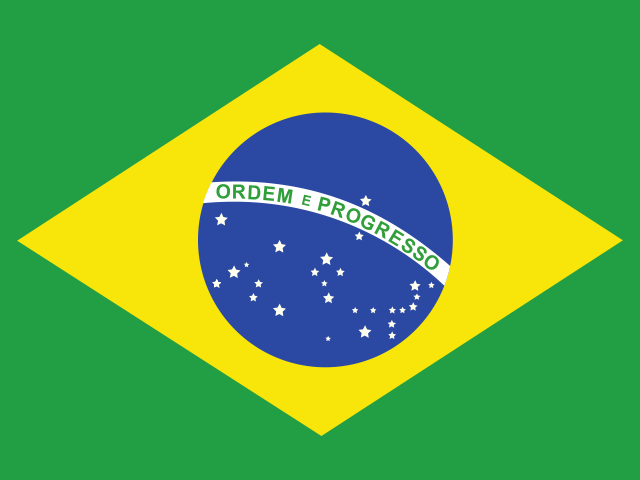
Flag types in Brazil: national, state and others
Published Written by Flagpole Guides
This page is an English translation of the Portuguese original. Where the two versions differ, the Portuguese text is the original.
On Brazilian flagpoles, the national flag is seldom alone. In front of town halls, courts and universities, it may appear next to the state flag and the municipal flag; at federal buildings, next to the Mercosur flag; at companies, next to flags with the brand’s logo. This guide presents the flags used in the country and the rules that apply to each.
The national flag
The national flag is the first of the national symbols (article 1 of Law 5,700 of 1 September 1971). For federal, state and municipal public offices, barracks and public and private schools, article 4 sets seven normal types, measured in panos of 45 centimetres wide: type 1 is one pano, type 2 is two, and so on up to type 7, with seven panos. Extraordinary types, larger, smaller or intermediate, may be made according to the conditions of use, keeping the proper proportions. The guide to flag sizes gives the measurements of each type.
Under article 5(X), the two faces are exactly the same, with the white band sloping from left to right for someone looking at it from the front, and making one face the reverse of the other is prohibited. That is why a pole flag is made double-sided. In a 2020 purchasing specification, the Federal University of Viçosa specifies, for outdoor use, flags of parachute nylon, 100% polyamide, embroidered double-sided, with UV protection, triple stitching and reinforced fabric loops at both ends of the hoist.
Flags of the states and municipalities
Under article 13(2) of the Constitution, the states, the Federal District and the municipalities may have their own symbols, established by their own laws. The same Viçosa specification includes, besides the national flag, the flag of the State of Minas Gerais and that of the city of Viçosa, with the same technical features. When flown together, the national flag takes the place of honour in article 19 of Law 5,700; the guide to flag protocol explains that position.
The Mercosur flag
Since Law 12,157 of 23 December 2009, the Mercosur flag has been raised daily with the national flag at the places in article 13 of Law 5,700: the Presidential Palace, the ministries, Congress, the higher and audit courts, the seats of the state and Federal District governments, town halls and municipal councils, public offices in the border strip, diplomatic missions and the merchant navy.
The Presidential Standard
The Presidential Standard shows the presence of the President of the Republic. Under article 21 of Decree 70,274 of 9 March 1972, as worded by Decree 7,419 of 2010, it is raised at the seat of government and where the President lives when in the Federal District, and at federal, state and municipal bodies, agencies and foundations whenever the President visits them. The Vice-President has a standard of their own, with the same rule.
Military and ship flags
Under article 44 of Law 5,700, the use of the flag in the Armed Forces follows their own regulations, insofar as they do not conflict with the law. On merchant navy units, the flag is raised daily according to the laws and regulations of navigation, naval police and international practice (article 13(IX)).
Indoor and table flags
In offices, classrooms and auditoriums, the flag may stand in panóplias, stands with a base into which the poles are fitted, which may be of wood, metal or plastic, as described by the Memorial of the Public Prosecutor’s Office of Minas Gerais. Article 11 of Law 5,700 also provides for the flag spread out without a pole, applied to a wall or hung from a horizontal cable; in that case, the longer side is horizontal and the single star at the top (article 22).
Corporate flags
Flags with a company’s name or logo are not regulated by Law 5,700, but municipal law may treat them as advertisements. In São Paulo, Law 14,223 of 26 September 2006, the Clean City Law (Lei Cidade Limpa), defines an advertisement as any means of visual communication present in the landscape visible from a public thoroughfare, made up of a display area and a structure. The guide to flagpoles for businesses covers these rules. An inscription or logo on the national flag itself, on the other hand, is prohibited by article 31(II) of Law 5,700.
Historical flags
Before the republican flag of 1889, Brazil had the flag of the Empire, adopted by decree on 18 September 1822: a green parallelogram with a yellow rhombus and, in the centre, the coat of arms. The guide to the history of the Brazilian flag traces this development.
Frequently asked questions
What are the official types of the national flag?
Under article 4 of Law 5,700, the fabric flag for public offices, barracks and schools is made in one of types 1 to 7, one to seven panos of 45 centimetres wide. Extraordinary types, larger, smaller or intermediate, may be made, keeping the proper proportions.
May states and municipalities have their own flag?
Yes. Under article 13(2) of the Constitution, the states, the Federal District and the municipalities may have their own symbols. State and municipal flags are established by the laws of those bodies.
What is the Presidential Standard?
It is the flag that shows the presence of the President of the Republic. Under article 21 of Decree 70,274 of 1972, it is raised at the seat of government and at the President’s residence when the President is in the Federal District, and at federal, state and municipal bodies whenever the President visits them.
May a company have its own flag?
Yes. Flags with a company’s name or logo are not regulated by Law 5,700, but municipal laws may treat them as advertisements. In São Paulo, Law 14,223 of 2006 defines an advertisement as any means of visual communication present in the landscape visible from a public thoroughfare.
May one side of the national flag differ from the other?
No. Under article 5(X) of Law 5,700, the two faces are exactly the same, with the white band sloping from left to right for someone looking at it from the front, and making one face the reverse of the other is prohibited.
Sources
This guide is based on the following sources, most of them in Portuguese:
- Lei nº 5.700, de 1º de setembro de 1971 (artigos 4º, 5º, 11, 13 e 44) – Presidência da República
- Constituição da República Federativa do Brasil de 1988 (artigo 13) – Presidência da República
- Decreto nº 70.274, de 9 de março de 1972 (artigo 21) – Presidência da República
- Lei nº 12.157, de 23 de dezembro de 2009 – Presidência da República
- Lei nº 14.223, de 26 de setembro de 2006 (Lei Cidade Limpa) – Câmara Municipal de São Paulo
- Projeto básico para aquisição de bandeiras e rosetas (Dispensa nº 74/2020) – Universidade Federal de Viçosa
- Panóplia – Memorial do Ministério Público de Minas Gerais
- Decreto de 18 de setembro de 1822 (escudo de armas e bandeira do Reino do Brasil) – Câmara dos Deputados
Related guides
- Flag sizesThe official sizes of Brazil’s national flag in panos of 45 cm, the proportions in modules of article 5 and the relation between flag and pole.
- Flag symbolismWhat the colours, the starry sky and the motto Ordem e Progresso on Brazil’s flag represent, with the star of each state under the annex of Law 8,421.
- History of the flagThe history of Brazil’s flag: the flag of the Empire of 1822, the provisional flag of 1889, Decree No. 4 and the laws of 1968, 1971 and 1992 up to 27 stars.
- Foreign flagsHow a flag of another country may be used in Brazil: the national flag on its right, of equal size, and the exception for embassies and consulates.