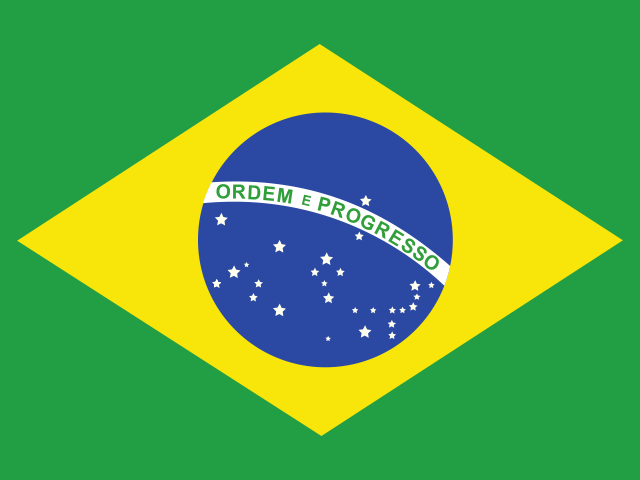
Flags on holidays in Brazil: national, state and municipal
Published Written by Flagpole Guides
This page is an English translation of the Portuguese original. Where the two versions differ, the Portuguese text is the original.
Holidays are the days on which the flag is seen most in Brazil outside public buildings. For public offices, schools and trade unions, Law 5,700 of 1 September 1971 makes raising the flag compulsory on days of national celebration (article 14). The holidays themselves are set by other laws: federal for the national ones, state for the states’ main days and municipal for religious holidays. This guide brings these rules together.
The national holidays
Law 662 of 6 April 1949, as worded by Law 10,607 of 2002, declares seven dates national holidays. Two other laws added two more:
| Date | Holiday | Law |
|---|---|---|
| 1 January | New Year’s Day (Confraternização Universal) | Law 662/1949 |
| 21 April | Tiradentes | Law 662/1949 |
| 1 May | Labour Day | Law 662/1949 |
| 7 September | Independence Day | Law 662/1949 |
| 12 October | Our Lady of Aparecida, Patroness of Brazil | Law 6,802/1980 |
| 2 November | All Souls’ Day (Finados) | Law 662/1949 |
| 15 November | Proclamation of the Republic | Law 662/1949 |
| 20 November | National Day of Zumbi and Black Consciousness | Law 14,759/2023 |
| 25 December | Christmas Day | Law 662/1949 |
Law 6,802 of 30 June 1980 declares 12 October a national holiday, for public and official worship of Our Lady of Aparecida. Law 14,759 of 21 December 2023 declares 20 November a national holiday, to celebrate the National Day of Zumbi and Black Consciousness. Under article 2 of Law 662, only absolutely essential private and administrative activities are allowed on national holidays.
The guide to flag days shows these dates in 2026 and 2027, with the weekday, together with Flag Day, 19 November, which is not a holiday.
Civil and religious holidays
Law 9,093 of 12 September 1995 distinguishes two kinds of holiday:
- civil holidays: those declared by federal law; the state’s main day set by state law; and the first and last days of the centenary year of a municipality’s foundation, set by municipal law;
- religious holidays: the days of observance declared by municipal law, according to local tradition, up to four in number, Good Friday included.
The states’ main days
Each state may set its main day by law. In São Paulo, state Law 9,497 of 5 March 1997 made 9 July, the state’s main day, a civil holiday, on the basis of Law 9,093. When the state flag flies next to the national flag, the national flag takes the place of honour under article 19 of Law 5,700, in the centre or in the position nearest the centre and to its right. The guide to flag protocol covers the order of flags.
Pontos facultativos
Optional days off (pontos facultativos) are not holidays. Under article 3 of Law 662, the pontos facultativos decreed by the states, the Federal District or the municipalities do not suspend normal school hours or affect the work of the courts, notaries and registry offices. Law 5,700 does not link compulsory flag raising to these days.
The flag at home and in shops
On holidays, the law does not require private persons or businesses to fly the flag, but it allows its use in private expressions (article 10), on poles, in windows, on balconies, on vehicles or on façades (article 11). The limits are in article 31: among other things, the flag is not displayed in poor condition, with added inscriptions or used as clothing or a table cover. The colours green and yellow, for their part, may be used without restriction (article 29). More information in the guide to the flag rules.
A holiday during mourning
If a national holiday falls during a period of official mourning, the flag is raised to the top that day: under article 18 of Law 5,700, the flag in mourning applies only when the situation does not coincide with days of national celebration. The guide on half-mast explains the procedure.
Frequently asked questions
What are the national holidays in Brazil?
Under Law 662 of 1949, as worded by Law 10,607 of 2002, the national holidays are 1 January, 21 April, 1 May, 7 September, 2 November, 15 November and 25 December. Law 6,802 of 1980 adds 12 October and Law 14,759 of 2023 adds 20 November.
Is the flag raised on holidays?
Under article 14 of Law 5,700, the flag is raised compulsorily on days of national celebration at all public offices, schools and trade unions. The law does not list those days; the table in the guide to flag days brings together the national holidays and Flag Day.
What is a state’s main day?
Under Law 9,093 of 1995, the state’s main day (data magna), set by state law, is a civil holiday. In São Paulo, state Law 9,497 of 1997 made 9 July, the state’s main day, a civil holiday.
Is Good Friday a national holiday?
Law 9,093 of 1995 treats Good Friday as a religious holiday: religious holidays are the days of observance declared by municipal law, according to local tradition, up to four in number, Good Friday included.
Is a ponto facultativo a holiday?
No. Under article 3 of Law 662 of 1949, the optional days off (pontos facultativos) decreed by the states, the Federal District or the municipalities do not suspend normal school hours or affect the work of the courts, notaries and registry offices.
Sources
This guide is based on the following sources, most of them in Portuguese:
- Lei nº 662, de 6 de abril de 1949 – Presidência da República
- Lei nº 10.607, de 19 de dezembro de 2002 – Presidência da República
- Lei nº 6.802, de 30 de junho de 1980 – Presidência da República
- Lei nº 14.759, de 21 de dezembro de 2023 – Presidência da República
- Lei nº 9.093, de 12 de setembro de 1995 – Presidência da República
- Lei nº 9.497, de 5 de março de 1997 (9 de julho, data magna do Estado de São Paulo) – Assembleia Legislativa do Estado de São Paulo
- Lei nº 5.700, de 1º de setembro de 1971 – Presidência da República
Related guides
- Flag daysThe days of national celebration on which Brazil’s national flag is raised in 2026 and 2027, with Flag Day, the time of raising and the weekday.
- Flag protocolThe ceremonial of Brazil’s national flag: the place of honour, order with other flags, the attitude of respect, the anthem and the Presidential Standard.
- Half-mastWhen Brazil’s national flag flies at half-mast, who decides, how it is raised and lowered in mourning and what happens on days of national celebration.
- Flag rulesThe rules for the national flag of Brazil: private use, forms of display, disrespect, worn-out flags, sale and penalties under Law 5,700 of 1971.