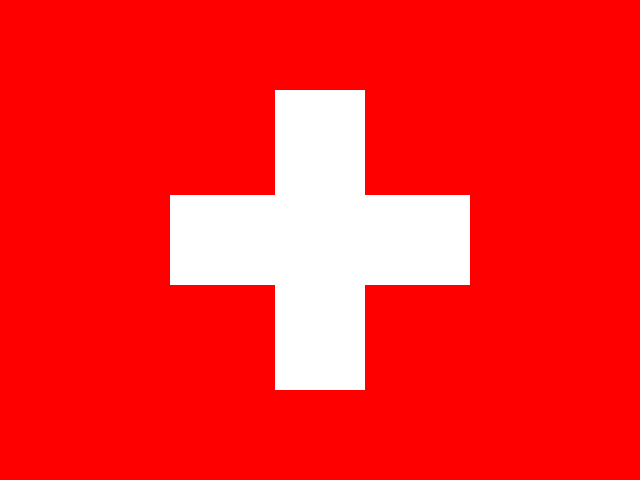
Flagpoles and flag flying in Switzerland
Published Written by Flagpole Guides
This page is an English translation of the German original. Where the two versions differ, the German text is the original.
In Switzerland, flags are part of everyday life: the Swiss flag at the family home, the cantonal and communal flags outside the commune hall, flags hanging from balconies on 1 August, the company flag outside the factory. Unlike many countries, however, Switzerland has no flag law that sets flag days for everyone. The rules are spread across the Coat of Arms Protection Act, the Federal Council’s instructions for federal buildings, the Swiss Armed Forces’ flag regulations and the building law of the cantons. This guide brings together the essentials of flag flying and flagpoles in Switzerland, with sources from federal law, cantonal law and the publications of the responsible authorities.
The essentials at a glance
- Flag days: the Federal Council’s instructions name 1 August, Europe Day on 5 May and United Nations Day on 24 October for federal buildings. There are also cantonal holidays such as 1 March in Neuchâtel and 23 June in the Jura. All dates are in the guide to flag days.
- Who may fly the flag: under the Coat of Arms Protection Act, anyone may in principle use the Swiss flag. More in the guide to the flag rules.
- Half-mast: for federal buildings, half-mast is ordered, depending on the occasion, by the Parliamentary Services, the Federal Chancellery, the Protocol of the Federal Department of Foreign Affairs or the President of the Confederation. More in the guide to half-mast.
- Order of flags: Swiss flag, cantonal flag, communal flag – in that order. How they are arranged on two, three or four poles is explained in the guide to flag protocol.
- Size: the Swiss Armed Forces’ flag regulations give a ratio of about 4:1 between pole and flag. The flag size calculator shows what that means for a given pole height.
- Buying: what affects the price is explained in the guides to buying a flagpole and buying a flag.
- Building permit: whether a flagpole needs a permit is decided by the cantons. More in the guide to flagpole installation.
Laws, instructions and responsible bodies
The Swiss flag is described in the Coat of Arms Protection Act of 21 June 2013, in force since 1 January 2017: it shows a Swiss cross in a square field. Under Article 1, the Swiss cross is an upright, free-standing white cross in a red field whose equal arms are each one sixth longer than they are wide. The model in the annex to the Act governs the shape, colour and proportions; the red is defined there, among other values, as Pantone 485 and RGB 255/0/0. The flags of the cantons and communes are set by cantonal law (Article 5).
How federal buildings fly flags is set out in the Federal Council’s instructions on flags on federal buildings of 20 April 2016. They apply to the Parliament Building and the buildings of the federal administration, not to private individuals. For buildings with several poles, they refer to the Swiss Armed Forces’ flag regulations (Regulation 51.340), which describe the order of flags and their handling in detail. In the Bern agglomeration, the Federal Office for Buildings and Logistics is responsible for flying the flags.
Protection of the flag is a matter for the Swiss Criminal Code: anyone who maliciously removes, damages or insults by acts a Swiss or cantonal flag displayed by an authority is liable to prosecution under Article 270. Article 298 protects the emblems of foreign states displayed publicly by a recognised representation of that state.
Private individuals, associations and businesses have no duty to fly a flag and no binding times. Many follow the federal practice and the calls to fly flags issued by their canton or commune.
The flagpole in Switzerland
There are no federal rules for the flagpole itself. Building law is a matter for the cantons, and the communes issue building permits. In the Canton of Zurich, only structures up to 2.5 m in total height are exempt; in the Canton of Bern, the building permit decree lists flags that are sovereign emblems as permit-free street advertising; in the Canton of Vaud, the commune decides on every project. In historic town centres, near listed buildings and in protected townscapes, the bar is higher.
Aluminium poles of 6 to 8 metres are common in gardens, and outside commune halls and schools there are often three poles for the Swiss, cantonal and communal flags. Flags hanging from houses and balconies are also very widespread in Switzerland. More in the guides to types of flagpoles and flag types.
About the guides
The guides below are grouped by topic. Each covers one subject, ends with frequently asked questions, lists its sources and shows when it was last updated. The flag days are calculated for 2026 and 2027. The guides are also available in German, the original, and in French, as a separate version for French-speaking Switzerland.
All guides
Flag flying and rules
When and how flags are flown in Switzerland – from the federal flag days to half-mast, flags in mourning and the order of the Swiss, cantonal and communal flags.
- Flag daysFlag days in Switzerland in 2026 and 2027: 1 August, Europe Day, UN Day and cantonal days of the republic, based on federal and cantonal rules.
- Flag rulesThe rules for the Swiss flag: Coat of Arms Protection Act, Federal Council instructions, army flag regulations, flying times and criminal law protection.
- Half-mastHalf-mast in Switzerland: who orders it for federal buildings, how the flag is lowered, what applies with several poles and which flags stay at full mast.
- Flags in mourningFlags in mourning in Switzerland: on which deaths and disasters the Confederation lowers flags to half-mast, for how long and which forms are used at funerals.
- Flags on holidaysFlags on holidays in Switzerland: 1 August as the National Day, cantonal public holidays, the cantons’ republic days and flags at festivals.
- Flag protocolOrder of the Swiss, cantonal and communal flags, the place of honour on two to four poles and the order of the cantons and of foreign flags in Switzerland.
- Foreign flagsForeign flags in Switzerland: what the Coat of Arms Protection Act says about foreign emblems, their place beside the Swiss flag and their protection.
The flag
The Swiss cross, flag types, flag sizes and what affects the price of a flag – and a calculator that shows which flag suits which pole height.
- Flag typesFlag types in Switzerland: hoisting flag, hanging flag, outrigger banner, Swiss flag at sea, association and table flags – with rules for hanging flags.
- Flag sizesWhich flag size suits which flagpole in Switzerland: the 4:1 ratio in the army flag regulations, the Swiss trade table and the proportions of the Swiss flag.
- Flag size calculatorThe calculator shows for each pole height the flag size by the 4:1 ratio of the Swiss army flag regulations and the matching row of the Swiss trade size table.
- The Swiss flagWhat the Swiss flag means: the origin of the white cross, its square shape, the colours set by the Coat of Arms Protection Act and its link with the Red Cross.
- Buying a flagWhat affects the price of a flag in Switzerland: size, fabric, printed or sewn cross, finishing and quantity – plus warranty rules and price display.
The flagpole
Types of pole, materials, heights, accessories, lighting and what affects the price of a flagpole – and the history of the Swiss flag.
- Types of flagpolesFlagpoles in Switzerland at a glance: external or internal halyard, outrigger pole, tilting pole, telescopic pole, façade and balcony brackets.
- Flagpole materialsAluminium, GRP, steel and wood flagpoles compared: weight, care, stability, wind load and the Swiss structural standards for load-bearing structures.
- Flagpole heightsHow tall a flagpole usually is in Switzerland: garden, business and commune, the link to flag size and what cantonal building law says about height.
- Flagpole accessoriesEvery part of a flagpole explained: finial, pulley, halyard, cleat, snap hooks, ground sleeve, outrigger, flag rotator and mourning band – and what each does.
- Flagpole mechanicsHow a flagpole works: external and internal halyards, raising the flag, half-mast, why the flag wraps around the pole and how a tilting pole works.
- Flag lightingFlags at night in Switzerland: what the army flag regulations say about darkness, the FOEN principles against light emissions and what neighbours can demand.
- History of the Swiss flagHistory of the Swiss flag: the white cross at Laupen in 1339, flamed flags, the Helvetic tricolour, Dufour’s federal flag of 1840 and the 1889 arms.
- Buying a flagpoleWhat affects the price of a flagpole in Switzerland: height, material, halyard, foundation, installation and transport – plus warranty rules.
Installation, safety and care
Building permits, foundations, safety, maintenance and transport – for houses, condominiums, businesses and communes.
- Flagpole installationPutting up a flagpole in Switzerland: when a building permit is needed (Zurich, Bern, Vaud), foundation, utility lines, neighbours, renting and condominiums.
- Flagpole safetyFlagpole safety in Switzerland: federal wind warnings, the owner’s liability for structures under Article 58 CO, ladders, overhead lines and children.
- Flagpole maintenanceMaintaining flagpole and flag: what is checked at an inspection, how rope, pulley and foundation are looked after and what the army’s leaflet on flags says.
- Flagpole repairCommon faults on a flagpole and their causes: snapped rope, seized pulley, rattling rope, leaning pole, corrosion and damage to the flag.
- Lifespan and sustainabilityHow long flagpole and flag last, how to recognise when replacement is due and how pole and flag are disposed of and recycled in Switzerland.
- Flagpole transportTransporting a flagpole: how far a load may overhang front and rear under the Swiss traffic rules ordinance, when it must be marked and how it is secured.
- Flagpoles for businessesCompany flags in Switzerland: permits as advertising in Zurich, Bern and Geneva, the Swiss cross and coat of arms, order of flags and liability.
Frequently asked questions
May anyone fly the Swiss flag?
Yes. Under Article 10 of the Coat of Arms Protection Act, the flags of the Confederation, the cantons and the communes may be used unless the use is misleading or contrary to public order, morality or the law. The Swiss coat of arms, the cross in a shield, is reserved for the Confederation.
Does Switzerland have a law with fixed flag days?
No. The Federal Council’s instructions on flags on federal buildings of 20 April 2016 apply only to those buildings: the Swiss flag is flown there for 1 August, and the flags of the Council of Europe and the United Nations on the Bundeshaus West on their days. Cantons and communes call for flags on other occasions.
Does a flagpole need a building permit in Switzerland?
Building law is a matter for the cantons. In the Canton of Zurich, only structures up to 2.5 m in total height are exempt under section 1 of the building procedure ordinance, and a typical flagpole is taller. In the Canton of Vaud, the commune decides whether a project needs a permit. The commune’s building authority can give information in the individual case.
Why is the Swiss flag square?
The Swiss flag grew out of military colours. The Coat of Arms Protection Act describes it as a Swiss cross in a square field. According to the Swiss Armed Forces’ flag regulations, it is, together with the flag of Vatican City, the only square national flag. At sea, Swiss ships fly a rectangular flag in the proportion 2:3.
Which flag size suits which flagpole in Switzerland?
There is no official rule for private poles. The Swiss Armed Forces’ flag regulations give a ratio of pole height to flag height of about 4:1, and the Swiss trade a flag of a quarter to a fifth of the pole height. For a 7-metre pole, the table of top-fahnen.ch lists 150 × 150 cm.
Sources
This guide is based on the following sources, most of them in German:
- Bundesgesetz über den Schutz des Schweizerwappens und anderer öffentlicher Zeichen (Wappenschutzgesetz, WSchG), SR 232.21 – Fedlex, Federal Chancellery
- Weisungen über die Beflaggung der Gebäude des Bundes vom 20. April 2016 (BBl 2016 3603) – Swiss Federal Council
- Reglement 51.340 d: Der Umgang mit Fahnen, Standarten und Fanions (Fahnenreglement), valid from 1 January 2025 – Swiss Armed Forces
- Bundesverfassung der Schweizerischen Eidgenossenschaft, Art. 1 und Art. 110 – Fedlex, Federal Chancellery
- Bauverfahrensverordnung (BVV), LS 700.6, § 1 – Canton of Zurich
- Schweizerkreuz – Historical Dictionary of Switzerland