Flag types in Switzerland: hoisting flag, hanging flag, outrigger banner and more
Published Written by Flagpole Guides
This page is an English translation of the German original. Where the two versions differ, the German text is the original.
In Swiss German, a flag is almost always a Fahne. The Historical Dictionary of Switzerland distinguishes between the Fahne, originally a single, often precious piece carried on a staff, and the Flagge, which comes from seafaring and is hoisted. Although the hoisted Swiss, cantonal and communal flags are flags in that sense, the word Flagge never caught on in Switzerland. The Coat of Arms Protection Act also speaks of the Schweizerfahne, and the Swiss Armed Forces’ flag regulations deliberately keep that word. This overview shows which kinds of flag are common in Switzerland.
Hoisting flag
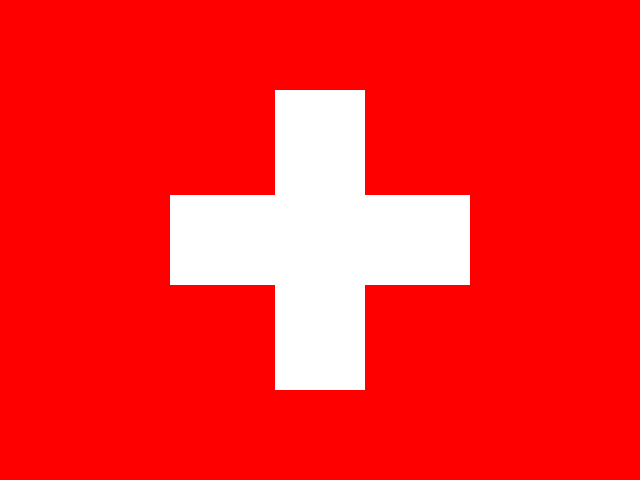
The hoisting flag is raised on a pole with a halyard. For the Swiss flag and the cantonal and communal flags it is square, in sizes from about 80 × 80 cm for small poles to 300 × 300 cm and more for tall poles. Along the hoist, the edge next to the pole, are snap hooks, eyelets or loops. It is the only form that can easily be set at half-mast. Which size suits which pole is covered in the guide to flag sizes.
Hanging flag
The hanging flag is particularly widespread in Switzerland: on balconies, façades and windows, above streets and in festival halls. It is upright in format and made for hanging from a rope, a pole or a wall. The Swiss Armed Forces’ flag regulations provide that flags not flown from poles are, wherever possible, hanging flags. Some rules apply:
- Swiss flags are hung as one would hang the corresponding coat of arms.
- The flags of the cantons of Schwyz, Lucerne and Ticino look different as flags than as coats of arms; when hung, their image is therefore oriented like the coat of arms.
- Flags to the left of the higher-ranking flag are turned towards it, that is hung reversed. The flag of the Canton of Vaud is the exception.
- Foreign flags are hung as on the pole, unless there are special flags for vertical hanging.
Outrigger banner and Knatterfahne
An outrigger banner hangs from a pole with a horizontal arm at the top, so that it stays visible at full size even when there is no wind. It is common at businesses and hotels. Heimgartner Fahnen AG mentions, for banners and outrigger flags, a pole twice as high as the flag, so that the flag stays well clear of the ground. Outrigger banners cannot easily be set at half-mast.
The Knatterfahne is a long, rectangular hoisting flag in portrait format that flutters (“knattert”) on the pole. It is common mainly as an advertising and company flag.
Rectangular Swiss flag and Swiss flag at sea
The Swiss flag is square under the Coat of Arms Protection Act. The maritime, aviation and military laws are reserved. The Swiss flag at sea, flown by ships under the Swiss flag and the army’s patrol boats, is rectangular in the proportion 2:3 under the Maritime Navigation Act.
The trade also sells rectangular Swiss flags. According to the size guide of top-fahnen.ch, they are used when the Swiss flag is flown together with other national flags, for example the flag of Liechtenstein. Under the flag regulations, however, the square Swiss flag can also fly beside rectangular flags; all then have the same height and differ in length.
Association flags and military colours
Association flags of bands, shooting, gymnastics or costume associations and guilds have a long tradition in Switzerland. Like historic flags, they are carried on a staff, are often embroidered and accompany parades, festivals and funerals. In the armed forces, battalions and units carry flags and standards as colours, which receive military honours; their dimensions are set out in the flag regulations.
Table flag, fanion and car flag
- Table flags stand at receptions and negotiations. Under the flag regulations, as a rule only one set stands on the table so that the gesture does not become “cheap decoration”, and the small flags stand in the correct order of precedence as seen from the guest in the place of honour.
- Fanions are small pennants, used in the armed forces as identification and location markers.
- Car flags are mounted on the front of a vehicle on special occasions, with the guest country’s flag on the right in the direction of travel and Switzerland’s as host on the left.
Strings of flags and decoration
For 1 August and festivals, many communes hang strings of flags with small Swiss and cantonal flags above streets and squares. For decorating festivals and events, Article 8 of the Coat of Arms Protection Act exceptionally also permits the use of coats of arms, which are otherwise reserved for the public body. What affects the price of a flag is covered in the guide to buying a flag.
Frequently asked questions
Why do the Swiss say Fahne rather than Flagge?
According to the Historical Dictionary of Switzerland, the hoisted Swiss, cantonal and communal flags are flags in the maritime sense (Flagge), but the word Flagge never caught on in Switzerland. The Coat of Arms Protection Act also speaks of the Schweizerfahne; only the Swiss flag at sea is called a Flagge.
What is a hanging flag?
A hanging flag is made for hanging from a rope, a wall or a façade and hangs vertically. The Swiss Armed Forces’ flag regulations provide for it where flags are not flown from poles. Swiss flags are then hung as one would hang the corresponding coat of arms.
Is there a rectangular Swiss flag?
The Swiss flag is square under the Coat of Arms Protection Act. The Swiss flag at sea is rectangular in the proportion 2:3. The trade also sells rectangular versions which, according to top-fahnen.ch, are used when the Swiss flag is flown together with other national flags.
Can a hanging flag be set at half-mast?
No, a hanging flag is fixed to a rope, wall or outrigger. Where half-mast is technically impossible, mourning is marked in another form under the Federal Council’s instructions.
Sources
This guide is based on the following sources, most of them in German:
- Fahnen – Historical Dictionary of Switzerland
- Reglement 51.340 d: Der Umgang mit Fahnen, Standarten und Fanions (Fahnenreglement), Kapitel 5 und 6.5 – Swiss Armed Forces
- Wappenschutzgesetz (WSchG), SR 232.21, Art. 3 – Fedlex, Federal Chancellery
- Grössenratgeber: Grösse der Fahne im Verhältnis zum Mast – top-fahnen.ch
- Flaggen und Fahnenmasten – worauf achten? – Heimgartner Fahnen AG
Related guides
- Flag sizesWhich flag size suits which flagpole in Switzerland: the 4:1 ratio in the army flag regulations, the Swiss trade table and the proportions of the Swiss flag.
- The Swiss flagWhat the Swiss flag means: the origin of the white cross, its square shape, the colours set by the Coat of Arms Protection Act and its link with the Red Cross.
- Flag protocolOrder of the Swiss, cantonal and communal flags, the place of honour on two to four poles and the order of the cantons and of foreign flags in Switzerland.
- Flag size calculatorThe calculator shows for each pole height the flag size by the 4:1 ratio of the Swiss army flag regulations and the matching row of the Swiss trade size table.
- Buying a flagWhat affects the price of a flag in Switzerland: size, fabric, printed or sewn cross, finishing and quantity – plus warranty rules and price display.