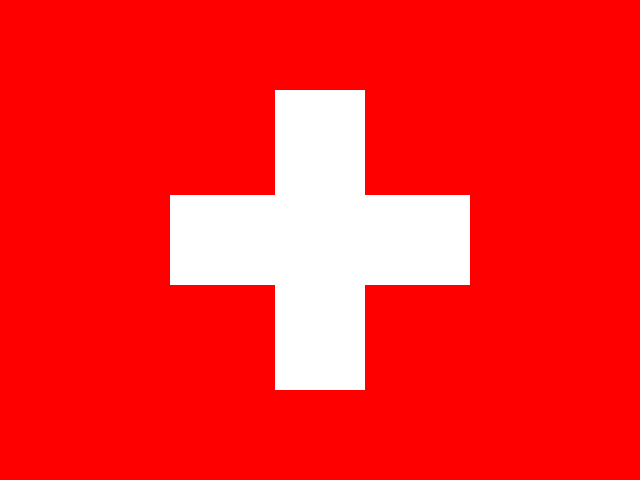
The Swiss flag: meaning of the cross, colours and square shape
Published Written by Flagpole Guides
This page is an English translation of the German original. Where the two versions differ, the German text is the original.
A white cross on a red ground, in a square field: the Swiss flag is one of the best-known national flags and at the same time one of the most unusual. Its image is identical to the coat of arms, its shape is square, and its reversed colours became the emblem of the Red Cross. Its meaning can be read from the law, from the Swiss Armed Forces’ flag regulations and from the history books.
The cross
The Swiss cross is originally a Christian symbol. The Historical Dictionary of Switzerland gives three interpretations of its origin:
- the Theban Legion, whose cult was particularly widespread in the Kingdom of Burgundy,
- the imperial war banner (Reichssturmfahne), recorded from the 12th century,
- the arma Christi, the instruments of Christ’s Passion, venerated in central Switzerland, which the original cantons were reportedly allowed to attach to their red “blood banner” from 1289.
As a common recognition mark, the Bernese wore the continuous white cross, sewn from two strips of cloth, on their clothing at the Battle of Laupen in 1339. It set them apart from the red St George’s cross of the Austrians and the Burgundian St Andrew’s cross of the Landsknechts. Only at the end of the 15th century did it become the true national emblem of the Confederates.
Today, the Coat of Arms Protection Act describes the cross precisely: upright, free-standing, white, with equal arms that are each one sixth longer than they are wide. The Swiss Armed Forces’ flag regulations describe the flag as a symbol of the unity and cohesion of the federal state.
The colours
Red and white are the federal colours. Since 2017, the red has been defined bindingly in the Coat of Arms Protection Act:
| Colour system | Value |
|---|---|
| Pantone | 485 C / 485 U |
| CMYK | 0 / 100 / 100 / 0 |
| RGB | 255 / 0 / 0 |
| Hexadecimal | #FF0000 |
| RAL | 3020 traffic red |
| NCS | S 1085-Y90R |
| Scotchcal | 100-13 |
The white is not defined in the Act. Military flags and standards carry, under the flag regulations, a ribbon in the federal colours red and white.
The square shape
According to the Swiss Armed Forces’ flag regulations, the Swiss flag grew out of military colours, which is also the reason for its square shape. In the version used on land, it is, together with the flag of Vatican City, the only square national flag in the world. The regulations point to two further features: Switzerland is the only state whose coat of arms and flag show exactly the same image, and because that image is perfectly symmetrical, the Swiss flag is the only national flag that cannot be flown upside down.
At sea, Swiss ships fly the Swiss flag at sea in the proportion 2:3, as the Maritime Navigation Act provides.
Flag and coat of arms
Even though the flag and coat of arms show the same image, the law distinguishes strictly between them. The Swiss coat of arms is the Swiss cross in a triangular shield and may in principle be used only by the Confederation (Article 8). The Swiss flag may be used by anyone, provided the use is not misleading or contrary to public order, morality or the law (Article 10). The Swiss cross can also serve as an indication of origin for goods and services; the Swissness rules of the Trade Mark Protection Act then apply (Article 13).
The link with the Red Cross
The emblem of the Red Cross is the Swiss flag in reversed colours. Article 38 of the First Geneva Convention of 1949 states: as a compliment to Switzerland, the heraldic emblem of the red cross on a white ground, formed by reversing the federal colours, is retained as the emblem and distinctive sign of the medical service of armed forces. Because of this compliment and the risk of confusion, Article 53 of the Convention prohibits private persons and firms from using the coat of arms of Switzerland as a trademark or for purposes contrary to commercial honesty.
Cantonal and communal flags
Besides the Swiss flag, the 26 cantons and most communes have their own flags, set by cantonal law. Many go back to medieval banners, such as the bull of Uri or the bear of Bern. How the Swiss flag developed from these flags and from military colours is told in the guide to the history of the Swiss flag.
Frequently asked questions
What does the cross on the Swiss flag mean?
The Historical Dictionary of Switzerland gives three interpretations of this originally Christian symbol: the Theban Legion, the imperial war banner recorded from the 12th century and the arma Christi, the instruments of the Passion venerated in central Switzerland. As a common recognition mark, the Bernese wore the white cross at the Battle of Laupen in 1339.
Why is the Swiss flag square?
According to the Swiss Armed Forces’ flag regulations, the Swiss flag grew out of military colours, which is also the reason for its square shape. Together with the flag of Vatican City, it is the only square national flag.
Is the Red Cross linked to the Swiss flag?
Yes. Article 38 of the First Geneva Convention of 1949 states that the emblem of the red cross on a white ground was formed by reversing the federal colours, as a compliment to Switzerland. Article 53 therefore also prohibits private persons from using the Swiss coat of arms as a trademark.
What red does the Swiss flag use?
The Coat of Arms Protection Act defines the red in Annex 2, among other values as Pantone 485 C, RGB 255/0/0, hexadecimal #FF0000 and RAL 3020 traffic red. The white is not defined in the Act.
Sources
This guide is based on the following sources, most of them in German:
- Schweizerkreuz – Historical Dictionary of Switzerland
- Wappenschutzgesetz (WSchG), SR 232.21, Art. 1–3, 8, 10 und 13, Anhang 2 – Fedlex, Federal Chancellery
- Reglement 51.340 d: Der Umgang mit Fahnen, Standarten und Fanions (Fahnenreglement), Kapitel 1.2 und Anhang 1 – Swiss Armed Forces
- Genfer Abkommen zur Verbesserung des Loses der Verwundeten und Kranken der bewaffneten Kräfte im Felde (I. Genfer Abkommen), SR 0.518.12, Art. 38 und 53 – Fedlex, Federal Chancellery
- Swissness – Swiss Federal Institute of Intellectual Property
Related guides
- History of the Swiss flagHistory of the Swiss flag: the white cross at Laupen in 1339, flamed flags, the Helvetic tricolour, Dufour’s federal flag of 1840 and the 1889 arms.
- Flag rulesThe rules for the Swiss flag: Coat of Arms Protection Act, Federal Council instructions, army flag regulations, flying times and criminal law protection.
- Flag sizesWhich flag size suits which flagpole in Switzerland: the 4:1 ratio in the army flag regulations, the Swiss trade table and the proportions of the Swiss flag.
- Flag typesFlag types in Switzerland: hoisting flag, hanging flag, outrigger banner, Swiss flag at sea, association and table flags – with rules for hanging flags.