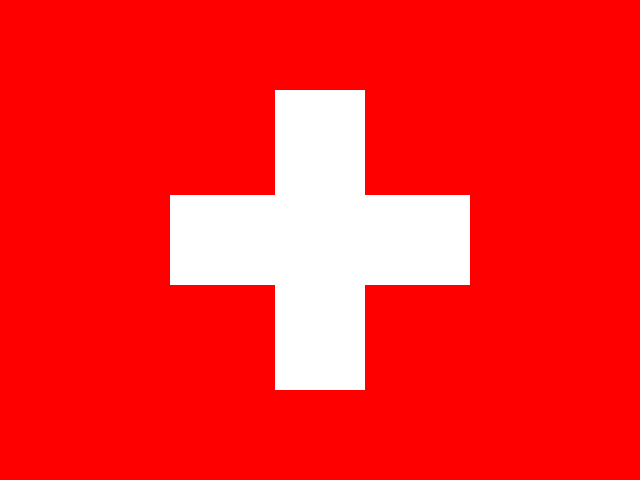
History of the Swiss flag: from the cross of Laupen to the Coat of Arms Protection Act
Published Written by Flagpole Guides
This page is an English translation of the German original. Where the two versions differ, the German text is the original.
The Swiss flag is younger than one might think. The white cross has been recorded as a sign of the Confederates since the 14th century, but a common flag for the whole of Switzerland has only existed since the 19th century. Its history runs through battlefields, foreign military service and a short period under a green, red and yellow tricolour. The main sources are the Historical Dictionary of Switzerland and the historical annex of the Swiss Armed Forces’ flag regulations.
Banners of the cantons and the white cross
In the Middle Ages, the Confederate cantons went to war under their own banners, in the main banner or the smaller pennant in each state’s colours. There was no federal banner. Because there were no uniforms yet, a common mark of recognition was needed: a white cross of linen strips, sewn onto clothing or attached to flags and armour.
The white cross is first recorded in 1339 at the Battle of Laupen: according to the contemporary account of a Bernese brother of the Teutonic Order, the Bernese marched out marked, from the highest to the lowest, with the sign of the holy cross made of white cloth. It set them apart from the red St George’s cross of the Austrians and from the Burgundian St Andrew’s cross that the Landsknechts later adopted. In the 15th century, the cantons also placed the white cross on their pennants. According to the flag regulations, it became the true national emblem of the Confederates only between about 1450 and 1520.
Julius banners, free flags and flamed flags
In 1512, Pope Julius II gave the Confederates the splendid Julius banners in gratitude for their support in northern Italy. In the 16th century, Confederate troops increasingly marched under pennants and free flags, and new colours emerged for the Swiss in foreign service: the continuous white cross with four quarters in the colours of the captains.
In the second half of the 17th century, the flame pattern appeared, which shaped military flags for some 200 years: the continuous white cross and four quarters with flames in the cantonal colours. According to the flag regulations, it very probably originated with the Swiss in French service and was then imitated at home.
The Helvetic tricolour
In 1798, the French revolutionary armies attacked the Confederation, and the Helvetic Republic was proclaimed on 19 March 1798. On 13 February 1799, the Helvetic Directory decided to introduce new flags to a uniform pattern in green, red and yellow. The Swiss Armed Forces’ flag regulations describe this Helvetic tricolour as Switzerland’s first national flag. With the Act of Mediation of 1803, the unitary republic ended and the flamed flags with the white cross returned.
Seal, armband and Dufour’s federal flag
In 1814, the Federal Diet debated a draft constitutional article under which the seal of the Confederation would be the colour of the old Swiss: a free-standing white cross in a red field. It was first used for the Federal Treaty of 1815. General Niklaus Franz von Bachmann introduced a red armband with a white cross on 3 July 1815, which the military regulations of 1817 adopted. The contingents of the individual cantons nevertheless kept different flags; only the white cross, the red and white ribbon used in part and the armband were common to all.
That changed thanks to Guillaume Henri Dufour. In 1830 he wrote that having only one flag was more important than people thought, because the flag is the sign of rallying together. After ten years of effort, he achieved that in July 1840 the federal military supervisory authority decided on a single flag: each infantry battalion received from its canton a flag with the white cross on a red ground and the name of the canton in gold. The painter Carl Stauffer drew the model in 1841. The first Federal Constitution of 1848 expressly mentions the federal flag, and in 1852 the flag and standard were described precisely in the regulations for the federal army.
The cross of 1889
The shape of the cross was disputed for a long time: a square cross with short arms or longer arms as on the federal seal. On 12 December 1889, the Federal Assembly decided: the coat of arms of the Confederation is an upright, free-standing white cross in a red field whose equal arms are each one sixth longer than they are wide. According to the flag regulations, nothing essential has changed in the military colours since.
1 August and the flag
The National Day emerged at the same time. According to the Historical Dictionary of Switzerland, the National Day refers to the Federal Charter of 1291 and was first celebrated in 1891 for the 600th anniversary; from 1899, the Federal Council had the bells rung on the evening of 1 August. Since a popular vote in 1993, 1 August has been a day off work. A bonfire, a speech, lanterns and fireworks are, according to the Historical Dictionary, part of National Day celebrations.
The Coat of Arms Protection Act of 2013
The Coat of Arms Protection Act of 21 June 2013, in force since 1 January 2017, repealed the federal decree of 1889 and the 1931 act on the protection of public coats of arms, but adopted the definition of the cross. It now also fixes, with model drawings, the shape, colour and proportions of the coat of arms and the flag. According to the flag regulations, the central position of the cross in the flag thus follows from the law for the first time, and the red is bindingly defined as Pantone 485.
From the carried banner to the hoisted flag
The way the flag is shown has also changed. According to the Historical Dictionary of Switzerland, the medieval Fahne was a single piece on a staff, carried and displayed on certain occasions but never hoisted. Hoisted flags come from 17th-century seafaring; only with the rise of national feeling at the end of the 18th century were they flown on land as well. Today, almost all public buildings have three poles for the Swiss, cantonal and communal flags, and carried flags live on in the colours of the armed forces and the flags of associations. What the flag means today is covered in the guide to the Swiss flag.
Frequently asked questions
Since when has the Swiss flag existed?
The white cross is first recorded as a common sign of the Confederates in 1339 at the Battle of Laupen. A troop flag for the whole of Switzerland with the free-standing white cross in a red field was created at the instigation of Guillaume Henri Dufour in 1840; the Federal Constitution of 1848 expressly mentions the federal flag.
Did Switzerland ever have a different flag?
Yes. During the Helvetic Republic, the Helvetic Directory decided on 13 February 1799 to introduce new flags in green, red and yellow. According to the Swiss Armed Forces’ flag regulations, this Helvetic tricolour can be regarded as Switzerland’s first national flag. With the Act of Mediation of 1803, the flags with the white cross returned.
When was the shape of the Swiss cross fixed?
On 12 December 1889, the Federal Assembly decided that the coat of arms of the Confederation is an upright, free-standing white cross in a red field whose equal arms are each one sixth longer than they are wide. The Coat of Arms Protection Act of 2013 adopted this definition and also fixed the shape, colour and proportions of the flag.
Why do the Swiss say Fahne rather than Flagge?
According to the Historical Dictionary of Switzerland, flags in the sense of Flagge come from seafaring, whereas the Fahne was originally carried on a staff. Although the hoisted Swiss, cantonal and communal flags are Flaggen in that sense, the word Flagge never caught on in Switzerland.
Sources
This guide is based on the following sources, most of them in German:
- Schweizerkreuz – Historical Dictionary of Switzerland
- Fahnen – Historical Dictionary of Switzerland
- Reglement 51.340 d: Der Umgang mit Fahnen, Standarten und Fanions (Fahnenreglement), Kapitel 1 und Anhang 1 – Swiss Armed Forces
- Wappenschutzgesetz (WSchG), SR 232.21, Anhang 3 – Fedlex, Federal Chancellery
- Bundesfeier – Historical Dictionary of Switzerland
Related guides
- The Swiss flagWhat the Swiss flag means: the origin of the white cross, its square shape, the colours set by the Coat of Arms Protection Act and its link with the Red Cross.
- Flag daysFlag days in Switzerland in 2026 and 2027: 1 August, Europe Day, UN Day and cantonal days of the republic, based on federal and cantonal rules.
- Flag typesFlag types in Switzerland: hoisting flag, hanging flag, outrigger banner, Swiss flag at sea, association and table flags – with rules for hanging flags.
- Flag rulesThe rules for the Swiss flag: Coat of Arms Protection Act, Federal Council instructions, army flag regulations, flying times and criminal law protection.