Flag rules in Switzerland
Published Written by Flagpole Guides
This page is an English translation of the German original. Where the two versions differ, the German text is the original.
The rules for the Swiss flag are not found in a single law. The Coat of Arms Protection Act describes the flag and sets out who may use it. The Federal Council’s instructions determine when federal buildings fly flags. The Swiss Armed Forces’ flag regulations describe the handling of flags in detail and also serve the Confederation as a reference for civil buildings. The Swiss Criminal Code protects flags against damage.
What the Swiss flag looks like
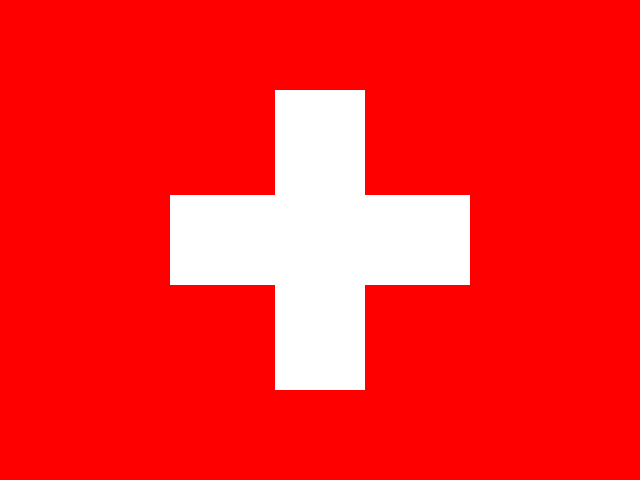
Under Article 3 of the Coat of Arms Protection Act, the Swiss flag shows a Swiss cross in a square field. Under Article 1, the Swiss cross is an upright, free-standing white cross in a red field whose equal arms are each one sixth longer than they are wide. The model in Annex 2 of the Act governs the shape, colour and proportions. The red is defined precisely there:
| Colour system | Value for the red |
|---|---|
| CMYK | 0 / 100 / 100 / 0 |
| Pantone | 485 C / 485 U |
| RGB | 255 / 0 / 0 |
| Hexadecimal | #FF0000 |
| RAL | 3020 traffic red |
| NCS | S 1085-Y90R |
According to the Swiss Armed Forces’ flag regulations, the length of a white arm of the cross relates to the side of the square flag as 20 to 32 in the model. The white is not defined in the Act. The maritime, aviation and military laws are reserved: Swiss ships at sea, for example, fly a rectangular flag in the proportion 2:3.
Who may use the flag
Under Article 10 of the Act, the flags of the Confederation, the cantons, districts, circles and communes may be used by anyone, unless the use is misleading or contrary to public order, morality or the law. The same applies to signs that can be confused with these flags.
The coat of arms is different: the Swiss coat of arms, that is the Swiss cross in a triangular shield, and the coats of arms of the cantons and communes may in principle be used only by the public body to which they belong (Article 8). Exceptions apply, for example, to reference works and to decoration at festivals and events. Someone who orders a flag with the cross in a shield is therefore legally using a coat of arms, not the flag.
How the Act governs use by businesses is explained in the guide to flagpoles for businesses.
Cantonal and communal flags
The coats of arms and flags of the cantons, districts, circles and communes are determined by cantonal law (Article 5). Each of the 26 cantons has its own flag, as do most communes. The flags of the cantons of Schwyz, Lucerne and Ticino differ from their coats of arms; the flag regulations point out that they need particular care when hung. Swiss, cantonal and communal flags flying side by side are the same size under the flag regulations.
Flying times and lighting
There is no rule for private individuals on when a flag is raised or taken in. The Swiss Armed Forces’ flag regulations state for military sites that the Swiss flag flies only by day and is taken in or lit at the latest when darkness falls. The Federal Council’s instructions govern federal buildings by days, not by hours; on 1 August, for example, the flags fly from the last working day before to the first working day after. More in the guide to flag lighting.
Condition of the flag
Under the flag regulations, torn or dirty flags are replaced with new ones, flags that have been taken in are folded neatly, and care is taken during raising that the flag does not touch the ground. These rules apply to the armed forces but describe a widespread practice.
Protection under criminal law
Article 270 of the Criminal Code punishes anyone who maliciously removes, damages or insults by acts a Swiss emblem of sovereignty displayed by an authority, in particular the coat of arms or the flag of the Confederation or of a canton. The penalty is a custodial sentence of up to three years or a monetary penalty. Article 298 contains the same rule for the emblems of foreign states displayed publicly by a recognised representation of that state. Both provisions concern flags of authorities or diplomatic missions, not privately owned flags.
Several flags
When several flags are flown, the flag regulations set the order Confederation, canton, district, commune, then other flags such as school, association or company. With two or more poles, the Swiss flag is always flown. The details are in the guide to flag protocol.
Frequently asked questions
May a private person fly the Swiss flag?
Yes. Under Article 10 of the Coat of Arms Protection Act, the flags of the Confederation, the cantons and the communes may be used unless the use is misleading or contrary to public order, morality or the law. There is no duty to fly a flag.
May the Swiss flag stay up at night?
There is no rule for private individuals. The Swiss Armed Forces’ flag regulations state for military sites that the Swiss flag flies only by day and is taken in or lit at the latest when darkness falls. Many private individuals follow this practice.
Is damaging a Swiss flag a criminal offence?
Article 270 of the Swiss Criminal Code punishes anyone who maliciously removes, damages or insults by acts a Swiss emblem of sovereignty displayed by an authority, in particular the flag of the Confederation or of a canton, with a custodial sentence of up to three years or a monetary penalty. The provision covers flags displayed by an authority.
What is the difference between the Swiss flag and the Swiss coat of arms?
The Swiss flag shows the Swiss cross in a square field, the Swiss coat of arms the Swiss cross in a triangular shield. Anyone may use the flag under Article 10 of the Coat of Arms Protection Act, provided the use is not misleading. The coat of arms may in principle be used only by the Confederation (Article 8).
Sources
This guide is based on the following sources, most of them in German:
- Wappenschutzgesetz (WSchG), SR 232.21, Art. 1, 2, 3, 5, 8 und 10 – Fedlex, Federal Chancellery
- Weisungen über die Beflaggung der Gebäude des Bundes vom 20. April 2016 (BBl 2016 3603) – Swiss Federal Council
- Reglement 51.340 d: Der Umgang mit Fahnen, Standarten und Fanions (Fahnenreglement), Kapitel 5.1 und 6.1 – Swiss Armed Forces
- Schweizerisches Strafgesetzbuch, Art. 270 und 298 – Fedlex, Federal Chancellery
Related guides
- Flag daysFlag days in Switzerland in 2026 and 2027: 1 August, Europe Day, UN Day and cantonal days of the republic, based on federal and cantonal rules.
- Flag protocolOrder of the Swiss, cantonal and communal flags, the place of honour on two to four poles and the order of the cantons and of foreign flags in Switzerland.
- Half-mastHalf-mast in Switzerland: who orders it for federal buildings, how the flag is lowered, what applies with several poles and which flags stay at full mast.
- The Swiss flagWhat the Swiss flag means: the origin of the white cross, its square shape, the colours set by the Coat of Arms Protection Act and its link with the Red Cross.