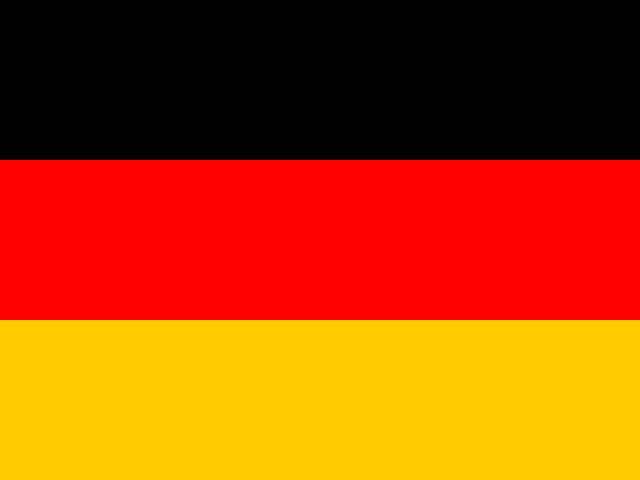
Flagpoles and flag flying in Germany
Published Written by Flagpole Guides
This page is an English translation of the German original. Where the two versions differ, the German text is the original.
In Germany anyone may show the black-red-gold flag – at a family home, in an allotment garden, at a residential complex, at company headquarters or at the town hall. The Federal Government itself speaks of a flag-flying tradition that is restrained compared with other countries. All the more questions arise when a flag is to be flown after all: on which days do authorities fly flags, when is a flag at half-mast, which flag may be used at all, and does a flagpole in the garden need a building permit? This page brings together the essentials of flag flying and flagpoles in Germany, with sources from federal law, state law and the publications of the responsible bodies.
The essentials in brief
- Flag days: the Federal Government’s flag decree lists ten regular flag days, including the Day of German Unity on 3 October and the election days for the Bundestag and the European Parliament. On 27 January and on the National Day of Mourning (Volkstrauertag), flags fly at half-mast. All dates are in the guide to flag days.
- Times: under the decree, flags are flown from daybreak, but not before 7 a.m., until sunset. More in the guide to flag rules.
- Half-mast: the flag is first raised fully and then lowered to half-mast. According to Protokoll Inland, the lower edge of the flag is then at half the height of the pole. More in the guide to half-mast.
- Which flag: anyone is free to use the federal flag. The federal service flag with the federal shield is reserved for federal authorities. More in the guide to flag types.
- Size: there is no official formula. The rule of thumb common in the trade and the standard formats are shown in the flag size calculator.
- Buying: what affects the price is described in the guides to buying a flagpole and buying a flag.
- Building law: under the Model Building Code, masts for flags are exempt from the permit procedure. Which rules still apply is in the guide to flagpole installation.
Laws, decrees and responsible bodies
The federal flag is anchored in the Basic Law (Grundgesetz): under Article 22(2) it is black-red-gold. It is described in more detail by the Order on the German Flags (Anordnung über die deutschen Flaggen) of 13 November 1996, issued by the Federal President on a proposal from the Federal Government: three horizontal stripes of equal width, black at the top, red in the middle and gold at the bottom, in the ratio 3 to 5. The same order describes the federal service flag, the banner form and the standard of the Federal President.
When and how federal buildings fly flags is set out in the Federal Government’s decree on flag flying at federal buildings (Erlass der Bundesregierung über die Beflaggung der Dienstgebäude des Bundes) of 22 March 2005, the flag decree for short. It governs the flag days, the order of several flags, half-mast and the times. The responsible body is the Federal Ministry of the Interior, whose Protokoll Inland division publishes detailed explanations of flag flying. The federal states have their own flag rules for their authorities and in some cases additional flag days.
For private individuals, associations and businesses there is no obligation to fly a flag and there are no binding times. Many nevertheless follow the flag decree, because it describes official practice. The state symbols are protected by criminal law: section 90a of the Criminal Code (StGB) makes it an offence to denigrate the colours and the flag of the Federal Republic, and section 104 StGB protects publicly displayed flags of foreign states.
The flagpole in Germany
There are no nationwide rules for the flagpole itself. Building regulations are a matter for the federal states. The Model Building Code, on which the state building codes are based, lists masts for flags as building projects exempt from the permit procedure. A development plan, heritage protection or rules for advertising installations can still play a role. For stability and fixing, the manufacturers’ specifications are what counts in practice, and they are based on the wind zones under DIN EN 1991-1-4.
In gardens and in front of residential buildings, aluminium poles 6 to 7 metres high are common, while company buildings and town halls often have poles 8 to 10 metres high, frequently in groups for several flags. More in the guides to types of flagpoles and flagpole heights.
About the guides
The guides below are sorted by topic. Each covers one clearly defined subject, ends with frequently asked questions, lists its sources and shows when it was last updated. The flag days are calculated for 2026 and 2027, including the National Day of Mourning, whose date changes every year.
All guides
Flag flying and rules
When, how and why flags are flown in Germany – from the federal flag days to half-mast, mourning and flags of other countries.
- Flag daysAll federal flag days in Germany in 2026 and 2027 with dates and weekdays: full mast and half-mast under the flag decree, plus the yearly special orders.
- Flag rulesTimes, lighting, federal flag or service flag and old flags: which flag rules in Germany are law and which apply only to public authorities.
- Half-mastHalf-mast in Germany: how high the flag hangs, why it is first raised fully, when a mourning ribbon is used instead of half-mast and who orders it.
- Flags in mourningFlags in mourning in Germany: fixed days of remembrance, orders on special occasions, state mourning, mourning ribbons and flags after private bereavements.
- Flags on holidaysWhich holidays in Germany are flag days, why Christmas and Easter are not, and how flags are flown at celebrations, for maypoles and at sporting events.
- Flag protocolThe order of the European, federal, state and municipal flags, the preferred position, flags indoors and ceremonial raising according to Protokoll Inland.
- Foreign flagsForeign flags in Germany: order under the flag decree, protection under section 104 StGB, embassies, the EU and UN flags and prohibited symbols.
The flag
Black-red-gold, flag types, flag sizes and what affects the price of a flag – and a calculator that shows which format suits which pole height.
- Flag typesHoisted flag, banner, portrait, outrigger and hanging flag explained – which forms of the German federal flag are officially permitted. Flagge or Fahne?
- Flag sizesStandard formats of the German federal flag from 100 × 150 to 300 × 500 cm, banners, portrait and table flags – with the trade’s rule of thumb for pole height.
- Flag size calculatorThe calculator shows, for a given flagpole height, the matching standard format of the German federal flag, the rule-of-thumb limit and the portrait flag.
- Black-red-goldWhere black-red-gold comes from, what the colours mean, why it is gold and not yellow, and how the flag became the federal flag between 1832 and 1990.
- Buying a flagBuying a flag in Germany: what affects the price of a German flag – size, fabric, print, stitching – and which flags are officially correct for private use.
The flagpole
Types of pole, materials, heights, accessories, lighting and what affects the price of a flagpole – and the history of flag and pole in Germany.
- Types of flagpolesFlagpoles with external or internal halyard, outrigger and telescopic poles, flagstaffs and roof poles: the types of flagpole in Germany and their uses.
- Flagpole materialsAluminium, GRP, steel and wood compared: weight, corrosion, care, conductivity and recycling of flagpoles in Germany – and what building law requires.
- Flagpole heightsHow tall a flagpole in Germany usually is, which flag suits which height, and what building codes and development plans say about pole height.
- Flagpole accessoriesPole head, pulley, halyard, snap hooks, cleat, ground sleeve, tilting device, outrigger and mourning ribbon: what belongs to a flagpole and what it is for.
- Flagpole mechanicsHow a flagpole works: external and internal halyards, the pulley, rotating pole heads, outriggers, tilting devices and wind forces – with German rules.
- Flag lightingWhat the German flag decree means by a floodlit flag, how flags in mourning are handled at night and what neighbour law and nature conservation law say.
- History of the flagpoleFrom regimental colours on staffs via Hambach 1832 and the Weimar flag dispute to the federal flag decree and the Flag of Unity at the Reichstag.
- Buying a flagpoleBuying a flagpole in Germany: what affects the price – height, material, halyard, foundation, delivery and installation – and buyers’ rights under the BGB.
Installation, safety and care
Building law, foundations, safety, maintenance and transport – for homeowners, owners’ associations, businesses and municipalities.
- Flagpole installationDoes a flagpole in Germany need a building permit? What building codes, development plans, heritage protection and owners’ law say, plus foundations.
- Flagpole safetyFlagpole safety in Germany: stability under building codes, wind zones, liability under section 836 BGB, power lines and why ladders against poles are unsafe.
- Flagpole maintenanceWhat is usually checked when maintaining a flagpole in Germany – pole, foundation, line, pulley and flag – and why section 836 BGB matters.
- Flagpole repairSnapped line, jammed pulley, rattling snap hooks, leaning or cracks: typical damage to a flagpole in Germany, its causes and the usual solutions.
- Lifespan and sustainabilityWhat determines the lifespan of flagpole and flag, how wear can be recognised and how aluminium, GRP and flag fabric are disposed of in Germany.
- Transport and shippingTransporting a flagpole by car, roof rack or trailer in Germany: overhang under section 22 StVO, a red flag from 1 metre, lighting, load securing and length.
- Flagpoles for businessesFlagpoles at company premises in Germany: when an advertising flag needs a permit, where the logo flag hangs, which state symbols are off limits, liability.
Frequently asked questions
May anyone fly the German federal flag?
Yes. According to Protokoll Inland of the Federal Government, anyone is free to use the federal flag, including on days that are not flag days. Private individuals may not, however, use the federal service flag with the federal shield; its unauthorised use is an administrative offence under section 124 of the Administrative Offences Act (OWiG).
Which rules govern flag flying in Germany?
Article 22(2) of the Basic Law states that the federal flag is black-red-gold. Its shape and proportions are set out in the Order on the German Flags of 1996. Flag days, times and half-mast are governed by the Federal Government’s flag decree of 22 March 2005, which applies to federal buildings, not to private individuals.
Does a flagpole need a building permit in Germany?
Under the Model Building Code and, for example, the Bavarian Building Code, masts for flags are exempt from the permit procedure and need no building permit. Building law is, however, a matter for the federal states, and even an exempt pole has to comply with public-law rules, such as a development plan or heritage protection. The building control authority can give information in the individual case.
At what times are flags flown in Germany?
Under the flag decree, flags are flown from daybreak, but not before 7 a.m., until sunset. Floodlit flags may stay up after sunset. These times are not binding on private individuals.
Which flag size suits which flagpole in Germany?
There is no official rule; the flag decree only asks for an appropriate proportion to the building and the pole. A rule of thumb common in the trade is that a hoisted flag in still air covers at most the upper third of the visible pole. For a pole 6 to 7 metres high, the format 100 × 150 cm is often mentioned there.
Sources
This guide is based on the following sources, most of them in German:
- Grundgesetz, Artikel 22 – Bundesministerium der Justiz
- Anordnung über die deutschen Flaggen (FlaggAnO 1996) – Bundesministerium der Justiz
- Erlass der Bundesregierung über die Beflaggung der Dienstgebäude des Bundes vom 22. März 2005 – Bundesministerium des Innern
- Bundesflagge – Protokoll Inland der Bundesregierung
- Musterbauordnung (MBO), § 61 Verfahrensfreie Bauvorhaben – Bauministerkonferenz / DIBt
- § 124 OWiG – Benutzen von Wappen oder Dienstflaggen – Bundesministerium der Justiz