History of the flag and the flagpole in Germany
Published Written by Flagpole Guides
This page is an English translation of the German original. Where the two versions differ, the German text is the original.
The history of the flagpole in Germany is closely tied to the history of the flag. This is already evident in the words: the Fahne was originally a cloth on a portable staff, while the Flagge is hoisted on a fixed pole and taken down again.
Fahne and Flagge
The German language preserves the distinction to this day. According to Protokoll Inland, a Fahne is a cloth that is usually firmly and permanently attached to a staff with nails, and thus a portable individual piece. In a military context especially, losing one’s own regimental colour was considered a disgrace. A Flagge, on the other hand, is hoisted on a pole or staff with a line and can be exchanged at any time. The Bundeswehr has had its own regimental colour (Truppenfahne) since 1964; otherwise official usage speaks of flags, flagpoles and flagstaffs.
Flags of the freedom movement
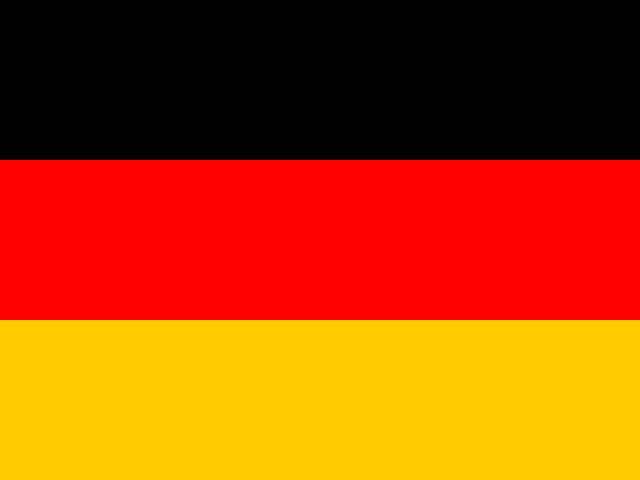
In the 19th century, flags became political symbols. According to the German Bundestag, the original student fraternity in Jena carried a black and red flag with gold decoration. At the Hambach Festival of 1832, many participants brought black-red-gold flags, and in the revolution of 1848/49 the colours were almost everywhere. These were flags in the original sense of Fahnen: carried, not hoisted. More about the history of the colours in the guide to black-red-gold.
Flags at sea and of the state
At sea, flags show which country a ship belongs to. According to Protokoll Inland, Bismarck decreed black-white-red as the flag of the navy and merchant navy of the North German Confederation, which the German Empire adopted as its national flag in 1892. To this day, a separate law in Germany, the Flag Law Act (Flaggenrechtsgesetz), governs which ships fly the federal flag.
In the Weimar Republic, the flag question became a constant dispute. The national colours were black-red-gold, and the merchant flag was black-white-red with the national colours in the upper corner. According to Protokoll Inland, the flag dispute even brought down the national government in 1926.
Flag flying in the Federal Republic
With the Basic Law, black-red-gold became the federal flag in 1949. Since the 1950s, a flag decree of the Federal Government has set when public authorities fly flags. Protokoll Inland names decrees from 1955, 1959, 1983, 1991, 2000 and the current one from 2005, plus an amending decree from 1964. The list of flag days has changed along the way:
| Period | Change |
|---|---|
| 1955–1958 | 7 September as a national day of remembrance, recalling the first sessions of the Bundestag and Bundesrat in 1949 |
| since 1955 | 17 June, first as the “Day of German Unity” |
| 1955–1983 | New Year’s Day as a flag day |
| since 1964 | 20 July |
| since 1983 | Europe Day, on 5 May until 2005 and on 9 May since then |
| since 1991 | 3 October as the Day of German Unity |
| since 2000 | 27 January |
Protokoll Inland still describes the German tradition of flag flying as restrained: only a few buildings fly flags every day, so that the flag days keep their special significance. Current dates are in the guide to flag days.
The Flag of Unity
At midnight on the night of 3 October 1990, the black-red-gold flag was raised in front of the Reichstag building. Today the Flag of Unity flies on the Platz der Republik on a pole 28.5 metres high. According to Protokoll Inland, it stays up permanently, is floodlit in the dark and, unlike the flags on the towers of the Reichstag building, is not lowered to half-mast when flags are in mourning. It has a special symbolic character, even though it is not a monument within the meaning of Berlin’s heritage protection law.
Wood, aluminium and GRP
Wooden poles are rare today; an exception is the maypole, which is put up on 1 May, especially in southern Germany, and which under building law is a mast erected for reasons of custom. Common today are flagpoles of aluminium or glass-fibre reinforced plastic (GRP), often with an internal halyard and a rotating top. More in the guides to flagpole materials and flag types.
Frequently asked questions
Since when has the German federal flag decree existed?
Protokoll Inland refers to flag decrees of the Federal Government from 1955, 1959, 1983, 1991 and 2000 and an amending decree from 1964. The decree in force today dates from 22 March 2005 and has applied since 2 April 2005.
What is the Flag of Unity?
The Flag of Unity flies on the Platz der Republik in front of the Reichstag building in Berlin on a pole 28.5 metres high. According to Protokoll Inland, it stays up permanently, is floodlit in the dark and, when flags are in mourning, is neither lowered to half-mast nor given a mourning ribbon.
Why do Germans say Fahnenmast when officials speak of Flaggen?
According to Protokoll Inland, a Fahne was originally a cloth firmly attached to a staff, while a Flagge is hoisted on a line. Official usage therefore speaks of a Flaggenmast. In everyday speech and in the trade, the word Fahnenmast has nevertheless become established.
Sources
This guide is based on the following sources, most of them in German:
- Flagge oder Fahne? – Protokoll Inland der Bundesregierung
- Bundesflagge – Protokoll Inland der Bundesregierung
- Regelmäßige allgemeine Beflaggungstage – Ein Blick zurück – Protokoll Inland der Bundesregierung
- Arten der Beflaggung – Flagge der Einheit – Protokoll Inland der Bundesregierung
- Gesetzliche Regelungen zu Staatssymbolen und zu deren Verwendung (WD 3 - 3000 - 084/17) – Wissenschaftliche Dienste des Deutschen Bundestages
- Bundesflagge – Glossar – Deutscher Bundestag
Related guides
- Black-red-goldWhere black-red-gold comes from, what the colours mean, why it is gold and not yellow, and how the flag became the federal flag between 1832 and 1990.
- Flag daysAll federal flag days in Germany in 2026 and 2027 with dates and weekdays: full mast and half-mast under the flag decree, plus the yearly special orders.
- Flag typesHoisted flag, banner, portrait, outrigger and hanging flag explained – which forms of the German federal flag are officially permitted. Flagge or Fahne?
- Flagpole materialsAluminium, GRP, steel and wood compared: weight, corrosion, care, conductivity and recycling of flagpoles in Germany – and what building law requires.