Black-red-gold: meaning and history of the German flag
Published Written by Flagpole Guides
This page is an English translation of the German original. Where the two versions differ, the German text is the original.
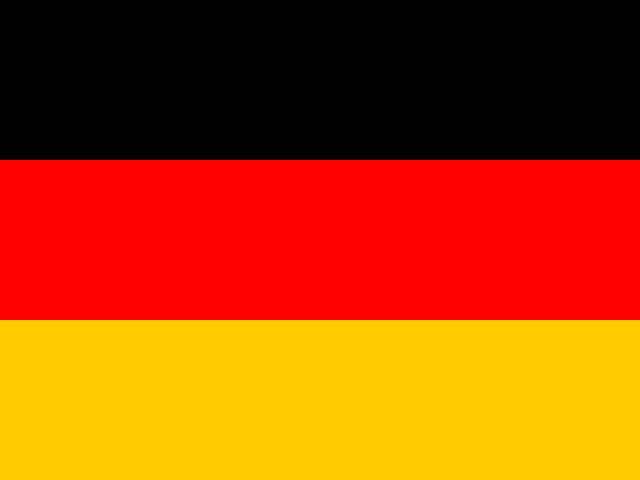
Black, red and gold in three horizontal stripes: that is how the Order on the German Flags describes the federal flag, black at the top, red in the middle and gold-coloured at the bottom. The sequence of colours is older than the German nation state and has had a turbulent history. The German Bundestag calls them the colours of the movement for unity and freedom.
Where the colours come from
According to the German Bundestag, the origin of black-red-gold cannot be clearly proven. After the Wars of Liberation against Napoleon, the colours were traced back to the Lützow Free Corps, whose members wore black uniforms with red piping and gold buttons. The colours became popular through the black and red flag with gold decoration of the original student fraternity in Jena (Jenaer Urburschenschaft), to which former Lützow soldiers belonged. Protokoll Inland names the General German Student Fraternity founded in Jena in 1818, which chose the colours in the belief that they were the colours of the old Empire.
According to the Bundestag, this belief was mistaken, but it gave the colours their national symbolic power. At the Hambach Festival of 1832, many participants carried black-red-gold flags. During the revolution of 1848/49, the colours were almost everywhere. On 9 March 1848, the Frankfurt Federal Assembly, the assembly of envoys of the individual states of the German Confederation, declared black-red-gold the federal colours.
What the colours mean
There is no official interpretation of what black, red and gold each stand for. What matters is the flag as a whole: it became the emblem of national unity and civil liberty. According to Protokoll Inland, a speaker in the Parliamentary Council summed up the tradition as “unity in freedom”.
Black-white-red and the Weimar Republic
After the revolution failed, black-red-gold disappeared as a symbol of the state as a whole. In the course of German unification under Prussian leadership, the colours were replaced at Bismarck’s instigation by black-white-red: black and white were the colours of Prussia, and red, according to the Bundestag, stood for the Hanseatic cities. In 1892 the German Empire adopted black-white-red as its national flag.
The Weimar Republic made black-red-gold the national colours in 1919, but with a compromise: the merchant flag remained black-white-red, with the national colours in the upper inner corner. The flag dispute remained a constant issue; according to Protokoll Inland, it even brought down the national government in 1926. In 1935 the National Socialist regime declared the swastika flag the national flag.
Federal Republic, GDR and reunification
In 1949 the Parliamentary Council decided on black-red-gold with one vote against. Since then, Article 22 of the Basic Law has stated: the federal flag is black-red-gold. The GDR also adopted these colours in 1949 and added its state emblem with hammer, compasses and a wreath of grain in 1959. According to Protokoll Inland, the two German states competed at the Olympic Games under a joint flag until 1968: black-red-gold with the Olympic rings.
During the peaceful revolution of 1989, many people in the GDR cut the emblem out of their flags. At midnight on 3 October 1990, the black-red-gold flag was raised in front of the Reichstag building, and Article 22 of the Basic Law now also applied in the new states. More about the days of remembrance in the guide to flag days.
Gold, not yellow
The Basic Law speaks of gold, and the Order on the German Flags of gold-coloured. The term “black-red-yellow” appears neither in the Basic Law nor in the order. Neither the Basic Law nor the order sets exact colour values such as RAL, Pantone or RGB.
The flag today
According to the German Bundestag, the colours are undisputed today both nationally and internationally, and people in Germany identify with them as rarely before in their history. They are protected by section 90a StGB, which makes denigrating the colours and the flag an offence. What the flag looks like in its various forms is described in the guide to flag types.
Frequently asked questions
What do the colours black, red and gold mean?
There is no official interpretation of the individual colours. According to the German Bundestag, after 1815 the colours were traced back to the black uniforms with red piping and gold buttons of the Lützow Free Corps. As a whole they stand for the 19th-century movement for unity and freedom and for democracy.
Is it black-red-gold or black-red-yellow?
Article 22(2) of the Basic Law states: the federal flag is black-red-gold. The Order on the German Flags describes the lower stripe as gold-coloured. The term black-red-yellow is not used officially.
Since when has black-red-gold been the German flag?
The colours were declared federal colours by the Frankfurt Federal Assembly in 1848, were the national colours of the Weimar Republic from 1919 and have been the colours of the federal flag under Article 22 of the Basic Law since 1949. Since 3 October 1990 this has also applied to the new states.
What are the colour values of the German flag?
Neither the Basic Law nor the Order on the German Flags sets colour values such as RAL, Pantone or RGB. The order only speaks of black, red and gold-coloured.
Sources
This guide is based on the following sources, most of them in German:
- Bundesflagge – Protokoll Inland der Bundesregierung
- Bundesflagge – Glossar – Deutscher Bundestag
- Grundgesetz, Artikel 22 – Bundesministerium der Justiz
- Anordnung über die deutschen Flaggen (FlaggAnO 1996) – Bundesministerium der Justiz
- § 90a StGB – Verunglimpfung des Staates und seiner Symbole – Bundesministerium der Justiz
- Gesetzliche Regelungen zu Staatssymbolen und zu deren Verwendung (WD 3 - 3000 - 084/17) – Wissenschaftliche Dienste des Deutschen Bundestages
Related guides
- History of the flagpoleFrom regimental colours on staffs via Hambach 1832 and the Weimar flag dispute to the federal flag decree and the Flag of Unity at the Reichstag.
- Flag typesHoisted flag, banner, portrait, outrigger and hanging flag explained – which forms of the German federal flag are officially permitted. Flagge or Fahne?
- Flag sizesStandard formats of the German federal flag from 100 × 150 to 300 × 500 cm, banners, portrait and table flags – with the trade’s rule of thumb for pole height.
- Flag daysAll federal flag days in Germany in 2026 and 2027 with dates and weekdays: full mast and half-mast under the flag decree, plus the yearly special orders.