Flag types in Germany: hoisted flag, banner, portrait flag and more
Published Written by Flagpole Guides
This page is an English translation of the German original. Where the two versions differ, the German text is the original.
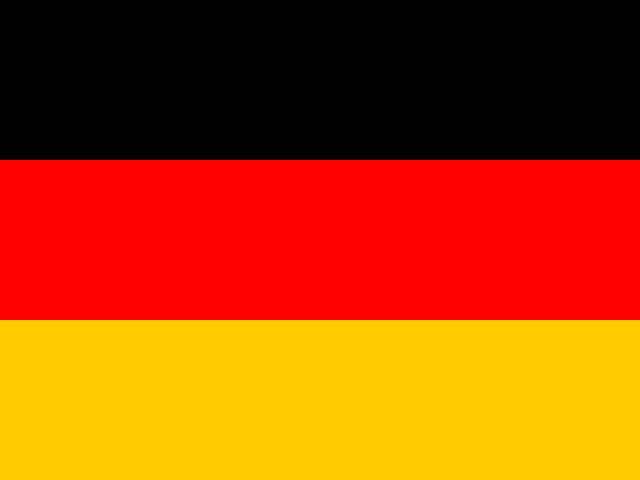
In everyday German most people say “Deutschlandfahne”, and shops talk about Hissfahnen, Knatterfahnen and Bannerfahnen. The Federal Government, on the other hand, almost exclusively speaks of flags (Flaggen). Behind the terms are different forms that differ in how the cloth hangs on the pole. Which form suits which pole depends above all on the mechanics. And for the federal flag, a clear restriction applies in official use.
Flagge or Fahne?
Protokoll Inland explains the difference like this: a Flagge is a usually rectangular cloth with standardised dimensions that is raised on a pole or staff with a line and is not permanently attached to it. It can be exchanged at any time. A Fahne, on the other hand, is a cloth firmly and permanently attached to a staff, formerly with nails, and thus a portable individual piece.
The Basic Law, the Order on the German Flags and the flag decree therefore speak of the Bundesflagge (federal flag). Exceptions in official usage are the regimental colours (Truppenfahnen) of the Bundeswehr. In the trade and in everyday speech, “Fahne” and “Fahnenmast” are nevertheless the more common words.
Flag types at a glance
| Type | How it hangs | Federal flag officially permitted? |
|---|---|---|
| Hoisted flag (Hissflagge) | landscape, raised on the pole by its short side | yes |
| Banner | fixed to a crossbar, hanging vertically | yes |
| Portrait flag (Hochformatflagge, Knatterflagge) | portrait, raised on the pole by its long side | no |
| Outrigger flag (Auslegerflagge) | portrait flag, additionally fixed to an arm at the top | no |
| Hanging flag (Hängeflagge) | on a staff projecting horizontally from the building | no |
Hoisted flag
According to Protokoll Inland, the hoisted flag is the most common type of flag nationally and internationally. Its proportions are usually 2 to 3, as with the European flag, or 3 to 5, as with the federal flag. With horizontally striped flags, the stripes are described from top to bottom; with vertically striped flags, from the staff to the flying end.
Banner
With a banner, the cloth is firmly attached to a crossbar that is hoisted up the pole. The stripes of the federal flag then run vertically: black on the left, red in the middle and gold on the right, as the Order on the German Flags states. According to Protokoll Inland, banners are considerably taller than they are wide, often in the ratio 1 to 4. In mourning they are not lowered to half-mast but given a mourning ribbon.
Portrait, outrigger and hanging flags
The portrait flag, also called Knatterflagge, is a hoisted flag that is considerably taller than it is wide. Its proportions and the arrangement of the stripes are not fixed. The outrigger flag is a portrait flag additionally hung from a horizontal arm at the top; according to Protokoll Inland, it is therefore fully visible even in still air. The hanging flag hangs from a staff projecting horizontally from a house wall and is often confused with the banner.
Because the Order on the German Flags only describes the hoisted flag and the banner, these three forms are not permitted for the federal flag and the federal service flag in official use by the Federation, states and municipalities. Protokoll Inland remarks critically that with national flags, a “better look” is often put before respect for the state symbol. There is no equivalent rule for private individuals and businesses; portrait and outrigger flags are widespread for company flags with a logo.
Flagstaff, table flag and pennant
- Flagstaff: a staff attached horizontally or at an angle to a façade. Under the flag decree it is only used when a vertical pole is not possible, for example when an office only uses part of a building.
- Table flag: according to Protokoll Inland, usually 15 × 25 cm, or 20 × 20 cm if square.
- Car pennant (Stander): small flags on the wings of official vehicles. The Order on the German Flags sets out which office holders fly which pennant, from the Federal President to heads of federal authorities.
Federal flag, federal service flag and state flags
Besides their form, flags differ in their design. Anyone may use the black-red-gold federal flag. The federal service flag with the federal shield is reserved for federal bodies. The states also have state flags and state service flags. More about the colours and history in the guide to black-red-gold, and the matching dimensions in the guide to flag sizes.
Frequently asked questions
What is the difference between Flagge and Fahne in German?
According to Protokoll Inland, a Flagge is a cloth raised on a pole with a line and not permanently attached to it. A Fahne, on the other hand, is firmly and permanently attached to a staff, such as a regimental colour. In official federal usage, the term is therefore Bundesflagge, not Deutschlandfahne.
What is a Knatterflagge?
Knatterflagge is another name for the portrait flag (Hochformatflagge), a hoisted flag that is considerably taller than it is wide. Its proportions and the arrangement of the stripes are not fixed. According to Protokoll Inland, the federal flag as a portrait flag is not permitted in official use.
Which forms of the German federal flag are officially permitted?
Under the Order on the German Flags, the federal flag and the federal service flag exist as a landscape hoisted flag in the ratio 3 to 5 and in banner form. According to Protokoll Inland, portrait, outrigger and hanging flags are not permitted in official use by the Federation, states and municipalities.
May private individuals use a black-red-gold portrait flag?
The restriction to the hoisted flag and the banner applies to official use. There is no rule on which form private individuals use. Black-red-gold portrait and outrigger flags are widely sold.
Sources
This guide is based on the following sources, most of them in German:
- Arten von Flaggen – Protokoll Inland der Bundesregierung
- Flagge oder Fahne? – Protokoll Inland der Bundesregierung
- Anordnung über die deutschen Flaggen (FlaggAnO 1996) – Bundesministerium der Justiz
- Erlass der Bundesregierung über die Beflaggung der Dienstgebäude des Bundes vom 22. März 2005, Abschnitt V – Bundesministerium des Innern
Related guides
- Flag sizesStandard formats of the German federal flag from 100 × 150 to 300 × 500 cm, banners, portrait and table flags – with the trade’s rule of thumb for pole height.
- Black-red-goldWhere black-red-gold comes from, what the colours mean, why it is gold and not yellow, and how the flag became the federal flag between 1832 and 1990.
- Flag rulesTimes, lighting, federal flag or service flag and old flags: which flag rules in Germany are law and which apply only to public authorities.
- Flag size calculatorThe calculator shows, for a given flagpole height, the matching standard format of the German federal flag, the rule-of-thumb limit and the portrait flag.
- Buying a flagBuying a flag in Germany: what affects the price of a German flag – size, fabric, print, stitching – and which flags are officially correct for private use.