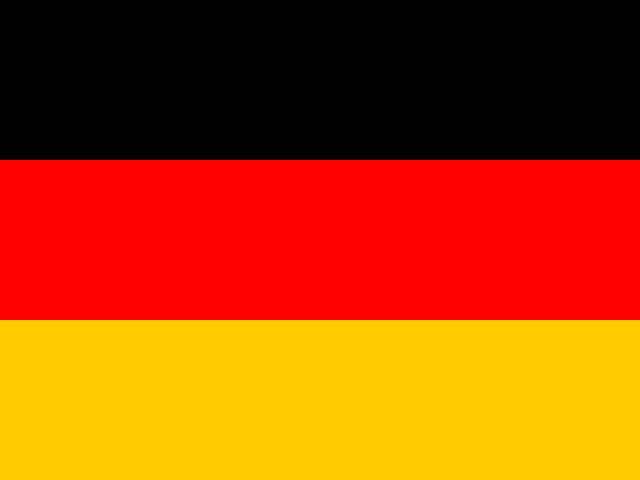
Half-mast in Germany – rules and procedure
Published Written by Flagpole Guides
This page is an English translation of the German original. Where the two versions differ, the German text is the original.
A flag at half-mast is the most visible sign of public mourning in Germany. Exactly how flags are flown at half-mast is set out for federal buildings in the Federal Government’s flag decree. More detailed explanations are published by Protokoll Inland, the division of the Federal Ministry of the Interior responsible for flag flying. Private flag owners are not bound by these rules, but many follow them.
How high the flag hangs
According to Protokoll Inland, the lower edge of a hoisted flag is at half the height of the flagpole. On an 8-metre pole, the lower edge therefore hangs at about 4 metres. There is no specification in centimetres and no formula as in some other countries.
| Pole height | Lower edge of the flag at half-mast |
|---|---|
| 6 m | about 3 m |
| 7 m | about 3.5 m |
| 8 m | about 4 m |
| 10 m | about 5 m |
According to Protokoll Inland, flags on poles mounted on roofs are also flown at half-mast when flags in mourning have been ordered.
The procedure
The flag decree describes a fixed procedure, which Protokoll Inland supplements:
- The flag is first raised fully, all the way to the top of the pole.
- Immediately afterwards it is lowered to half-mast.
- At the end of the mourning period, the flag is raised fully again and only then taken down.
According to Protokoll Inland, flags at half-mast get no additional mourning ribbon. The times are the same as for any flag flying: from daybreak, but not before 7 a.m., until sunset. According to Protokoll Inland, even with flags that fly permanently and are floodlit, flying at half-mast only begins at daybreak and ends at sunset. If it extends over several days, floodlit flags can stay at half-mast throughout.
Mourning ribbon instead of half-mast
Some flags cannot be lowered to half-mast. For these, the decree provides for a mourning ribbon (Trauerflor), a black band that according to Protokoll Inland is preferably made of the same material as the flag.
- Banners are never lowered to half-mast. A mourning ribbon is tied to each end of the crossbar; its total length equals twice the width of the banner, and it is 20 cm wide.
- Hoisted flags on flagstaffs or on poles without a halyard get a mourning ribbon, usually tied at the upper corner on the pole side. Its total length equals twice the height of the flag, and it is 10 cm wide for small flags and 20 cm for large outdoor flags.
- Table flags are neither lowered to half-mast nor given a mourning ribbon.
Protokoll Inland gives guide dimensions, such as a mourning ribbon of 300 × 10 cm for a hoisted flag of 150 × 250 cm and 400 × 20 cm for a flag of 200 × 335 cm.
Several flags
When the federal flag or federal service flag is lowered to half-mast, under the decree the same applies to the European flag. Flags of foreign states and international organisations, on the other hand, stay at full mast. State and municipal flags also stay at full mast if the state or municipality has not ordered its own mourning. According to Protokoll Inland, in such cases it can look more uniform to give the federal and European flags a mourning ribbon instead of showing half-mast and full mast side by side.
An exception is the standard of the Federal President: it is not lowered to half-mast during mourning, except on the death of the incumbent Federal President. The “Flag of Unity” in front of the Reichstag building also stays at full mast during mourning.
When flags fly at half-mast
Without a special order, flags fly at half-mast in Germany twice a year: on 27 January, the Day of Remembrance for the Victims of National Socialism, and on the National Day of Mourning (Volkstrauertag). In addition, every year on 11 March there is the National Day of Remembrance for the Victims of Terrorist Violence. On special occasions, such as the death of senior representatives or after disasters, the Federal Ministry of the Interior orders flags at half-mast. More in the guide to flags in mourning; all dates are in the guide to flag days.
Half-mast on a private pole
There is no obligation for private flagpoles to join official mourning. Those who do can follow the official procedure. On poles with an external or internal halyard, the flag can be set at half height. With outrigger flags this is only possible if the outrigger with the flag can be lowered; otherwise the mourning ribbon remains. More about the mechanics in the guide to flagpole mechanics.
Frequently asked questions
How high does a flag hang at half-mast in Germany?
According to the explanations by Protokoll Inland of the Federal Government, the lower edge of a hoisted flag is at half the height of the flagpole. There is no specification in centimetres.
Why is the flag first raised all the way before half-mast?
For federal buildings, the flag decree stipulates that flags are first raised fully and immediately afterwards lowered to half-mast when flying in mourning. According to Protokoll Inland, at the end the flag is also first raised fully again before it is taken down.
What is a mourning ribbon (Trauerflor)?
A mourning ribbon is a black band attached to flags that cannot be lowered to half-mast, such as banners or flags on flagstaffs. According to Protokoll Inland, its total length is twice the height of the hoisted flag or the width of the banner.
Who orders half-mast in Germany?
For federal buildings, the Federal Ministry of the Interior orders flags at half-mast on special occasions, and the Federal Government does so in cases of particular importance. Under the flag decree, flags fly at half-mast on 27 January and on the National Day of Mourning without a special order. The federal states issue orders for their own authorities.
Is the European flag also lowered to half-mast in Germany?
Yes. Under section V(4) of the flag decree, the European flag is lowered to half-mast when the federal flag or the federal service flag is at half-mast. Flags of foreign states and international organisations are exempt.
Sources
This guide is based on the following sources, most of them in German:
- Erlass der Bundesregierung über die Beflaggung der Dienstgebäude des Bundes vom 22. März 2005, Abschnitt V Absatz 4 – Bundesministerium des Innern
- Arten der Beflaggung – Trauerbeflaggung – Protokoll Inland der Bundesregierung
- Flaggenzeremoniell – Protokoll Inland der Bundesregierung
Related guides
- Flags in mourningFlags in mourning in Germany: fixed days of remembrance, orders on special occasions, state mourning, mourning ribbons and flags after private bereavements.
- Flag rulesTimes, lighting, federal flag or service flag and old flags: which flag rules in Germany are law and which apply only to public authorities.
- Flag daysAll federal flag days in Germany in 2026 and 2027 with dates and weekdays: full mast and half-mast under the flag decree, plus the yearly special orders.
- Flagpole mechanicsHow a flagpole works: external and internal halyards, the pulley, rotating pole heads, outriggers, tilting devices and wind forces – with German rules.