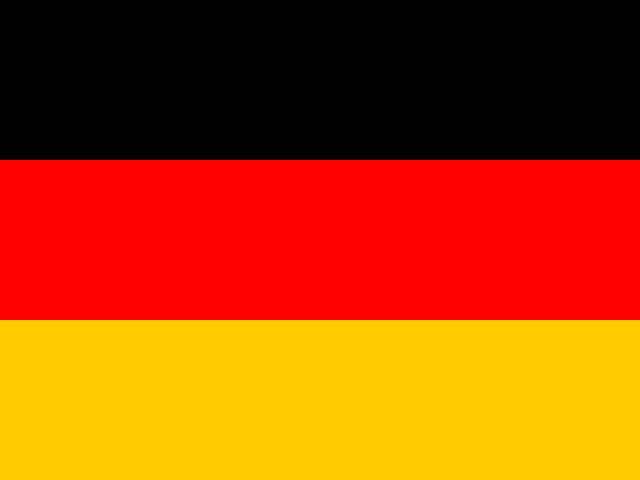
Flag protocol in Germany: order and ceremony
Published Written by Flagpole Guides
This page is an English translation of the German original. Where the two versions differ, the German text is the original.
Where several flags fly side by side, the question of order arises. In Germany it is answered for the Federation by the Federal Government’s flag decree, supplemented by the explanations of Protokoll Inland. States and municipalities have their own rules, which can differ. For businesses, associations and private individuals these rules are not binding, but they offer a recognised order that many follow.
The preferred position
The decree speaks of the preferred position (bevorzugte Stelle). It is on the left-hand side, as seen from outside looking at the building. Anyone standing in front of the building and looking at it therefore sees the highest-ranking flags on the left. The European flag and the federal flag or federal service flag are generally placed there.
The order under the flag decree
From the preferred position, section V(2) of the decree applies:
- Flags of international and supranational organisations, such as the United Nations, NATO and the European Union
- Flags of foreign states, in alphabetical order of the official German short name
- Federal service flag or federal flag
- Flags of the states, in alphabetical order
- Flags of municipalities and associations of municipalities
With four poles, this gives from left to right: Europe – Federation – state – municipality. Which flags are flown at all is governed by section IV: federal authorities fly the federal service flag and, where technically possible, the European flag. State and municipal flags are added for regional and local occasions. Federal authorities fly other flags only with the approval of the Federal Ministry of the Interior.
Under the decree, several flags on one building are to be the same size. Notes on the order with foreign flags are in the guide to foreign flags in Germany.
Flags indoors
Indoors, the same order applies at federal events, read from left to right. Protokoll Inland describes several special cases:
- Bilateral press conference: the European flag stands in the middle. The host stands in front of the federal flag, and the guest to the host’s right in front of the flag of their state.
- EU events: the flags of the member states follow the “EU alphabet”, the names of the states in their own languages, from Belgique/België to Sverige.
- Presidencies: at meetings held under a presidency, the flags can stand in the order of the presidencies.
- Event hosted by a state or city: if a state or municipality hosts the event, for example for an entry in the Golden Book, its rules apply.
- Table flags: usually 15 × 25 cm, square flags 20 × 20 cm. They are neither lowered to half-mast nor given a mourning ribbon.
In offices and foyers, Protokoll Inland recommends keeping in principle to the same order as outdoors and adapting the size of the flags to the room.
Ceremonial raising
According to Protokoll Inland, there is no binding rule, apart from the Bundeswehr, for a flag ceremony in Germany. For formal occasions, such as the accreditation of an ambassador, Protokoll Inland describes the following procedure:
- The folded flag is attached with all hooks to the flag line, the halyard.
- The person to the left of the pole, facing the building, pulls the line slowly and evenly.
- A second person carries the folded flag on their forearms, steps back a few paces and spreads the corners at the flying end.
- During the raising, care is taken that the flag does not touch the ground.
- The flag is raised to the top. When flags are in mourning, it is then lowered to half-mast.
In the Bundeswehr, according to Protokoll Inland, the federal service flag is raised every day at the flag parade. More about the procedure in mourning in the guide to flags in mourning.
Flags the right way up
Protokoll Inland points out common mistakes. The European flag is upside down when the points of the stars face downwards. On the Union Jack, at the corners nearest the pole, the broad white stripe lies above the narrow red one. The flags of Poland and of Indonesia or Monaco differ only in which colour is at the top; the same applies to the state flags of Thuringia and Hesse. The Swiss flag is square and, on official occasions, is chosen large enough for its area to match that of the rectangular flag next to it.
Frequently asked questions
In what order are flags flown in Germany?
Under section V(2) of the flag decree, as seen from the preferred position: flags of international organisations, flags of foreign states in alphabetical order, the federal flag or federal service flag, state flags in alphabetical order and finally municipal flags.
Where is the preferred position?
Under the flag decree, the preferred positions are on the left-hand side, as seen from outside looking at the building, site or facility. The European flag and the federal flag or federal service flag are placed there.
Is there a rule for ceremonially raising a flag in Germany?
According to Protokoll Inland, apart from the Bundeswehr there is no binding rule for a flag ceremony in Germany. Protokoll Inland does, however, describe a procedure in which the flag is raised slowly and evenly and does not touch the ground.
How large are table flags usually?
According to Protokoll Inland, table flags are usually 15 × 25 cm, and 20 × 20 cm for a square format such as the Swiss flag. Table flags are neither lowered to half-mast nor given a mourning ribbon.
Sources
This guide is based on the following sources, most of them in German:
- Erlass der Bundesregierung über die Beflaggung der Dienstgebäude des Bundes vom 22. März 2005, Abschnitte IV und V – Bundesministerium des Innern
- Arten der Beflaggung – Außen- und Innenbeflaggung – Protokoll Inland der Bundesregierung
- Flaggenzeremoniell – Protokoll Inland der Bundesregierung
Related guides
- Foreign flagsForeign flags in Germany: order under the flag decree, protection under section 104 StGB, embassies, the EU and UN flags and prohibited symbols.
- Flags in mourningFlags in mourning in Germany: fixed days of remembrance, orders on special occasions, state mourning, mourning ribbons and flags after private bereavements.
- Flag typesHoisted flag, banner, portrait, outrigger and hanging flag explained – which forms of the German federal flag are officially permitted. Flagge or Fahne?
- Flagpoles for businessesFlagpoles at company premises in Germany: when an advertising flag needs a permit, where the logo flag hangs, which state symbols are off limits, liability.