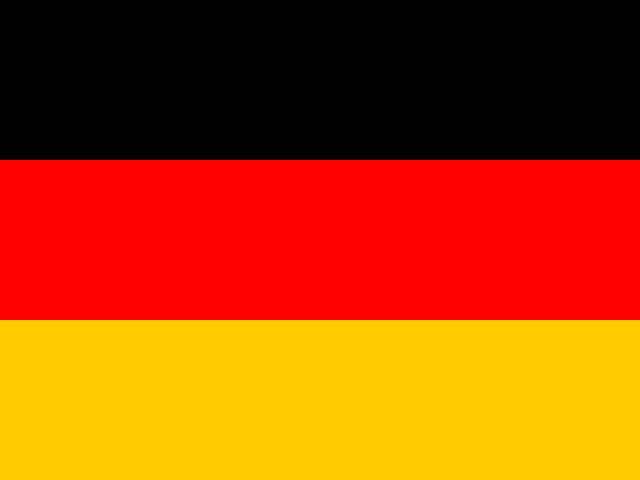
Foreign flags in Germany
Published Written by Flagpole Guides
This page is an English translation of the German original. Where the two versions differ, the German text is the original.
Flags of other states are an everyday sight in Germany: in front of embassies and consulates, hotels and exhibition halls, at company headquarters with international guests and in the gardens of people who want to show their origins. There are hardly any rules for private individuals and businesses. For public authorities, the Federal Government’s flag decree governs when and in what order foreign flags are flown.
Who may show foreign flags
- Private individuals, associations and businesses may show the flags of other states. No permission is required.
- Federal authorities fly foreign flags under section IV(4) of the decree only on special occasions. The Federal Ministry of the Interior decides in agreement with the Federal Foreign Office, and on purely military occasions the Federal Ministry of Defence.
- Embassies and consulates fly flags on their buildings under international law: Article 20 of the Vienna Convention on Diplomatic Relations allows the mission and its head to use the flag of the sending state. According to Protokoll Inland, how this is done is decided by the sending state itself; the German flag rules do not bind foreign missions.
The order
When foreign flags hang next to the federal flag, section V(2) of the decree applies, as seen from the preferred position:
| Position | Flag |
|---|---|
| 1 | International and supranational organisations, such as the UN, NATO and the EU |
| 2 | Foreign states, in alphabetical order of the official German short name |
| 3 | Federal flag or federal service flag |
| 4 | State flags, in alphabetical order |
| 5 | Municipal flags |
The preferred position is on the left, as seen from outside looking at the building. What counts is the German short form of the state’s name: “Frankreich” (France) therefore comes before “Italien” (Italy), and “Vereinigtes Königreich” (United Kingdom) after “Spanien” (Spain). At EU events, on the other hand, according to Protokoll Inland the “EU alphabet” applies, with the names of the states in their official languages. More about the order in the guide to flag protocol.
The European flag and the UN flag
According to the description quoted by Protokoll Inland, the European flag shows twelve golden five-pointed stars in a circle on an azure background, in the ratio 2 to 3. The stars stand upright, with one point at the top; if the points face downwards, the flag is upside down. Under the flag decree, federal authorities fly it next to the federal service flag where the technical conditions allow.
According to Protokoll Inland, the flag of the United Nations is regarded as a sovereign symbol of the member states. As the flag of an international organisation, it comes before the flags of states in the order.
State visits
During a state visit, according to Protokoll Inland, flags are flown not only at the buildings visited in Berlin but also along the so-called protocol route. If the visit coincides with flags in mourning, foreign flags generally stay at full mast. More in the guide to flags in mourning.
Protection of foreign flags
Under section 104 StGB, anyone who removes, destroys, damages or defaces a flag of a foreign state that is publicly displayed under legal provisions or recognised custom, or commits insulting mischief on it, is liable to punishment. So is anyone who publicly destroys or damages the flag of a foreign state and thereby denigrates it. This also applies to flags that can be confused with the state flag. The penalty is up to two years’ imprisonment.
Prohibited symbols
A different matter are the symbols of unconstitutional and terrorist organisations. Under section 86a StGB, it is an offence to use them publicly in Germany; flags are expressly named. This concerns, for example, the flags of banned parties and associations, but not the national flags of recognised states.
Businesses with international guests
When foreign delegations visit, a business can raise their flag as a gesture of hospitality. There is no rule on this for private flagpoles. Those who want to follow the official order fly the flags in the same size and in the order of the decree. More about company flagpoles in the guide to flagpoles for businesses.
Frequently asked questions
May a foreign flag be flown in Germany?
Yes. There is no ban on private individuals, associations and businesses showing the flags of other states. Federal authorities, on the other hand, fly foreign flags under the flag decree only with the approval of the Federal Ministry of the Interior, which decides in agreement with the Federal Foreign Office.
How are foreign flags arranged next to the German federal flag?
Under section V(2) of the flag decree, as seen from the preferred position on the left, first come the flags of international organisations, then foreign states in alphabetical order of the official German short name, then the federal flag, the state flags and the municipal flags.
Is it an offence to damage a foreign flag in Germany?
Under section 104 StGB, it is an offence to remove, destroy, damage or deface a flag of a foreign state that is publicly displayed under legal provisions or recognised custom. It is also an offence to publicly destroy or damage the flag of a foreign state and thereby denigrate it.
Which flags are prohibited in Germany?
Under section 86a StGB, it is an offence to publicly use symbols of unconstitutional and terrorist organisations. These symbols expressly include flags, as well as symbols that can be confused with them. National flags of recognised states are not covered.
Sources
This guide is based on the following sources, most of them in German:
- Erlass der Bundesregierung über die Beflaggung der Dienstgebäude des Bundes vom 22. März 2005, Abschnitte IV und V – Bundesministerium des Innern
- Beflaggung diplomatischer Vertretungen – Protokoll Inland der Bundesregierung
- Hinweise zur Beflaggung – Protokoll Inland der Bundesregierung
- § 104 StGB – Verletzung von Flaggen und Hoheitszeichen ausländischer Staaten – Bundesministerium der Justiz
- § 86a StGB – Verwenden von Kennzeichen verfassungswidriger und terroristischer Organisationen – Bundesministerium der Justiz
Related guides
- Flag protocolThe order of the European, federal, state and municipal flags, the preferred position, flags indoors and ceremonial raising according to Protokoll Inland.
- Flagpoles for businessesFlagpoles at company premises in Germany: when an advertising flag needs a permit, where the logo flag hangs, which state symbols are off limits, liability.
- Flag daysAll federal flag days in Germany in 2026 and 2027 with dates and weekdays: full mast and half-mast under the flag decree, plus the yearly special orders.
- Flag rulesTimes, lighting, federal flag or service flag and old flags: which flag rules in Germany are law and which apply only to public authorities.