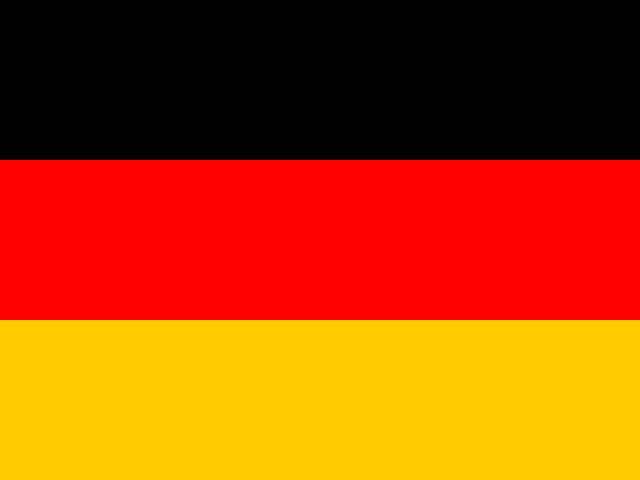
Flag rules in Germany
Published Written by Flagpole Guides
This page is an English translation of the German original. Where the two versions differ, the German text is the original.
Many people assume that a law governs when and how flags are flown in Germany. In fact there are two levels. The Basic Law and the Order on the German Flags set out what the flags look like and who flies which flag. When and how flags are flown, on the other hand, is set out in an administrative regulation, the Federal Government’s flag decree of 22 March 2005. It binds federal bodies. For private individuals, associations and businesses it is guidance, not an obligation.
Times
| Situation | Rule under the flag decree |
|---|---|
| Start of flag flying | at daybreak, but not before 7 a.m. |
| End of flag flying | at sunset |
| Flags flown over several days | flags are taken down at sunset and raised again in the morning |
| Floodlit flags | may stay up after sunset |
Unlike in Scandinavia, for example, the decree gives no fixed time for taking the flag down, but sunset. In summer the flag therefore stays up considerably longer than in winter. What “floodlit” means is explained in more detail by Protokoll Inland: not the diffuse light of a street lamp, but lighting that keeps the flag clearly visible in the dark. More in the guide to flag lighting.
Who the rules apply to
The decree applies to all federal authorities and bodies and to corporations, institutions and foundations under public law that are supervised by federal authorities. The federal states have their own decrees for their authorities, which follow the federal rules on many points. Depending on the state, municipalities have their own rules.
There is no rule on when a flag is flown from a private pole. Anyone who permanently shows a flag in their garden breaks no rule. It is nevertheless common to follow the official times, especially on flag days and when flags are at half-mast.
Federal flag or federal service flag
Germany has two flags in black-red-gold:
- Federal flag (Bundesflagge): three horizontal stripes of equal width, black at the top, red in the middle and gold at the bottom, in the ratio 3 to 5. According to Protokoll Inland, anyone is free to use it.
- Federal service flag (Bundesdienstflagge): the same stripes with the federal shield, shifted slightly towards the pole. Under the Order on the German Flags, it is reserved for federal bodies. Unauthorised use of a service flag of the Federation or a state is an administrative offence under section 124 OWiG that can be punished with a fine. This also applies to flags that can be confused with it.
Protokoll Inland points out that many “flags with an eagle” sold in shops do not show the federal service flag at all, but the centred federal coat of arms. This flag has no official definition; Protokoll Inland informally calls it a “federal coat-of-arms flag” (Bundeswappenflagge). The same rule as for the Federation applies in the states: besides the state flag there is usually a state service flag with the coat of arms, reserved for the authorities.
Further rules in the flag decree
- Vertical poles: under the decree, flags are flown on vertical flagpoles. Horizontal or angled flagstaffs are only used where that is not possible.
- Raising and lowering: flags that can be hoisted up and lowered on the pole are to be used.
- Size: under the decree, the size of the flags has to be in appropriate proportion to the size of the building and the pole. Several flags on one building are to be the same size.
- Form: only the forms in the Order on the German Flags are permitted, namely the hoisted flag and the banner. Portrait flags, outrigger flags and hanging flags are not provided for in official use. More in the guide to flag types.
Protection of the flag
The Criminal Code protects the state symbols. Under section 90a StGB, anyone who publicly denigrates the colours, the flag, the coat of arms or the anthem of the Federal Republic or of a state is liable to punishment. It is also an offence to remove, destroy, damage or deface a publicly displayed federal or state flag. Anyone who flies their own flag on their own property does not commit an offence, even if the flag is faded or frayed. Out of respect for the state symbol, it is nevertheless customary to replace a flag that has become shabby.
Old flags
There is no special rule on disposing of a worn-out flag. Most flags today are made of polyester. Since 1 January 2025, public waste management authorities have been required under section 20 KrWG to collect textile waste from households separately. Exactly how this is arranged locally differs from municipality to municipality.
Frequently asked questions
At what time is the flag raised in Germany?
Under section V(5) of the flag decree, flags are flown from daybreak, but not before 7 a.m., until sunset. These times apply to federal buildings. There are no prescribed times for private individuals.
May a flag stay up overnight in Germany?
Under the flag decree, floodlit flags may stay up after sunset. Protokoll Inland explains that this means clear lighting and not the diffuse light of a street lamp. There is no rule for private flagpoles.
May the federal service flag with the eagle be bought and flown?
Under the Order on the German Flags, the federal service flag is flown by federal bodies. Anyone who uses it without authorisation commits an administrative offence under section 124 OWiG; this also applies to flags that can be confused with it. According to Protokoll Inland, however, many eagle flags sold in shops do not show the federal shield but the federal coat of arms.
Is it illegal to damage the German flag?
Under section 90a of the Criminal Code, it is an offence to publicly denigrate the colours or the flag of the Federal Republic, or to remove, destroy or damage a publicly displayed federal or state flag. Section 104 StGB applies to foreign flags.
What happens to an old, worn-out flag in Germany?
There is no rule on this for private individuals. Flags today are mostly made of polyester and thus count as textile waste, which public waste management authorities have been required to collect separately under section 20 KrWG since 1 January 2025. The local waste authority can say which collection point accepts such fabrics.
Sources
This guide is based on the following sources, most of them in German:
- Erlass der Bundesregierung über die Beflaggung der Dienstgebäude des Bundes vom 22. März 2005 – Bundesministerium des Innern
- Anordnung über die deutschen Flaggen (FlaggAnO 1996) – Bundesministerium der Justiz
- Bundesflagge – Protokoll Inland der Bundesregierung
- Hinweise zur Beflaggung – Protokoll Inland der Bundesregierung
- § 90a StGB – Verunglimpfung des Staates und seiner Symbole – Bundesministerium der Justiz
- § 124 OWiG – Benutzen von Wappen oder Dienstflaggen – Bundesministerium der Justiz
- § 20 KrWG – Pflichten der öffentlich-rechtlichen Entsorgungsträger – Bundesministerium der Justiz
Related guides
- Flag daysAll federal flag days in Germany in 2026 and 2027 with dates and weekdays: full mast and half-mast under the flag decree, plus the yearly special orders.
- Half-mastHalf-mast in Germany: how high the flag hangs, why it is first raised fully, when a mourning ribbon is used instead of half-mast and who orders it.
- Flag lightingWhat the German flag decree means by a floodlit flag, how flags in mourning are handled at night and what neighbour law and nature conservation law say.
- Flag typesHoisted flag, banner, portrait, outrigger and hanging flag explained – which forms of the German federal flag are officially permitted. Flagge or Fahne?