Flag size calculator: size by pole height in France
Published Written by Flagpole Guides
This page is an English translation of the French original. Where the two versions differ, the French text is the original.
What size of flag suits a pole? In France, no text sets it. The calculator below shows the standard size from a French flag maker’s table for the chosen pole height, and then, for that size, the width of the three bands of the tricolour and of the bands of the naval ensign.
Calculator
How it is calculated
- Nearest standard size: the size in the table of the flag maker Doublet for the chosen pole height. The rows of the table meet at their limits (3, 4, 6, 8 and 10 metres); for these heights, the calculator shows both sizes.
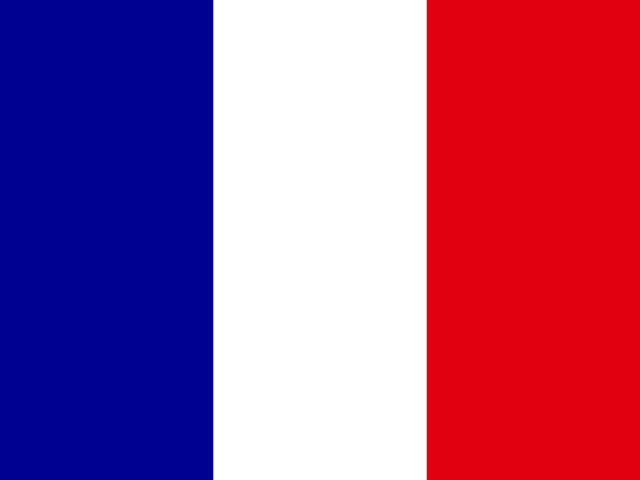
- Equal bands: for the larger of the sizes found, the length divided into three equal bands, blue, white and red, as on the tricolour.
- Bands of the naval ensign: for the same size, 30% of the length for the blue, 33% for the white and 37% for the red, under the 1836 table cited by the Secretary of State for Veterans in answer to a written question in the Senate in 2002.
The pole height is its height above ground, without the part set in the foundation or the ground sleeve. More on this is in the guide to flagpole heights.
When another size is usual
- Several flags side by side: the tricolour and the European flag are generally the same size. The size that suits the shortest pole then often decides the size of all the flags.
- A lot of wind: at the seaside or in the mountains, owners often choose a smaller flag, which wears less and puts less load on the pole. According to Doublet, its table applies to winds up to force 8.
- Communication flags: for company flags, the same maker gives smaller sizes in its guide to poles.
- Façade staff: a slanting staff carries smaller flags, from 40 × 60 to 150 × 225 cm depending on its length.
- Maker’s specification: the pole maker states the flag size the pole can carry. This specification takes precedence over the table.
The guide to flag sizes sets out the complete tables.
Frequently asked questions
How does the calculator work out the flag size?
It uses the table of the French flag maker Doublet, which links the height of the pole to the size of the flag, from 40 × 60 cm for a 1.5 to 2-metre pole to 300 × 450 cm for a pole of 10 metres or more. When the height lies on the border between two rows, both sizes are shown.
Why does the calculator show the band widths?
The tricolour has three equal bands, each one third of the length. The naval ensign has bands of 30%, 33% and 37%, under a table from 1836 cited in a 2002 ministerial answer. The calculator shows both, in centimetres, for the size found.
Is the calculator’s result binding?
No. No text sets the size of the flag in France. The calculator shows the values of a maker’s table. The pole maker states which flag size the pole, halyard and pulley can carry.
Sources
This guide is based on the following sources, most of them in French:
- Comment bien choisir un drapeau ? – Doublet (fabricant de drapeaux)
- Dimension des bandes du drapeau tricolore (question écrite n° 00563) – Sénat
- Constitution du 4 octobre 1958, article 2 – Conseil constitutionnel
Related guides
- Flag sizesCommon flag sizes in France, from 40 × 60 to 300 × 450 cm, the 2:3 proportions of the tricolour, and sizes by pole height and façade staff.
- Flagpole heightsCommon flagpole heights in France, the 12-metre threshold of the Planning Code, the matching flag size and what influences the choice of height.
- Price of a flagWhat makes the price of a flag vary in France: size, fabric, printing, finish and fixing, plus the legal guarantee of conformity and the right of withdrawal.
- Flag typesThe types of flag used in France: pole flag, flag on a façade staff, ceremonial flag, naval ensign, regional flags and vertical banners.