Flag sizes in France: formats and proportions
Published Written by Flagpole Guides
This page is an English translation of the French original. Where the two versions differ, the French text is the original.
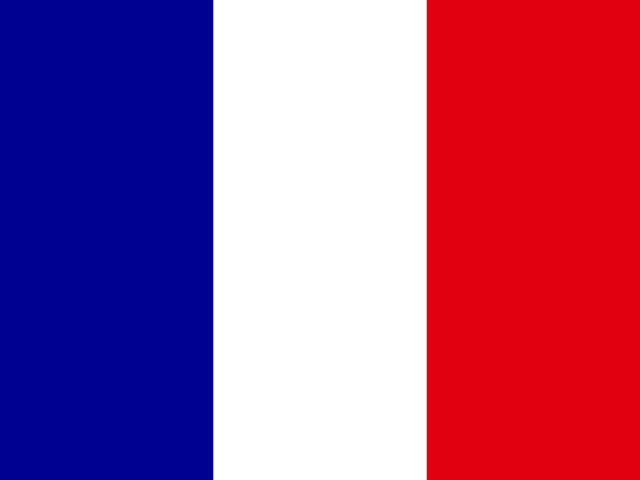
In France, no text sets the size of a flag. The Constitution defines the tricolour by its colours, and custom gives it three equal vertical bands in 2:3 proportions. Common sizes come from the flag makers, who link them to the height of the pole or the length of the staff. This guide presents these formats, and the flag size calculator applies them to a given pole.
Proportions and bands
The tricolour is made in 2:3 proportions: a flag 100 cm high is 150 cm long. According to a ministerial answer published in the Senate’s Official Journal in 2002, the law of 27 Pluviôse Year II provided for three colours “arranged in three equal bands, placed vertically”, and the 1946 Constitution spoke of “three vertical bands of equal dimensions”. The 1958 Constitution says nothing about this, and those provisions are considered unchanged.
The navy is an exception: its ensign has bands of 30%, 33% and 37% of the length, from blue to red, so that the bands look equal when the ensign flies.
Sizes by pole height
The French flag maker Doublet publishes the following table for horizontal flags raised on a pole (height × length):
| Pole height | Flag size |
|---|---|
| 1.5 to 2 m | 40 × 60 cm |
| 3 m | 60 × 90 cm |
| 3 to 4 m | 80 × 120 cm |
| 4 to 6 m | 100 × 150 cm |
| 6 to 8 m | 150 × 225 cm |
| 8 to 10 m | 200 × 300 cm |
| 10 m and more | 300 × 450 cm |
According to Doublet, these guide values apply to winds up to force 8; above that, the maker recommends taking the flag down to avoid damaging the pole. In its guide to poles, the same maker gives smaller sizes for communication flags, for example 80 × 120 cm to 120 × 180 cm for an 8-metre pole. Advertising flags are often chosen smaller than the tricolour on a memorial or a town hall.
Sizes by façade staff
For flags on a staff, Doublet links the size to the length of the staff:
| Staff length | Flag size |
|---|---|
| 1.25 m | 40 × 60 or 50 × 75 cm |
| 1.50 m | 60 × 90 cm |
| 1.70 m | 80 × 120 cm |
| 2 m | 100 × 150 cm |
| 2.30 m | 120 × 180 or 150 × 225 cm |
On town halls, the tricolour and the European flag are generally the same size, fixed in a cluster or side by side.
What influences the choice
- Wind: at the seaside and on open ground, a smaller flag wears less quickly and puts less load on the pole.
- Viewing distance: a flag seen from afar, on a roundabout or a tall building, is often chosen larger.
- Several flags: side by side, flags are generally the same size, so that none is given more importance than another.
- The pole maker: the maker states the largest flag the pole, halyard and pulley can carry.
The guide to flagpole heights covers the choice of height.
Frequently asked questions
What are the proportions of the French flag?
The tricolour is made in 2:3 proportions: the height is two thirds of the length, for example 100 × 150 cm. The three vertical bands are equal. The Constitution does not set the proportions; they are a matter of custom.
What size of flag for a 6-metre pole?
In the table of the French flag maker Doublet, a 4 to 6-metre pole carries a 100 × 150 cm flag, and a 6 to 8-metre pole a 150 × 225 cm flag. For a 6-metre pole, both sizes are therefore in the table.
What size of flag for a façade staff?
According to Doublet’s table, a 1.25-metre staff carries a 40 × 60 or 50 × 75 cm flag, a 1.50-metre staff a 60 × 90 cm flag, a 1.70-metre staff an 80 × 120 cm flag and a 2-metre staff a 100 × 150 cm flag.
Is there an official size for town halls?
No. No text sets the size of the flag on public buildings. Town halls choose the size to suit the façade, the staff or the pole, often with a European flag of the same size.
Sources
This guide is based on the following sources, most of them in French:
- Comment bien choisir un drapeau ? – Doublet (fabricant de drapeaux)
- Comment choisir un mât pour drapeau ? – Doublet (fabricant de drapeaux)
- Dimension des bandes du drapeau tricolore (question écrite n° 00563) – Sénat
- Constitution du 4 octobre 1958, article 2 – Conseil constitutionnel
Related guides
- Flag size calculatorCalculator for the size of a flag by the height of the pole, based on a French flag maker’s table, with the band widths of the flag and of the naval ensign.
- Flagpole heightsCommon flagpole heights in France, the 12-metre threshold of the Planning Code, the matching flag size and what influences the choice of height.
- Flag typesThe types of flag used in France: pole flag, flag on a façade staff, ceremonial flag, naval ensign, regional flags and vertical banners.
- Price of a flagWhat makes the price of a flag vary in France: size, fabric, printing, finish and fixing, plus the legal guarantee of conformity and the right of withdrawal.