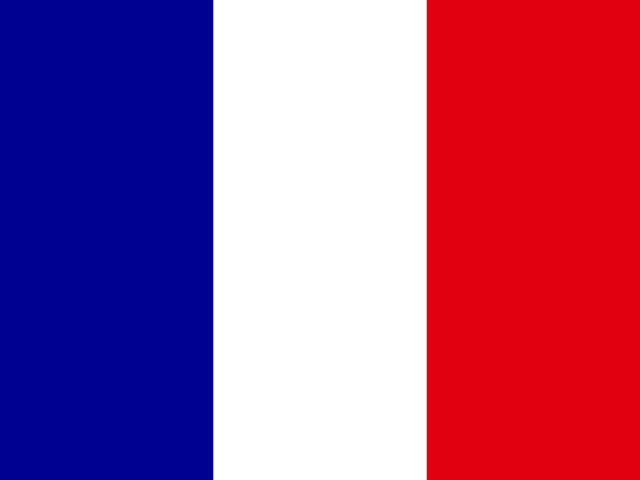
Flag protocol in France: place of honour and ceremonies
Published Written by Flagpole Guides
This page is an English translation of the French original. Where the two versions differ, the French text is the original.
Flag protocol in France rests on republican custom and on decree no. 89-655 of 13 September 1989 on public ceremonies, precedence and civil and military honours. The Ministry of the Interior sums up the practical rules in its protocol guide for mayors. One principle dominates: the national flag always takes the place of honour.
The tricolour and the European flag
The European flag, adopted in 1955 by the Committee of Ministers of the Council of Europe (twelve stars on an azure field), is compulsory on public buildings on 9 May and flies permanently at schools. According to the Ministry of the Interior’s guide, when it is displayed it is placed on the right of the French flag, which takes the place of honour. Seen from the front, looking at the building, the European flag is therefore on the left of the national flag.
On a town hall façade, the two flags are often fixed in a cluster on slanting staffs; in front of a building, they fly on two poles of the same height.
The place of honour by number of flags
A 2023 report of the National Assembly cites the definition used in particular in documentation of the Ministry of the Armed Forces. The place of honour is:
- on the right when there are two flags;
- in the centre when there are three flags;
- on the far left when there are more than three flags.
With a foreign flag and the European flag, the Ministry of the Interior’s guide describes the arrangement seen from the front: the foreign flag on the left of the French flag, the European flag on its right, and the French flag in the centre. More on this is in the guide to foreign flags in France.
Foreign, regional and other flags
- Foreign flags: when foreign dignitaries visit, it is traditional to honour them by temporarily flying their country’s flag. If several foreign flags are flown, the order is alphabetical, using the name of each country in its own language. According to the National Assembly report, there is no rule of precedence between foreign flags.
- Regional and departmental flags: according to the Ministry of the Interior, they can have a place at local cultural or folk events, provided this is temporary and the national flag always keeps the place of honour.
- Company and association flags: no official rule covers them. In practice, when they fly beside the tricolour, the national flag keeps the place of honour and all flags are of a similar size.
Ceremonies
The Ministry of the Interior’s guide describes how public ceremonies run in the municipalities:
- Precedence: in departments other than Paris, the prefect comes first, followed by the deputies, the senators, the members of the European Parliament, the president of the regional council, the president of the departmental council and the mayor of the municipality. At a ceremony not prescribed by the Government, the mayor, as host, takes second place after the representative of the State.
- Speeches: they are given in reverse order of precedence; the representative of the State always speaks last. By republican tradition, the mayor of the municipality speaks first.
- Laying of wreaths: this also follows the reverse order of precedence. The prefect lays their wreath last and salutes all the wreaths standing to attention. A minute’s silence and the Marseillaise follow.
The tricolour sash
The mayor’s tricolour sash also follows an order of colours. According to the Ministry of the Interior’s guide, when the mayor wears it around the waist, blue is at the top; worn from the right shoulder to the left side, blue is next to the collar, unlike members of parliament, who place red next to the collar. Mayors wear it with gold-fringed tassels, deputy mayors and councillors, when they stand in for the mayor, with silver-fringed tassels.
Frequently asked questions
Where does the European flag go in relation to the French flag?
According to the Ministry of the Interior’s protocol guide, the French flag takes the place of honour and the European flag is placed on its right; seen from the front, looking at the building, the European flag is therefore on the left of the national flag.
In what order are several foreign flags placed?
According to the Ministry of the Interior, the order is alphabetical, using the name of each country in its own language. The national flag is always present and keeps the place of honour.
Where is the place of honour when there are several flags?
According to documentation of the Ministry of the Armed Forces cited in a 2023 National Assembly report, the place of honour is on the right when there are two flags, in the centre when there are three, and on the far left when there are more than three.
In what order are wreaths laid?
According to the Ministry of the Interior’s guide, wreaths are laid and speeches given in reverse order of precedence: the representative of the State comes last. By republican tradition, the mayor of the municipality speaks first.
Sources
This guide is based on the following sources, most of them in French:
- Le protocole à l’usage des maires – Ministère de l’Intérieur
- Rapport n° 1180 sur la proposition de loi visant à rendre obligatoire le pavoisement des drapeaux français et européen sur le fronton des mairies – Assemblée nationale
- Décret n° 89-655 du 13 septembre 1989 relatif aux cérémonies publiques, préséances, honneurs civils et militaires – Légifrance
- Le drapeau européen – Union européenne
Related guides
- Foreign flagsFlying a foreign flag in France: freedom for private households, official visits, alphabetical order and the neutrality of public buildings.
- Flag rulesThe rules on flag flying in France: the Constitution, Government instructions, schools, neutrality of public buildings and the offence of insulting the flag.
- Flag daysThe flag days for public buildings in France in 2026 and 2027: national days, Bastille Day and Europe Day, with the legal text behind each day.
- Half-mastHow a flag is flown at half-mast in France according to the Ministry of the Interior, who decides on half-mast and the black ribbon at the top of the pole.
- Flagpoles for businessesCompany flagpoles and flags in France: the Environmental Code rules on signs, planning, the tricolour beside logo flags, safety and maintenance.