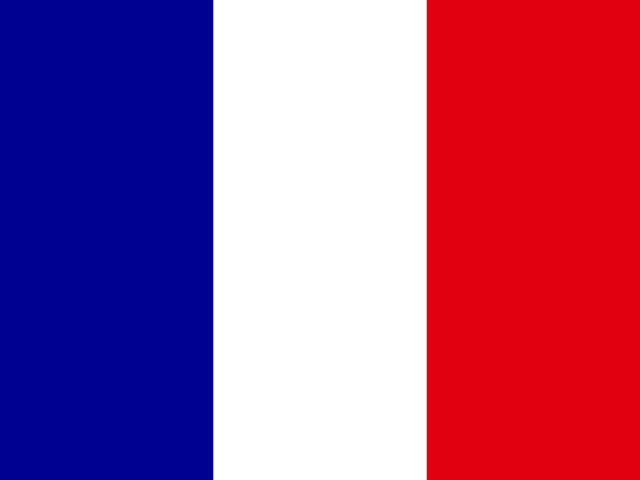
Symbolism of the French flag: blue, white, red
Published Written by Flagpole Guides
This page is an English translation of the French original. Where the two versions differ, the French text is the original.
Under article 2 of the Constitution, the tricolour is the national emblem of France. It was born in the Revolution and, according to the French presidency, today flies on all public buildings and is displayed at most official ceremonies, civil or military. This guide presents the origin of its colours, the order of the bands and the debates about the shade of blue.
The colours
According to the French presidency, the tricolour was born from combining the colours of the king (white) and of the city of Paris (blue and red). Before it was a flag, it was a cockade: it is said that La Fayette handed Louis XVI, received at the Hôtel de Ville three days after the storming of the Bastille, a tricolour cockade, declaring that it “will go around the world”. The mayor of Paris saw in it a sign of the alliance between the monarch and the people.
No official text today assigns a meaning to each colour. Readings that link blue, white and red to liberty, equality and fraternity, or to other values, are a matter of interpretation.
The order of the bands
In autumn 1790 the Constituent Assembly decided that ships would fly an ensign with three vertical bands, red next to the pole. According to the French presidency, the vertical arrangement set it apart from the Dutch flag, with the same colours arranged horizontally. The flag took its final form on 15 February 1794 (27 Pluviôse Year II), when the Convention decreed that the national flag would be made of the three colours in vertical bands, “so that the blue is attached to the pole, the white in the middle and the red flying in the air”.
According to a 2002 ministerial answer, the three bands are equal on the flag, whereas the navy keeps bands of 30, 33 and 37% on its ensign.
The shade of blue
Neither the Constitution nor any other text sets the shade of the colours. According to a 2021 AFP report, a lighter blue, close to that of the European flag, was chosen in 1976 to match that flag. The flags behind the President’s addresses returned to the navy blue used before 1976 from late 2018, followed by those on the buildings of the presidency in 2020. The presidency then referred to the blue of the Volunteers of Year II, the Poilus of 1914 and the Companions of the Liberation. Both shades remain in use in the trade and on public buildings.
One symbol among others
Beside the flag, the Constitution names the national anthem (La Marseillaise) and the motto “Liberty, Equality, Fraternity”. Other symbols are customary without being defined in the Constitution: Marianne, of which the Ministry of the Interior’s guide states that there is no official model of bust, the cockerel or the seal of the Republic. The tricolour also appears in the sash of mayors and members of parliament and in the cockade.
The flag is protected by the Criminal Code against insult (article 433-5-1 and article R. 645-15). More on this is in the guide to flag rules, and the guide to the history of flag flying traces the flag’s history since 1789.
Frequently asked questions
What do the colours of the French flag stand for?
According to the French presidency, the tricolour was born from combining the colours of the king (white) and of the city of Paris (blue and red). The tricolour cockade appeared in July 1789, before the flag took its final form in 1794.
Why is the blue next to the pole?
The decree of the Convention of 27 Pluviôse Year II (15 February 1794) provides that the national flag is made of the three colours in vertical bands, “so that the blue is attached to the pole, the white in the middle and the red flying in the air”.
What is the official shade of blue?
No text sets it. According to AFP, a lighter blue, close to that of the European flag, was chosen in 1976; since 2020 the buildings of the French presidency have again flown a navy blue, the one used before 1976.
Is the flag the only symbol of the Republic?
It is the only national emblem defined by the Constitution (article 2). The same article names the national anthem, La Marseillaise, and the motto “Liberty, Equality, Fraternity”. Marianne and the cockerel are customary symbols, with no constitutional definition.
Sources
This guide is based on the following sources, most of them in French:
- Le drapeau français – Présidence de la République
- Constitution du 4 octobre 1958, article 2 – Conseil constitutionnel
- Rapport n° 1180 sur la proposition de loi visant à rendre obligatoire le pavoisement des drapeaux français et européen sur le fronton des mairies – Assemblée nationale
- France : l’Élysée est revenu au bleu marine du drapeau tricolore – Arab News en français (AFP)
- Dimension des bandes du drapeau tricolore (question écrite n° 00563) – Sénat
- Le protocole à l’usage des maires – Ministère de l’Intérieur
Related guides
- HistoryThe history of the tricolour and of flag flying in France: the 1789 cockade, the 1794 decree, the white flag, 1830, 1848, 1958 and the European flag.
- Flag typesThe types of flag used in France: pole flag, flag on a façade staff, ceremonial flag, naval ensign, regional flags and vertical banners.
- Flag rulesThe rules on flag flying in France: the Constitution, Government instructions, schools, neutrality of public buildings and the offence of insulting the flag.
- Flag sizesCommon flag sizes in France, from 40 × 60 to 300 × 450 cm, the 2:3 proportions of the tricolour, and sizes by pole height and façade staff.