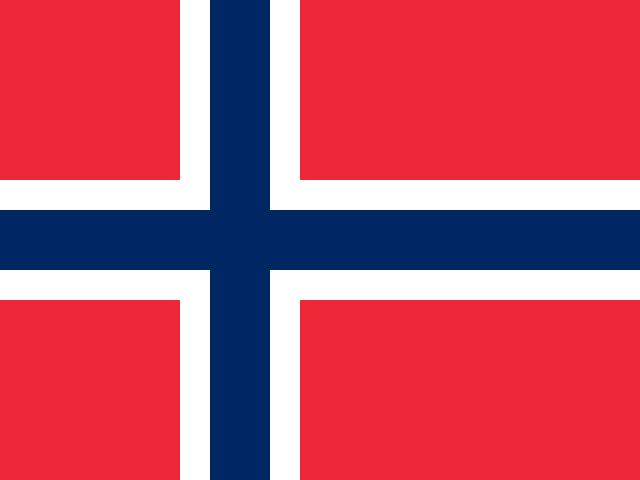
Flagpoles and flag flying in Norway
Published Written by Flagpole Guides
This page is an English translation of the Norwegian original. Where the two versions differ, the Norwegian text is the original.
Norway flies a lot of flags. The flag hangs outside houses, cabins, farms, housing cooperatives, businesses and town halls, and on 17 May there are few places without one. Yet surprisingly few rules apply to the individual: the Flag Act and the flag regulation are aimed at the state, and the 1933 Act at the municipalities. Private individuals fly flags by custom. The key facts about flag flying and flagpoles in Norway are collected here, with sources from acts, regulations and official guidance.
Key facts at a glance
- Flag days: section 4 of the flag regulation lists 16 official flag days, including 17 May, Easter Sunday, Whit Sunday and the day of the Storting election. After King Harald V died on 28 August 2026, his birthday on 21 February is, according to Lovdata, to be removed from the list. All dates are in the guide to flag days.
- Flag times: the flag is raised at 8 or 9 a.m. and lowered at sunset, but no later than 9 p.m. Northern Norway has its own winter times. More in the guide to flag rules.
- Half-mast: the flag is first raised fully and then lowered. According to Store norske leksikon, the upper edge of the flag is then one third of the pole’s length below the top. More in the guide to half-mast.
- Which flag: anyone can use the rectangular flag. The swallow-tailed flag is the state’s flag. More in the guide to flag types.
- Size: there is no official formula. The rule of thumb from Norwegian flag makers and the standard sizes are shown in the flag size calculator.
- Buying: what affects the price is described in the guides to buying a flagpole and buying a flag.
- Flagpole and municipality: by long-standing administrative practice, flagpoles do not need a permit, but municipal plans can regulate them. More in the guide to flagpole installation.
Acts, regulations and authorities
Article 120 of the Constitution states that the flag is set by law. The Flag Act (flaggloven) of 10 December 1898, which came into force on 16 December 1899, describes the flag: bright red with a dark blue cross edged in white, in the proportion 16 to 22. Under section 2, the same flag with a swallow tail and tongue is used on the state’s public buildings. The Act falls under the Ministry of Foreign Affairs.
The flag regulation (flaggforskriften) of 21 October 1927 repeats the measurements in more modern language and sets the official flag days (section 4), where the flag is flown (section 5) and the flag times (section 6). It applies to state bodies. The Act on flag flying on municipal public buildings of 1933 decides which flags municipalities can use: the Norwegian flag without swallow tail and tongue, the Sámi flag and municipal or county flags. Since 2021, municipalities can also use other flags for events, observances and commemorative days of general interest. The Sámi flag has its own rules, set by the Sámi Parliament (Sametinget).
According to Lovdata, the Flag Act and the flag regulation contain no rules for private individuals. Many nevertheless follow the flag days and flag times, because they describe official practice. The custom of treating the flag with respect is described in the guide to flag rules.
The flagpole in Norway
There is no separate act for the flagpole itself. Flagpoles are not mentioned in the Planning and Building Act or the building application regulation. According to the Norwegian Municipal Engineering Association, the ministry has taken the view that they are not measures requiring a permit, but that the municipality can regulate them in plans. Along the sea, the building ban in the 100-metre belt and the Outdoor Recreation Act can matter. Wind load, snow and ice are taken into account in the manufacturers’ installation instructions.
In Norwegian gardens, flagpoles 6 to 10 metres high are common, and manufacturers often link the height to the house: one third of the pole above the roof ridge is a widespread rule of thumb. Glass fibre and aluminium dominate. More in the guides to types of flagpoles and flagpole heights.
About the guides
The guides below are sorted by topic. Each covers one clearly defined subject, ends with frequently asked questions, lists its sources and shows when it was last updated. The flag days are calculated for 2026 and 2027, including Easter and Whitsun, which move from year to year.
All guides
Flag flying and rules
When, how and why flags are flown in Norway – from the official flag days and flag times to half-mast, mourning and flags of other countries.
- Flag daysAll official flag days in Norway in 2026 and 2027 with dates and weekdays, plus the Sámi flag days and the changes after the accession of King Haakon.
- Flag rulesFlag rules in Norway: flag times under the flag regulation, who the rules apply to, the state flag and the customs for handling and disposing of the flag.
- Half-mastFlying the flag at half-mast in Norway: how high the flag hangs, why it is first raised to the top, the flag times in mourning and when it goes back up.
- Flags in mourningFlags in mourning in Norway: deaths, funerals and national mourning, what the state and municipalities do, and the customs of private owners.
- Flags on holidaysFlying flags on 17 May, Christmas, Easter, Whitsun, Olsok and private occasions in Norway: which days are official flag days and which customs are common.
- Flag protocolFlag protocol in Norway: the Norwegian flag’s place of honour, the Sámi flag, other countries’ flags and the usual order when several flags fly together.
- Foreign flagsOther countries’ flags in Norway: what private individuals can fly, the rules for municipal buildings from 1933 and 2021 and the Sámi flag.
The flag
The cross flag, the swallow-tailed state flag and the pennant, flag sizes and what affects the price – and a calculator that shows which size suits which pole.
- Flag typesNorwegian flag types: the rectangular flag, the swallow-tailed state flag, the royal standard, the post and customs flags, the pennant, table flags and banners.
- Flag sizesFlag sizes in Norway: the rule of thumb of one third of the pole, standard sizes for the Norwegian flag in 16:22 and common pennant lengths per pole height.
- Flag size calculatorCalculator showing the flag and pennant size for a given pole height by the rule of thumb of Norwegian flag makers and the flag’s proportions of 16:22.
- Flag symbolismWhat the Norwegian flag stands for: the Nordic cross, the colours of liberty, Frederik Meltzer’s proposal of 1821 and the flag’s colours today.
- Buying a flagBuying a Norwegian flag: what affects the price – size, fabric, stitching, colours and fastening – and the rights consumers have under Norwegian law.
The flagpole
Types, materials, heights, accessories, lighting and what affects the price of a flagpole – and the history of the flag and the pole in Norway.
- Types of flagpolesFlagpoles with external or internal halyard, tilting and telescopic poles, balcony poles and flag installations: the types of flagpole in Norway.
- Flagpole materialsFlagpole materials in Norway: glass fibre, aluminium, steel and wood – properties, maintenance and how coast, snow and frost in Norway affect the choice.
- Flagpole heightsHow tall flagpoles are in Norway: common heights for cabins, houses and businesses, the roof-ridge rule of thumb and what municipal plans can say.
- Flagpole accessoriesFinial, pulley, halyard, cleat, hooks, ground sleeve, tilting foundation and pennant fittings: the parts of a Norwegian flagpole and what they do.
- Flagpole mechanicsHow a flagpole works: external and internal halyard, pulley, cleat, counterweight, telescopic and tilting poles – and what the mechanics mean for half-mast.
- Flag lightingFlags after sunset in Norway: what the flag regulation says about lowering, the pennant at night, lighting the flagpole and who can install lights.
- History of the flagpoleThe history of the Norwegian flag and flagpole: the lion banner, Dannebrog, 1821, the herring salad, the pure flag of 1899, 1905 and the flag days from 1927.
- Buying a flagpoleBuying a flagpole in Norway: what affects the price – height, material, halyard, foundation, delivery and installation – and the rights buyers have.
Installation, safety and care
Planning and building law, foundations, safety, maintenance and transport – for houses, cabins, housing cooperatives, owners’ associations, businesses and municipalities.
- Flagpole installationInstalling a flagpole in Norway: permits under the Planning and Building Act, municipal plans, the 100-metre belt, cooperatives, foundation and position.
- Flagpole safetyFlagpole safety in Norway: wind load and Eurocodes, snow and ice, foundations, neighbour relations, working at height for employers and power lines.
- Flagpole maintenanceMaintaining a flagpole and flag in Norway: what is checked in spring and autumn, halyard, pulley and foundation, and how the flag is cared for.
- Flagpole repairCommon damage to flagpoles in Norway: a broken halyard, a jammed pulley, a leaning pole, cracks and corrosion – the causes, and who usually does the repair.
- Lifespan and sustainabilityHow long flagpoles and flags last in Norway, what wears them most, reuse and waste – and the custom for disposing of a worn-out Norwegian flag.
- Flagpole transportTransporting a flagpole in Norway: the rules for protruding loads in the vehicle regulation, marking, lights in the dark, securing and delivery.
- Flagpoles for businessesFlagpoles for businesses in Norway: company and advertising flags, sign rules, flag installations, the state flag and working at height.
Frequently asked questions
May anyone fly the Norwegian flag?
Yes. According to Lovdata, the Flag Act and the flag regulation contain no rules for private individuals. Private individuals can fly the flag whenever they like. Under section 2 of the Flag Act, the swallow-tailed flag is the state’s flag; the ordinary rectangular flag is the one used privately.
Which rules govern flag flying in Norway?
The Flag Act of 10 December 1898 sets out the flag’s colours and proportions. The flag regulation of 1927 sets the official flag days and flag times for state bodies, and the 1933 Act on flag flying on municipal public buildings governs which flags municipalities can use. The rules apply to public bodies, not to private individuals.
Does a flagpole in Norway need a building permit?
According to the Norwegian Municipal Engineering Association (NKF), the ministry has taken the view that flagpoles are not measures requiring a permit under the building part of the Planning and Building Act. The municipality can still regulate their position and height in zoning provisions, and several poles together can require a permit. The municipality can give information for the individual property.
When is the flag raised and lowered in Norway?
Under section 6 of the flag regulation, the flag is raised at 8 a.m. from March to October and at 9 a.m. from November to February. It is lowered at sunset, but no later than 9 p.m. In Nordland, Troms and Finnmark it is raised at 10 a.m. and lowered at 3 p.m. from November to February. The times apply to state bodies, but many private individuals follow them.
Which flag size suits which Norwegian flagpole?
There is no official rule. Norwegian flag makers give as a rule of thumb that the flag’s length is about one third of the pole’s height, and that anything between a quarter and a third is common. For an 8-metre pole, a 250-centimetre flag is often mentioned.
Sources
This guide is based on the following sources, most of them in Norwegian:
- Lov om Norges Flag [flaggloven] – Lovdata
- Forskrift angående bruk av statsflagget og handelsflagget [flaggforskriften] – Lovdata
- Lov om flagging på kommunenes offentlige bygninger – Lovdata
- Flagget og loven – Lovdata
- Reglene for tronskifte – Lovdata
- Søknadsplikt for flaggstenger? – Norsk Kommunalteknisk Forening (NKF)
- Norges flagg – Store norske leksikon