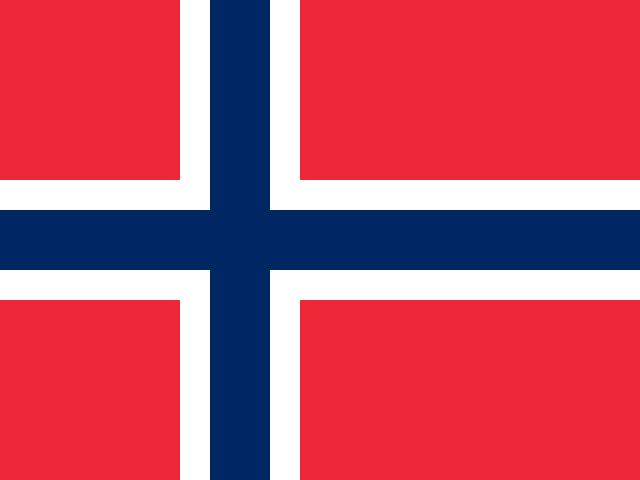
Flag rules in Norway
Published Written by Flagpole Guides
This page is an English translation of the Norwegian original. Where the two versions differ, the Norwegian text is the original.
Flag rules in Norway work on three levels. The Flag Act of 1898 decides what the flag looks like. The flag regulation of 1927 sets the flag days and flag times for state bodies. The Act on flag flying on municipal public buildings of 1933 governs which flags municipalities can use. For private individuals there are no statutory rules, but there is a firm custom that most people know from 17 May.
Who the rules apply to
| Who | Rules | Content |
|---|---|---|
| The state | Flag Act, flag regulation | Swallow-tailed flag, flag days, flag times |
| Municipalities and county authorities | Act on flag flying on municipal public buildings | Which flags can be used |
| The Sámi Parliament and Sámi occasions | Regulation on the use of the Sámi flag | Sámi flag days, times, position |
| Private individuals, associations, businesses | No act | Custom |
According to Lovdata, the Flag Act and the flag regulation contain no rules for private individuals. The law is nevertheless a natural starting point for anyone interested in custom. In housing cooperatives and owners’ associations, statutes and house rules can matter for flagpoles on façades and common areas.
Flag times
Section 6 of the flag regulation sets when the flag is raised and lowered on state buildings:
| Period | Raised | Lowered |
|---|---|---|
| March to October | 8 a.m. | at sunset, no later than 9 p.m. |
| November to February | 9 a.m. | at sunset, no later than 9 p.m. |
| November to February in Nordland, Troms and Finnmark | 10 a.m. | 3 p.m. |
During the polar night in the north, the sun does not rise at all in some places, which is why the regulation has fixed times there. The regulation on the Sámi flag has similar times, but with raising at 10 a.m. and lowering at 3 p.m. from Nordland county northwards. It is common for private individuals to follow the same times. Flags left up after sunset, and the question of lighting, are covered in the guide to flag lighting.
Where the flag is flown
Under section 5 of the flag regulation, the flag is flown on a pole on the roof, from the side of the building or on a free-standing pole, and on vessels from the ensign staff aft or under the gaff. On state buildings, the state flag with swallow tail and tongue is used. Under section 3 of the regulation, this applies to buildings owned by the state, or rented by the state and mainly used by state institutions. The state flag is not used at exhibitions, agricultural shows, festivities and the like that are not organised by the state. Private individuals and municipalities use the rectangular flag, which the Flag Act calls the “koffardiflag” (merchant flag). The different variants are covered in the guide to flag types.
The pennant
The pennant (vimpel) in Norwegian colours is not regulated in the Flag Act. According to Store norske leksikon, it is used more informally than the flag and can stay hoisted day and night. Many leave the pennant on the pole on days when the flag is not up, and change to the flag on flag days and special occasions.
Custom
Store norske leksikon describes a number of norms that are commonly followed, even though they are not laid down in law for private individuals:
- The flag is treated with respect as a symbol of the nation.
- It is kept clean, does not drag on the ground and is not used as a covering.
- It is hoisted taut to the top and hangs freely.
- After use, it is dried before being folded or rolled up so that only the red colour is visible.
- When worn out, it is unpicked along the seams so that the colours are separated, and burnt.
In mourning, the flag is flown at half-mast. How that is done is described in the guide to half-mast. The official flag days are listed in the guide to flag days.
Frequently asked questions
When is the flag raised and lowered in Norway?
Under section 6 of the flag regulation, the flag is raised at 8 a.m. from March to October and at 9 a.m. from November to February. It is lowered at sunset, but no later than 9 p.m. if the sun sets later.
Does Northern Norway have its own flag times?
Yes. Under the second paragraph of section 6 of the flag regulation, the flag in Nordland, Troms and Finnmark is raised at 10 a.m. and lowered at 3 p.m. in the months November to February.
Is it an offence to fly the Norwegian flag incorrectly?
No, not for private individuals. According to Lovdata, the Flag Act and the flag regulation contain no rules for private individuals. The rules are aimed at the state, and the 1933 Act at the municipalities. The custom of treating the flag with respect is not laid down in law for private individuals.
Can the Norwegian pennant stay up at night?
According to Store norske leksikon, the pennant (vimpel) in the national colours is used more informally than the flag and can stay hoisted day and night. The pennant is not regulated in the Flag Act.
How is a worn-out Norwegian flag disposed of?
According to Store norske leksikon, it is customary for a flag that is no longer serviceable to be unpicked along the seams so that the colours are separated, before it is burnt. This is custom, not law.
Sources
This guide is based on the following sources, most of them in Norwegian:
- Forskrift angående bruk av statsflagget og handelsflagget [flaggforskriften], §§ 3–6 – Lovdata
- Lov om Norges Flag [flaggloven] – Lovdata
- Flagget og loven – Lovdata
- Lov om flagging på kommunenes offentlige bygninger – Lovdata
- Flaggregler (Norge) – Store norske leksikon
- Vimpel – Store norske leksikon
Related guides
- Flag daysAll official flag days in Norway in 2026 and 2027 with dates and weekdays, plus the Sámi flag days and the changes after the accession of King Haakon.
- Half-mastFlying the flag at half-mast in Norway: how high the flag hangs, why it is first raised to the top, the flag times in mourning and when it goes back up.
- Flag lightingFlags after sunset in Norway: what the flag regulation says about lowering, the pennant at night, lighting the flagpole and who can install lights.
- Flag typesNorwegian flag types: the rectangular flag, the swallow-tailed state flag, the royal standard, the post and customs flags, the pennant, table flags and banners.