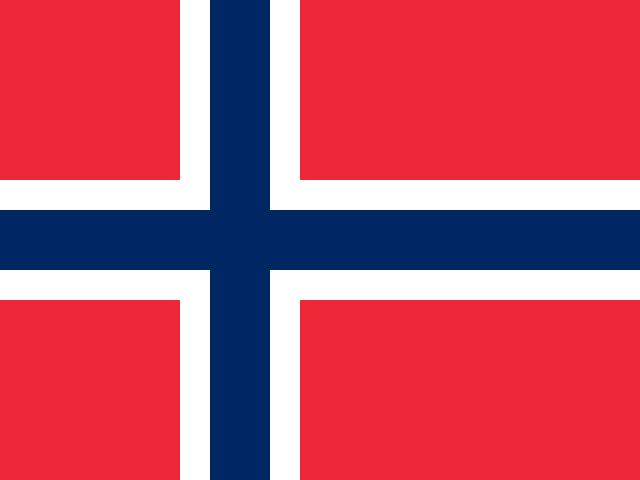
Flag symbolism: the cross and colours of the Norwegian flag
Published Written by Flagpole Guides
This page is an English translation of the Norwegian original. Where the two versions differ, the Norwegian text is the original.
The Norwegian flag is a three-coloured Nordic cross flag: a dark blue cross edged in white on a bright red field. Both the cross and the colours have a history, and their interpretations have changed over time. The Flag Act only describes what the flag looks like, not what it means.
The cross
According to Store norske leksikon, the cross represents the country’s Christian tradition, as the crosses do in the other Nordic flags. Nordic cross flags differ from other cross flags in that the vertical part of the cross is offset towards the pole. The first Nordic cross flag was the Danish Dannebrog, regarded as the world’s oldest national flag. Sweden, Norway, Finland and Iceland followed.
Norway’s flag was the first Nordic cross flag in three colours. According to Store norske leksikon, it has been a model for around 30 other flags, the first being Iceland in 1918, the Faroe Islands in 1919 and Åland in 1954.
The colours of liberty
Frederik Meltzer justified his proposal in 1821 by saying that the flag ought to have the colours of liberty, red, white and blue, as in the French, Dutch, American and British flags. According to Store norske leksikon, he felt that a red flag with a white cross satisfied those who wished to remember the union with Denmark, while the blue was a courteous gesture to the new union partner, Sweden. Meltzer also pointed to a practical advantage: old Dannebrog flags could be cut up and sewn together with blue stripes.
| Colour | Traditional interpretation |
|---|---|
| Red | Strength and courage |
| White | Purity |
| Blue | Loyalty |
According to the encyclopedia, the colours have also been given other meanings, such as blood ties, snow and sea.
The colours today
Section 1 of the Flag Act describes the colours as “høirødt” (bright red), “mørkeblaat” (dark blue) and white, without colour codes. According to Store norske leksikon, the Ministry of Foreign Affairs internally recommended specific Pantone colours for print until 2018, but withdrew the recommendation after criticism from flag makers who felt the red was not bright enough. The ministry now gives no recommendations, and in 2018 the Foreign Minister asked the makers to create a common industry standard. Several Norwegian makers use Pantone 200 C for red and 281 C for blue on textile flags.
The proportions
The Flag Act sets the measurements precisely: the width relates to the length as 16 to 22, the two red fields nearest the pole are squares, the cross is 2/16 of the width and the white edge 1/16. According to Store norske leksikon, the proportions can be expressed as 6–1–2–1–12 lengthwise and 6–1–2–1–6 in height. What the proportions mean for the size in relation to the pole is covered in the guide to flag sizes.
A symbol of independence
The flag became a political symbol during the union with Sweden. The dispute over the union mark, the “herring salad”, and the adoption of the “pure” flag in 1898 are, according to Lovdata, regarded as a foreshadowing of the dissolution of the union in 1905. The history is in the guide to the history of the flagpole, and the variants of the flag in the guide to flag types. The dissolution of the union on 7 June is today an official flag day.
Frequently asked questions
What do the colours of the Norwegian flag symbolise?
According to Store norske leksikon, red, white and blue were chosen as an expression of freedom and independence, inspired among other things by the French and American revolutionary colours. A traditional interpretation links red with strength and courage, white with purity and blue with loyalty.
What does the cross in the Norwegian flag mean?
According to Store norske leksikon, the cross represents the country’s Christian tradition, like the crosses in the other Nordic flags. The Nordic cross is offset towards the flagpole.
Who designed the Norwegian flag?
The flag was designed by Frederik Meltzer, a member of the Storting, and presented to the Odelsting on 4 May 1821. It was adopted by royal decree on 13 July 1821.
Are there official colour codes for the Norwegian flag?
No. The Flag Act only says bright red, dark blue and white. According to Store norske leksikon, the Ministry of Foreign Affairs gives no recommendations for the colours, and several Norwegian flag makers use Pantone 200 C for red and 281 C for blue.
Sources
This guide is based on the following sources, most of them in Norwegian:
- Norges flagg – symbolikk, farger og historikk – Store norske leksikon
- Lov om Norges Flag [flaggloven], § 1 – Lovdata
- Flagget og loven – Lovdata
Related guides
- History of the flagpoleThe history of the Norwegian flag and flagpole: the lion banner, Dannebrog, 1821, the herring salad, the pure flag of 1899, 1905 and the flag days from 1927.
- Flag typesNorwegian flag types: the rectangular flag, the swallow-tailed state flag, the royal standard, the post and customs flags, the pennant, table flags and banners.
- Flag sizesFlag sizes in Norway: the rule of thumb of one third of the pole, standard sizes for the Norwegian flag in 16:22 and common pennant lengths per pole height.
- Flag daysAll official flag days in Norway in 2026 and 2027 with dates and weekdays, plus the Sámi flag days and the changes after the accession of King Haakon.