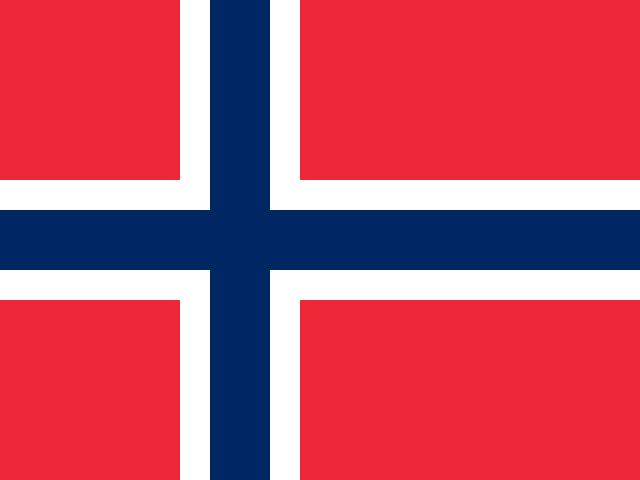
Flags in mourning in Norway
Published Written by Flagpole Guides
This page is an English translation of the Norwegian original. Where the two versions differ, the Norwegian text is the original.
The flag at half-mast is the clearest sign of mourning in Norway. It is used both when an individual dies and in national mourning. No Norwegian act governs flags in mourning for private individuals. For the state, the government decides case by case, and for the rest of society, custom applies.
Occasions
| Occasion | Common practice |
|---|---|
| Death in the family or neighbourhood | Half-mast on the day of the death |
| Cremation or funeral | Half-mast in the morning, to the top after the ceremony |
| National mourning | Half-mast at state bodies by decision of the government |
| Memorial events | Half-mast by decision of the pole’s owner |
According to Flagg.no, the flag flies at half-mast on the day of the death and the day of the funeral, and once the funeral has taken place, the flag is raised to the top and lowered at the normal time. How the flag is raised and lowered is described in the guide to half-mast.
National mourning and state flag flying
National mourning is not a term in Norwegian law. According to Store norske leksikon, there are no fixed rules or arrangements, and the government decides case by case. Some examples:
- King Olav V died on 17 January 1991. Flags flew at half-mast across the country, and the authorities encouraged a minute’s silence on the day of the funeral.
- 22 July 2011: after the terrorist attacks, the government declared 21 August 2011 a national day of mourning.
- King Harald V died on 28 August 2026. The government declared national mourning until the funeral on 9 September. Flags flew at half-mast from royal residences, state buildings and military bases, and after the funeral began at 1 p.m., the flag was raised to the top.
According to Norske Boligbyggelag, only state bodies were required to fly flags at half-mast during the national mourning in 2026. The government stated that private individuals and businesses could follow the same rules as state institutions.
Municipalities and county authorities
The Act on flag flying on municipal public buildings governs which flags municipalities can use, not when they fly them. In national mourning, municipalities commonly follow the state’s practice. Many municipalities also fly flags at half-mast when a mayor, a former mayor or an employee dies, under their own guidelines.
Housing cooperatives, owners’ associations and businesses
For shared poles in housing cooperatives and owners’ associations, the board or the annual meeting decides the routines. It is common to fly the flag at half-mast when a resident dies, often in agreement with the family. Businesses often fly flags at half-mast when an employee or a former manager dies, and during national observances of mourning. More in the guide to flagpoles for businesses.
The flag at the funeral
At funerals of public figures, the flag is also used in the ceremony itself, for example draped over the coffin or carried by a colour guard. It is common custom that the flag does not touch the ground. Order and position are covered in the guide to flag protocol.
After the period of mourning
When the period of mourning is over, the flag is raised fully again. An accession also changes the flag days: according to Lovdata, King Harald V’s birthday on 21 February is to be removed from the list of official flag days by an amending regulation. More in the guide to flag days.
Frequently asked questions
When is the flag flown at half-mast after a death in Norway?
It is common to fly the flag at half-mast on the day of the death and on the day of the funeral. According to Store norske leksikon, the flag is raised to the top and lowered to half-mast on the morning of the funeral day, and raised to the top when the ceremony is over.
What is national mourning (landesorg) in Norway?
According to Store norske leksikon, landesorg is mourning shared by the population of a country, or a formal period of mourning declared by the authorities. The term is not mentioned in Norwegian law. In 2026, the government declared national mourning after King Harald’s death.
Do Norwegian municipalities have to fly flags at half-mast in national mourning?
No. After King Harald V’s death, according to Norske Boligbyggelag, only state bodies were required to fly flags at half-mast. Municipalities, businesses and private individuals could choose to follow the same rules.
Can a housing cooperative fly its flag at half-mast when a resident dies?
Yes. There are no statutory rules for this. Many housing cooperatives and owners’ associations have their own routines, often decided by the board, for when the shared pole is used at half-mast.
Sources
This guide is based on the following sources, most of them in Norwegian:
- Flagge på halv stang – Store norske leksikon
- Landesorg – Store norske leksikon
- Regler for å flagge på halv stang – Norske Boligbyggelag (NBBL)
- Reglene for tronskifte – Lovdata
- Forskrift angående bruk av statsflagget og handelsflagget [flaggforskriften], § 4 – Lovdata
- Flaggregler, flaggtider og offentlige flaggdager – Flagg.no (bransje)
Related guides
- Half-mastFlying the flag at half-mast in Norway: how high the flag hangs, why it is first raised to the top, the flag times in mourning and when it goes back up.
- Flag protocolFlag protocol in Norway: the Norwegian flag’s place of honour, the Sámi flag, other countries’ flags and the usual order when several flags fly together.
- Flag rulesFlag rules in Norway: flag times under the flag regulation, who the rules apply to, the state flag and the customs for handling and disposing of the flag.
- Flag daysAll official flag days in Norway in 2026 and 2027 with dates and weekdays, plus the Sámi flag days and the changes after the accession of King Haakon.