Norwegian flag types: flag, swallow-tailed flag, pennant and more
Published Written by Flagpole Guides
This page is an English translation of the Norwegian original. Where the two versions differ, the Norwegian text is the original.
The Norwegian flag exists in several variants. Some are set out in the Flag Act, others were decided by royal decree, and some, like the pennant, are not regulated at all. Which variant is used depends on who is flying it and where.
Overview
| Flag type | Shape | Proportions | Used by |
|---|---|---|---|
| National flag (merchant flag) | Rectangular | 16:22 | Everyone |
| Swallow-tailed flag (state flag, naval ensign) | Swallow tail and tongue | 16:27 | The state, the armed forces |
| Post and customs flags | Swallow-tailed flag with white field | 16:27 | Post and customs vessels |
| Royal standard | Armorial banner with the lion | – | The King |
| Pennant (vimpel) | Narrow, usually triangular | Not regulated | Everyone |
| Table flags, hand flags | Rectangular | 16:22 | Everyone |
The national flag
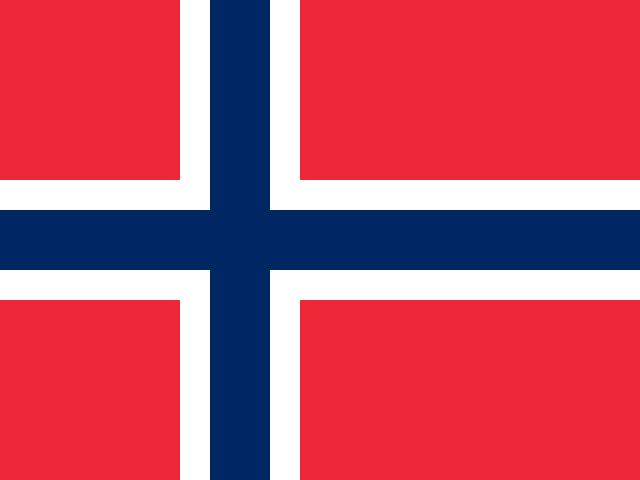
The ordinary Norwegian flag is called the “koffardiflag” in the Flag Act and otherwise often the merchant flag. Under section 1 of the Flag Act, it is bright red, divided into four right-angled fields by a dark blue cross with a white edge, and its width relates to its length as 16 to 22. This is the flag used by private individuals, businesses, associations and municipalities. Under the Act on flag flying on municipal public buildings, municipalities use the Norwegian flag without swallow tail and tongue.
The swallow-tailed flag
The swallow-tailed flag is the same flag with a swallow tail and tongue. According to Store norske leksikon, it was introduced as the naval ensign in 1844 with the union mark, and without the union mark on 9 June 1905. As the state flag, it was introduced without the union mark by the Flag Act of 10 December 1898. Its proportions are 16:27. Under section 3 of the flag regulation, it is used on buildings owned by the state, or rented by the state and mainly used by it, and at Norway’s missions abroad. It is not used on state property mainly let to private parties, nor at exhibitions, agricultural shows and festivities not organised by the state.
Post and customs flags
Under section 2 of the Flag Act, the post and customs flags have a white field in the centre with the words “Post” or “Toll” and a crown above. Under section 3 of the flag regulation, mail-carrying vessels can use the post flag only when the ship is Norwegian and the shipping company has a contract with the state to carry mail.
The royal standard
According to Store norske leksikon, the royal standard is a modern version of the first Norwegian flag from the Middle Ages: the Norwegian lion on a bright red field. The current royal standard was introduced in 1905. The Crown Prince’s standard from 1924 also has a shallow swallow tail.
The pennant
According to Store norske leksikon, the pennant (vimpel) is a narrow, usually triangular flag. The pennant in the national colours is used more informally than the flag and can stay hoisted day and night. It is not regulated, and sizes and proportions vary between makers. It usually has only horizontal stripes. The maker Flaggfabrikken also describes the cross pennant, which has a cross near the pole and according to the maker is most common in Western Norway, and the “flyndrevimpel”, which hangs from an arm and lies flat in the wind.
Table flags, hand flags and banners
Table flags and hand flags usually follow the ordinary flag’s proportions. Banners hanging vertically from a pole or an arm are more common at events and businesses than on private flagpoles. Which size suits a pole is covered in the guide to flag sizes, and the flag size calculator works out the size for a given height. The cross and the colours are covered in the guide to flag symbolism.
Frequently asked questions
What is the difference between the Norwegian flag and the swallow-tailed flag?
The ordinary Norwegian flag is rectangular with the proportions 16:22. The swallow-tailed flag has a swallow tail and tongue and the proportions 16:27. Under section 2 of the Flag Act, it is used on the state’s public buildings, and it is also Norway’s naval ensign.
Can private individuals use the swallow-tailed flag?
Under section 2 of the Flag Act and section 3 of the flag regulation, the swallow-tailed flag is the state’s flag for state buildings and certain vessels. The regulation also says that the state flag is not used at exhibitions, agricultural shows and festivities not organised by the state. Private individuals use the rectangular flag.
What does a Norwegian pennant look like?
The pennant (vimpel) is not regulated in the Flag Act. According to Store norske leksikon, Norwegian pennants vary greatly in size and proportions, and usually have only horizontal stripes without a cross. Some makers also produce cross pennants.
What is the Norwegian post flag?
Under section 2 of the Flag Act, the post and customs flags are swallow-tailed flags with a white field in the centre bearing the words “Post” or “Toll” with a crown above. The post flag can be used by vessels with a contract with the state to carry mail.
Sources
This guide is based on the following sources, most of them in Norwegian:
- Lov om Norges Flag [flaggloven], §§ 1–2 – Lovdata
- Forskrift angående bruk av statsflagget og handelsflagget [flaggforskriften], §§ 1–3 – Lovdata
- Norges flagg – varianter av flagget – Store norske leksikon
- Vimpel – Store norske leksikon
- Norske flagg og vimpler – Flaggfabrikken (produsent)
Related guides
- Flag sizesFlag sizes in Norway: the rule of thumb of one third of the pole, standard sizes for the Norwegian flag in 16:22 and common pennant lengths per pole height.
- Flag symbolismWhat the Norwegian flag stands for: the Nordic cross, the colours of liberty, Frederik Meltzer’s proposal of 1821 and the flag’s colours today.
- Flag rulesFlag rules in Norway: flag times under the flag regulation, who the rules apply to, the state flag and the customs for handling and disposing of the flag.
- Flag size calculatorCalculator showing the flag and pennant size for a given pole height by the rule of thumb of Norwegian flag makers and the flag’s proportions of 16:22.
- Buying a flagBuying a Norwegian flag: what affects the price – size, fabric, stitching, colours and fastening – and the rights consumers have under Norwegian law.