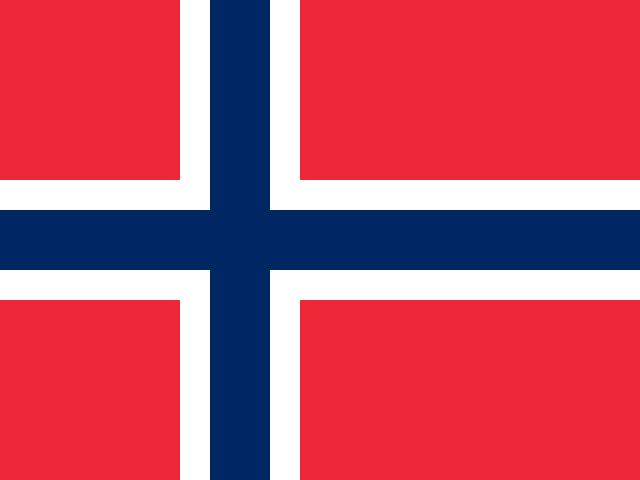
Half-mast in Norway – rules and procedure
Published Written by Flagpole Guides
This page is an English translation of the Norwegian original. Where the two versions differ, the Norwegian text is the original.
A flag at half-mast is a sign of mourning. In Norway it is used for deaths, cremations and funerals, and in national mourning. The procedure is not laid down in the Flag Act or the flag regulation, but it is well established and described in the same way by Store norske leksikon and in guidance from, among others, Norske Boligbyggelag, the national federation of housing cooperatives.
How the flag hangs at half-mast
According to Store norske leksikon, the flag is lowered until its upper edge is one third of the pole’s height below the top. On a 9-metre pole, the upper edge therefore hangs about 3 metres below the top. Norske Boligbyggelag puts it as one third of the pole’s height being visible above the flag, and refers to a practical tip from the flag rules: counting the number of pulls on the halyard when the flag is raised to the top, and dividing that number by three.
The Norwegian name “halv stang” (half pole) is therefore not quite precise. The flag hangs higher than the middle of the pole. In some other countries, such as Germany, the lower edge of the flag hangs at half the height instead.
To the top first
| Situation | Procedure |
|---|---|
| In the morning | The flag is raised to the top and then lowered to half-mast |
| In the evening | The flag is raised to the top and then lowered completely |
| After the funeral | The flag is raised to the top and stays up until the normal lowering time |
The custom of raising the flag to the top first is firm. According to Store norske leksikon, the flag is also raised all the way to the top before being taken down when flying at half-mast over several days.
Times
At half-mast, the normal flag times apply. Under section 6 of the flag regulation, the flag is raised at 8 a.m. from March to October and at 9 a.m. from November to February, and lowered at sunset, but no later than 9 p.m. In Nordland, Troms and Finnmark, 10 a.m. to 3 p.m. applies in winter. More in the guide to flag rules.
At funerals
According to Store norske leksikon, the flag is raised to the top and lowered to half-mast on the morning of the funeral day. When the ceremony is over, it is raised fully. After a death in the family or the neighbourhood, it is also common to fly the flag at half-mast on the day of the death. Occasions and customs are covered in the guide to flags in mourning.
National mourning
National mourning (landesorg) is not a term in Norwegian law, and according to Store norske leksikon there are no fixed rules for it. The government decides on official half-mast flag flying at state bodies. After King Harald V died on 28 August 2026, the government declared national mourning until the funeral on 9 September. According to Norske Boligbyggelag, only state bodies were required to fly flags at half-mast, while the government stated that private individuals and businesses that wished to could follow the same rules as state institutions. After the funeral, which began at 1 p.m., the flag was raised to the top.
The pole and the equipment
Half-mast requires a flagpole with a halyard or an internal line. On a telescopic pole without a halyard, or with a flag on an angled pole on the house wall, the flag cannot be lowered. Halyard, pulley and cleat are covered in the guide to flagpole mechanics.
Frequently asked questions
How high does the flag hang at half-mast in Norway?
According to Store norske leksikon, the flag is lowered until its upper edge is one third of the pole’s height below the top. Norske Boligbyggelag describes the same thing: one third of the pole’s height is visible above the flag.
Why is the flag raised to the top before being lowered to half-mast?
It is a firm custom in Norway that the flag is first raised all the way to the top and then lowered to half-mast. When the flag is taken down in the evening, it is also raised to the top before being lowered completely.
When does the flag go back up after a funeral in Norway?
According to Store norske leksikon, the flag flies at half-mast from the morning of the funeral day, and is raised to the top when the ceremony is over. It then stays up until the normal time for lowering.
Who decides on official half-mast flag flying in Norway?
In national mourning, the government decides on half-mast flag flying at state bodies. After King Harald V died on 28 August 2026, state bodies flew flags at half-mast until the funeral on 9 September. Private individuals and municipalities can choose to follow the same rules.
Can a pennant be flown at half-mast?
Half-mast is associated with the flag. The pennant is not regulated, and it is common to replace the pennant with the flag when flying at half-mast.
Sources
This guide is based on the following sources, most of them in Norwegian:
- Flagge på halv stang – Store norske leksikon
- Flaggregler (Norge) – Store norske leksikon
- Regler for å flagge på halv stang – Norske Boligbyggelag (NBBL)
- Forskrift angående bruk av statsflagget og handelsflagget [flaggforskriften], § 6 – Lovdata
- Landesorg – Store norske leksikon
- Flaggregler, flaggtider og offentlige flaggdager – Flagg.no (bransje)
Related guides
- Flags in mourningFlags in mourning in Norway: deaths, funerals and national mourning, what the state and municipalities do, and the customs of private owners.
- Flag rulesFlag rules in Norway: flag times under the flag regulation, who the rules apply to, the state flag and the customs for handling and disposing of the flag.
- Flag daysAll official flag days in Norway in 2026 and 2027 with dates and weekdays, plus the Sámi flag days and the changes after the accession of King Haakon.
- Flagpole mechanicsHow a flagpole works: external and internal halyard, pulley, cleat, counterweight, telescopic and tilting poles – and what the mechanics mean for half-mast.