Flagpoles and flag rules in Sweden
Published Written by Flagpole Guides
This page is an English translation of the Swedish original. Where the two versions differ, the Swedish text is the original.
In Sweden anyone may fly the blue and yellow flag, and many people do – at houses, summer cottages, housing cooperatives, businesses and town halls. At the same time there are clear rules and traditions for how it is done: when the flag is raised and lowered, which days are general flag days, how a flag is flown at half-mast and how large the flag is in relation to the pole. This page brings together flag flying and flagpoles in Sweden, with sources from Swedish law and the authorities responsible for these matters.
The essentials in brief
- Flag days: Ordinance (1982:270) lists 19 general flag days, two of which are election days that only occur in election years. The others include New Year’s Day, National Day on 6 June, Midsummer Day and Christmas Day. All dates are in the guide to flag days.
- Times: The flag is raised at 08:00 from March to October and at 09:00 from November to February. It is lowered at sunset, no later than 21:00. More in the guide to flag rules.
- Half-mast: The flag is first raised to the top and then lowered so that the middle of the flag’s short side sits at two thirds of the pole’s height. More in the guide to half-mast.
- Size: According to Riksarkivet’s rule of thumb, the flag’s length is about one quarter of the pole’s height. More in the flag size calculator.
- Buying: What affects the price is described in the guides to buying a flagpole and buying a flag.
- Planning permission: A flagpole is a mast under the Planning and Building Act. It requires planning permission if it is taller than 20 metres or stands closer to the boundary than its own height. More in the guide to flagpole installation.
Laws and authorities
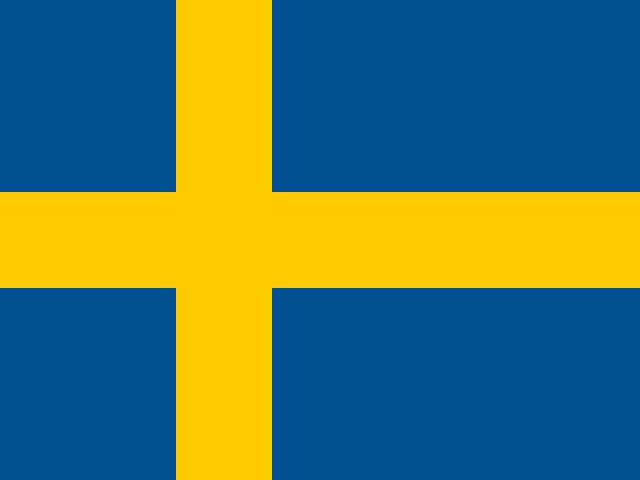
The Swedish flag is regulated by three statutes. The Act (1982:269) on the Flag of Sweden describes the flag’s design: a yellow cross on a blue field, its proportions and who may use the swallow-tailed flag. Ordinance (1983:826) sets out the flag’s exact colour shades in the NCS system. Ordinance (1982:270) on general flag days lists the days that are general flag days.
There is, however, no law stating at what time of day the flag is raised or how a flag is flown at half-mast. Those rules are recommendations. Riksarkivet (the Swedish National Archives), the state authority for heraldry and state symbols, refers to the recommendations published by the Swedish National Day Foundation (Stiftelsen Sveriges Nationaldag). They are based on the regulations of the Swedish Armed Forces, long tradition and international flag customs. Public authorities and the Armed Forces follow them, and for private individuals, associations and businesses they are good guidance. Riksarkivet’s own summary is worth remembering: better to fly the flag than to refrain for fear of doing it wrong.
For the flagpole itself there are no official rules on appearance or material. Instead, the Planning and Building Act and the municipality’s local development plan decide whether planning permission is needed, and the manufacturer’s instructions govern the foundation and installation.
The flagpole in Sweden
The classic Swedish flagpole is white with a gilded finial. In the past poles were made of wood; today they are usually made of glass-fibre reinforced plastic, and poles of aluminium and other metals are also common. Riksarkivet recommends that a flagpole at an ordinary house does not reach more than 3.5 metres above the ridge of the roof. Common heights for house gardens are 6–8 metres, while businesses and public buildings often have poles 10–12 metres high. More in the guides to types of flagpoles and flagpole heights.
When the flag is not flying, the pennant can be up instead. The blue and yellow pennant may fly around the clock and adorns the pole between flag days.
About the guides
The guides below are sorted by topic. Each guide covers one clearly defined subject, ends with frequently asked questions, lists its sources and shows when it was last updated. Dates for movable flag days, such as Easter Sunday and Midsummer Day, are calculated for 2026 and 2027.
All guides
Flag flying and rules
When, how and why flags are flown in Sweden – from the general flag days to half-mast, mourning and flags of other countries.
- Flag daysAll general flag days in Sweden in 2026 and 2027 with dates and weekdays, under Ordinance (1982:270). Includes election days and Veterans’ Day.
- Flag rulesFlying times in Sweden, lighting, the pennant and worn-out flags – and which rules are law and which are recommendations from Riksarkivet.
- Half-mastHow high the flag sits at half-mast in Sweden, how it is customarily raised and lowered, and which flags are not flown at half-mast – according to Riksarkivet.
- Flags in mourningSwedish custom for flying the flag at half-mast after a death and at a funeral, when it returns to the top, and what applies in royal and national mourning.
- Flags on holidaysFlag flying at Christmas, Easter, Midsummer, National Day, birthdays, weddings and graduation in Sweden – which holidays are flag days and what is tradition.
- Flag protocol at ceremoniesFlags and banners at ceremonies in Sweden: flag or banner, banner bearers, placement at funerals, the place of honour and raising the flag at formal occasions.
- Foreign flags in SwedenFlying other countries’ flags in Sweden: the place of honour, the order of national flags, the EU flag and flag days for neighbouring countries and minorities.
The flag
The Swedish flag’s design, sizes and symbolism, what affects the price of a flag, and a calculator that shows which flag and pennant suit a flagpole.
- Flag types and useRectangular and swallow-tailed flags, pennants, banners, wall flags and storm flags: which flag types exist in Sweden, who may use them and when.
- Flag sizesFlag sizes and pennant lengths for flagpoles of 6–18 metres by Riksarkivet’s rule of thumb, plus the Swedish flag’s statutory proportions of 10:16.
- Flag size calculatorA calculator showing the flag and pennant size for a given pole height, following Riksarkivet’s rule of thumb and the Swedish flag’s proportions of 10:16.
- Flag symbolismWhy the Swedish flag is blue and yellow, what the cross means and which exact colours the flag has under Ordinance (1983:826): NCS, Pantone and print colours.
- Buying a flagBuying a flag in Sweden: what affects the price of a Swedish flag – size, fabric, stitching and print – and what a correct flag looks like under the flag act.
The flagpole
Types, materials, heights, accessories, lighting and what affects the price of a flagpole – and how the flagpole came to Sweden.
- Types of flagpolesFree-standing, hinged, telescopic and wall-mounted poles, internal or external halyard: the most common flagpoles in Sweden and where they are usually used.
- Flagpole materialsComparing flagpoles in glass fibre, aluminium, steel and wood: strength, weight, maintenance and what suits the Swedish climate, houses and businesses.
- Flagpole heightsCommon flagpole heights for houses, cottages and businesses in Sweden, Riksarkivet’s advice on height above the roof and when permission is needed.
- Flagpole accessoriesFinial, pulley, halyard, cleat, flag clips, pennant rotator, ground sleeve and hinged base: what the parts of a flagpole are and what they do.
- Flagpole mechanicsHow a flagpole works: the halyard over the pulley, the cleat, internal halyards, rotating tops and hinged bases – and how wind affects pole and flag.
- Flag lightingA floodlit flag may stay up after sunset in Sweden. Ways of lighting a flagpole, what electrical safety rules say and when lighting needs permission.
- History of the flagpoleFrom blue and yellow cross flags on 16th-century ships to white glass-fibre poles at houses: the history of the flag and the flagpole in Sweden, with key dates.
- Buying a flagpoleBuying a flagpole in Sweden: what affects the price – height, material, halyard, base, delivery and installation – and what consumer law and planning rules say.
Installation, safety and care
Planning permission, foundations, safety, maintenance and transport – for homeowners, housing cooperatives, businesses and municipalities.
- Flagpole installationInstalling a flagpole in Sweden: when planning permission is required, placement, underground cables, foundations, ground sleeves and raising the pole.
- Flagpole safetyFlagpole safety in Sweden: the Planning and Building Act on load-bearing capacity and upkeep, wind load, fall zones, power lines and work at height.
- Flagpole maintenanceFlagpole maintenance in Sweden: halyard, pulley and foundation, cleaning glass fibre and aluminium, painting a wooden pole and caring for the flag.
- Flagpole repairCommon flagpole faults: a snapped halyard, a stiff pulley, a loose finial, glass-fibre damage and a leaning pole – and when poles are repaired or replaced.
- Lifespan and sustainabilityHow long do a flagpole, halyard, flag and pennant last? What affects their lifespan in Sweden and what applies to worn-out poles and flags.
- Transport and shippingTransporting a flagpole by car or trailer in Sweden: Transport Agency rules for projecting loads, load securing, sectional poles and home delivery.
- Flagpoles for businessesFlags for businesses and municipalities in Sweden: company flags, planning permission, the Swedish flag’s place of honour, flag policies and lighting.
Frequently asked questions
Is permission needed to fly the flag in Sweden?
No. Anyone may raise the Swedish flag whenever they like, including on days that are not flag days. The times and rules that exist are primarily meant for public authorities and the Swedish Armed Forces, but they are recommended for anyone who wants to fly the flag in the customary way.
Which laws govern the flag in Sweden?
The flag’s design is regulated by the Act (1982:269) on the Flag of Sweden, and its colours by Ordinance (1983:826). The general flag days are listed in Ordinance (1982:270) on general flag days. The times for raising and lowering the flag are recommendations published by Riksarkivet (the Swedish National Archives) and the Swedish National Day Foundation.
Does a flagpole need planning permission in Sweden?
A flagpole counts as a mast. Under the Planning and Building Act, planning permission is required if it is taller than 20 metres or stands closer to the boundary than its own height. A ten-metre pole five metres from the boundary therefore needs permission. The local development plan can contain further requirements, and the municipality can say what applies to a specific site.
Which flag size is recommended in Sweden?
Riksarkivet recommends a flag length of about one quarter of the flagpole’s height. A ten-metre pole therefore suits a flag about 250 centimetres long. The flag’s height relates to its length as 10 to 16.
At what times is the flag flown in Sweden?
From 1 March to 31 October the flag is raised at 08:00, and from 1 November to the end of February at 09:00. It is lowered at sunset, but no later than 21:00. A floodlit flag may stay up after sunset.
Sources
This guide is based on the following sources, most of them in Swedish:
- Lag (1982:269) om Sveriges flagga – Sveriges riksdag
- Förordning (1982:270) om allmänna flaggdagar – Sveriges riksdag
- Sveriges flagga – Riksarkivet
- Flaggningstider – Stiftelsen Sveriges Nationaldag
- Bygglov för mast och torn – Boverket