The history of the flagpole and the flag in Sweden
Published Written by Flagpole Guides
This page is an English translation of the Swedish original. Where the two versions differ, the Swedish text is the original.
The flagpole at the Swedish house is a fairly recent phenomenon, but the flag it carries has a history of almost 500 years. It began at sea, where flags and pennants showed which country a ship belonged to, and gradually moved ashore, to royal palaces, fortresses, farms and finally to gardens all over the country.
The flag at sea
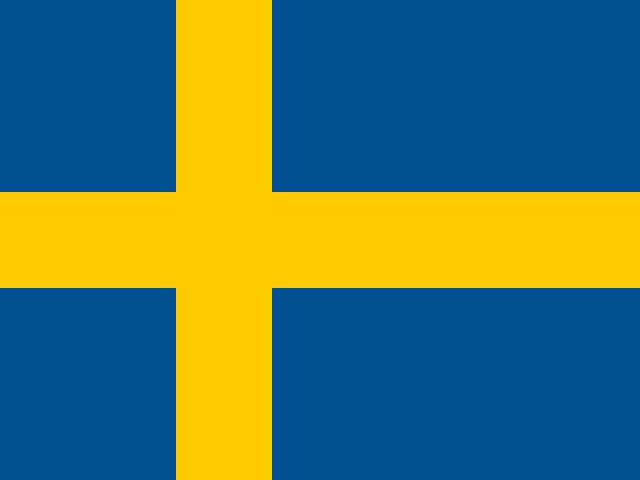
According to Riksarkivet, the history of the Swedish flag goes back to the middle of the 16th century, the end of Gustav Vasa’s reign. The model was almost certainly Denmark’s Dannebrog, the red flag with a white cross, and the colours were taken from the national coat of arms with its three golden crowns on a blue field.
From the 1620s, in the reign of Gustav II Adolf, there is pictorial evidence that blue and yellow cross flags were flown on Swedish ships. The flag was then above all a mark of identity at sea, and the ship’s mast was its first flagpole.
Sweden’s first flag law of 1663 stipulated that the flag with three tongues could only be used by naval vessels, the navy’s warships. That distinction remains today: the swallow-tailed flag is the Swedish Armed Forces’ naval ensign and the flag of the Royal House. The pennant also has a long history in the navy and was regulated as early as the beginning of the 18th century.
The union period
For much of the union with Norway, which lasted from 1814 to 1905, the Swedish and Norwegian flags carried a common union mark in the upper inner field. The mark, which combined the colours of both countries, was popularly called the herring salad (sillsallaten). It was removed after the dissolution of the union in 1905.
The flag act of 1906
The year after the dissolution of the union, a new flag act came in 1906. For the first time, it set fixed rules for the flag’s proportions and colour shades.
The flag moves ashore
Towards the end of the 19th century, the flag became a symbol of the whole people and not only of the state and the navy. According to Riksarkivet, flag festivals have been held at Skansen since the 1890s, and from 1916 Swedish Flag Day on 6 June was celebrated officially and throughout the country. The date was chosen because Gustav Vasa was elected king on 6 June 1523 and the Instrument of Government of 1809 was adopted on the same date.
As more and more people wanted to fly the flag on special days, the flagpole became common at farms, schools, community halls and summer houses, and during the 20th century at ordinary houses too. The classic Swedish flagpole, white with a gilded finial, is still the most common.
From wood to glass fibre
Flagpoles used to be made of wood, often from a straight trunk of pine or spruce painted white. Wooden poles needed regular painting and could rot at ground level. Today, according to Riksarkivet, flagpoles are usually made of glass-fibre reinforced plastic, and poles of metal also exist. The change of material has made poles lighter, more durable and easier to look after. More in the guide to flagpole materials.
The modern flag act
In 1982 the flag legislation was modernised through the Act (1982:269) on the Flag of Sweden, and the same year saw Ordinance (1982:270) on general flag days. In 1983 Swedish Flag Day gained the status of National Day, and the same year the flag’s exact colours were set in NCS by Ordinance (1983:826). Since 2005, National Day on 6 June has also been a public holiday, after the Riksdag decided that it would replace Whit Monday.
Timeline
| Year | Event |
|---|---|
| 1550s | The blue and yellow cross flag comes into use, at the end of Gustav Vasa’s reign |
| 1620s | Pictorial evidence of blue and yellow cross flags on Swedish ships |
| 1663 | The first flag law: swallow-tailed flag only for naval vessels |
| Early 18th century | The pennant is regulated in the navy |
| 1814–1905 | The union with Norway, for much of the time with a union mark in the flags |
| 1890s | Flag festivals at Skansen |
| 1906 | New flag act with fixed proportions and colours |
| 1916 | Swedish Flag Day celebrated throughout the country |
| 1982 | Today’s flag act and ordinance on general flag days |
| 1983 | 6 June becomes National Day, the flag’s colours are set in NCS |
| 2005 | National Day becomes a public holiday |
How the flag’s colours and cross are interpreted is described in the guide to flag symbolism.
Frequently asked questions
How old is the Swedish flag?
The Swedish flag dates back to the middle of the 16th century, the end of Gustav Vasa’s reign. From the 1620s there is pictorial evidence that blue and yellow cross flags were flown on Swedish ships.
When did 6 June become Swedish Flag Day?
Swedish Flag Day has been celebrated throughout the country since 1916. The day became the National Day of Sweden in 1983 and a public holiday in 2005. The date recalls that Gustav Vasa was elected king on 6 June 1523 and that the Instrument of Government of 1809 was adopted on that day.
What was the “herring salad”?
For much of the union with Norway, which lasted from 1814 to 1905, the flags carried a union mark with both countries’ colours. The mark was popularly called the herring salad (sillsallaten) and was removed after the dissolution of the union in 1905.
What were flagpoles made of in the past?
Flagpoles used to be made of wood. Today they are usually made of glass-fibre reinforced plastic, and metal poles also exist, according to Riksarkivet.
Sources
This guide is based on the following sources, most of them in Swedish:
- Sveriges flagga – flaggans historia – Riksarkivet
- Flaggans historia – Stiftelsen Sveriges Nationaldag
- Nationaldagen den 6 juni som allmän helgdag (prop. 2004/05:23) – Sveriges riksdag
- Lag (1982:269) om Sveriges flagga – Sveriges riksdag
Related guides
- Flag symbolismWhy the Swedish flag is blue and yellow, what the cross means and which exact colours the flag has under Ordinance (1983:826): NCS, Pantone and print colours.
- Flag daysAll general flag days in Sweden in 2026 and 2027 with dates and weekdays, under Ordinance (1982:270). Includes election days and Veterans’ Day.
- Flagpole materialsComparing flagpoles in glass fibre, aluminium, steel and wood: strength, weight, maintenance and what suits the Swedish climate, houses and businesses.
- Flag types and useRectangular and swallow-tailed flags, pennants, banners, wall flags and storm flags: which flag types exist in Sweden, who may use them and when.