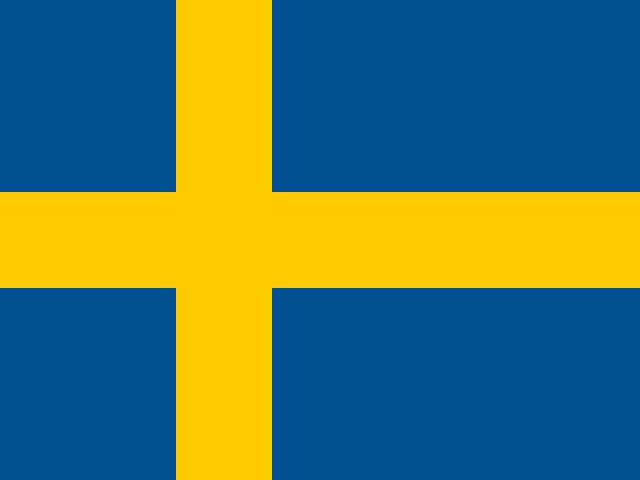
Flying the flags of other countries in Sweden
Published Written by Flagpole Guides
This page is an English translation of the Swedish original. Where the two versions differ, the Swedish text is the original.
Flags from other countries are a common sight in Sweden: at embassies, hotels and businesses, during state visits and sporting events, and at private homes. There is no ban on flying another country’s flag in Sweden, but there is an established order for how the flags are placed when several countries’ flags fly at the same time. This guide summarises Riksarkivet’s guidance.
Private individuals
According to Riksarkivet, foreign citizens living in Sweden may fly their own country’s flag. On Swedish holidays and general flag days, foreign missions and consulates, as well as foreign citizens living here, usually fly their own countries’ flags. Foreign citizens permanently resident in Sweden are also welcome to fly the Swedish flag on the general flag days.
Under the Swedish recommendations, the following also applies:
- One nation per pole. Only one flag is raised on each flagpole.
- The same size. When several national flags fly at the same time, they are the same size.
The place of honour
According to Riksarkivet, the Swedish flag always has the place of honour when flags of several nations are flown. The place of honour is determined with one’s back to the building or place where the flags fly:
- Odd number of poles: the Swedish flag is raised on the middle pole.
- Even number of poles: the Swedish flag is raised on the pole immediately to the right of the middle, and that pole then becomes “the new middle”.
The order of several countries
According to Riksarkivet, the other national flags are raised in alphabetical order of the countries’ names in Swedish, from the place of honour outwards, alternately to heraldic right and heraldic left. Where needed, Swedish flags are raised on the outermost poles so that no poles stand empty.
Riksarkivet’s examples, where pole no. 1 is the place of honour:
| Number of poles | Placement |
|---|---|
| 2 | The Swedish flag in the place of honour, one foreign flag on no. 2. With two poles, only one foreign nation can be honoured. |
| 3 | The Swedish flag in the place of honour, foreign flags on nos. 2 and 3 in alphabetical order. |
| 5, one foreign nation | The Swedish flag on nos. 1, 4 and 5, the foreign flag on nos. 2 and 3. |
| 5, four foreign nations | The Swedish flag in the place of honour, the four countries on nos. 2–5 in alphabetical order. |
| 7, five foreign nations | The Swedish flag on nos. 1 and 7, the five countries on nos. 2–6 in alphabetical order. |
When the flagpoles stand in two rows in front of a building, according to Riksarkivet the two poles nearest the building count as the place of honour, and both carry Swedish flags. When the poles stand in a row leading away from the building, the pole nearest the building is the place of honour.
The EU flag and other international flags
The EU flag and the UN flag are not national flags, but the same logic applies: the Swedish flag has the place of honour. Riksarkivet gives the example of a county administrative board flying the Swedish flag, the EU flag and its own flag: the Swedish flag goes on pole no. 1, the EU flag on no. 2 and the board’s flag on no. 3. During visits from several EU countries, the EU flag can be raised on pole no. 2 instead of choosing between the countries.
According to Riksarkivet, international flags, company flags and association flags are not flown at half-mast. More in the guide to half-mast.
Days when many fly other flags
Several municipalities and authorities fly other flags on certain days. These are not general flag days but decisions each organisation makes. The City of Stockholm, for example, flies flags as follows:
| Date | Occasion | Flag |
|---|---|---|
| 6 February | Sami National Day | The Sami flag |
| 24 February | Day of the Sweden Finns | The Sweden Finnish flag |
| 8 April | International Roma Day | The Roma flag |
| 9 May | Europe Day | The EU flag |
| 17 May | Norway’s Constitution Day | The Norwegian flag |
| 5 June | Denmark’s Constitution Day | The Danish flag |
| 17 June | Iceland’s National Day | The Icelandic flag |
| 15 July | Day of the Tornedalians | The Tornedalian flag |
| 6 December | Finland’s Independence Day | The Finnish flag |
On the national minorities’ days, municipalities often fly the Swedish flag together with the minority’s flag.
State visits and official visits
During official visits from another country, it is common for authorities, municipalities and businesses to fly the guest country’s flag as a courtesy. According to Riksarkivet, the Swedish flag has the place of honour then too, and the guest country’s flag is raised on pole no. 2 and, where there are more poles, no. 3. More about ceremonies in the guide to flag protocol at ceremonies.
Frequently asked questions
May another country’s flag be flown in Sweden?
Yes. There is no ban on flying foreign flags in Sweden. According to Riksarkivet, foreign citizens living here may fly their country’s flag, both at their own celebrations and on Swedish flag days.
Which flag has the place of honour in Sweden?
According to Riksarkivet, the Swedish flag always has the place of honour when flags of several nations are flown in Sweden. With an odd number of poles it is the middle pole; with an even number, the pole immediately to the right of the middle, as seen with one’s back to the building.
In what order are several countries’ flags usually flown?
According to Riksarkivet, they are flown in alphabetical order of the countries’ names in Swedish, from the place of honour outwards, alternately to heraldic right and heraldic left.
Is the EU flag flown at half-mast in Sweden?
No. According to Riksarkivet, only the Swedish flag is used in mourning, and international flags such as the EU flag and the UN flag are not flown at half-mast.
On which days do Swedish municipalities fly other flags?
Each municipality decides. The City of Stockholm, for example, flies the EU flag on Europe Day on 9 May, the flags of the Nordic neighbours on their national days and the flags of the national minorities on their special days.
Sources
This guide is based on the following sources, most of them in Swedish:
- Sveriges flagga – utländsk flaggning i Sverige och internationell flaggning – Riksarkivet
- Flaggregler och flaggtyper – Stiftelsen Sveriges Nationaldag
- Flaggning i Stockholms stad – Stockholms stad
- Nationella minoriteternas flaggdagar – Strängnäs kommun
Related guides
- Flag protocol at ceremoniesFlags and banners at ceremonies in Sweden: flag or banner, banner bearers, placement at funerals, the place of honour and raising the flag at formal occasions.
- Flagpoles for businessesFlags for businesses and municipalities in Sweden: company flags, planning permission, the Swedish flag’s place of honour, flag policies and lighting.
- Flag daysAll general flag days in Sweden in 2026 and 2027 with dates and weekdays, under Ordinance (1982:270). Includes election days and Veterans’ Day.
- Flag rulesFlying times in Sweden, lighting, the pennant and worn-out flags – and which rules are law and which are recommendations from Riksarkivet.