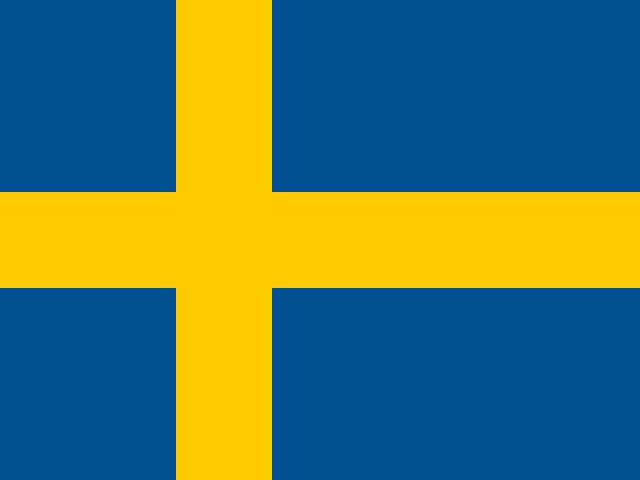
Flag rules in Sweden
Published Written by Flagpole Guides
This page is an English translation of the Swedish original. Where the two versions differ, the Swedish text is the original.
Many people believe that a law governs when the flag is raised and lowered in Sweden, but that is not the case. The Act on the Flag of Sweden describes what the flag looks like, and the ordinance on general flag days states which days are flag days. The times and most of the flag etiquette are instead recommendations. Riksarkivet (the Swedish National Archives), the state authority for state symbols, refers to the recommendations published by the Swedish National Day Foundation. They are based on the regulations of the Swedish Armed Forces, long tradition and international flag customs.
Flying times
| Period | Flag raised | Flag lowered |
|---|---|---|
| 1 March – 31 October | 08:00 | At sunset, no later than 21:00 |
| 1 November – 28/29 February | 09:00 | At sunset, no later than 21:00 |
The times apply on all days, both general flag days and other days. A floodlit flag may stay up after sunset, which is common at public buildings and on evenings with festivities. More in the guide to flag lighting.
North of the Arctic Circle the sun does not rise for a period around the winter solstice. The Swedish Armed Forces have special times for the dark period, when the flag only flies for a few hours in the middle of the day.
Who the rules apply to
The times are written for public authorities and the Swedish Armed Forces, and they are followed there. For private individuals, associations and businesses there is, according to the Swedish National Day Foundation, a certain freedom. It is not illegal to raise the flag later than 08:00 or to leave it up on a light summer evening after 21:00, but the times above are what counts as established Swedish practice.
Riksarkivet sums it up like this: formality should not go so far that the flag is not flown at all, and it is better to fly the flag than to refrain for fear of doing it wrong.
Flag etiquette according to the recommendations
- At the top: the flag is raised properly all the way up to the finial, with the halyard taut. It is worth bearing in mind that a flag hanging some way down the pole can be mistaken for mourning.
- One flag per pole: only one flag is raised on each pole, so flying both the Swedish flag and, for example, an association’s flag is done on two poles.
- Whole and clean: the flag is whole and clean and has kept its colours. A worn, torn or faded flag is not recommended.
- Respect: the flag is treated with respect, and many therefore avoid letting it touch the ground.
- The pennant: the pennant adorns the pole when the flag is not flying and is taken down when the flag is raised.
How a flag is flown at half-mast is described in the guide to half-mast.
The pennant
The Swedish pennant is a long, tapering streamer, split lengthwise into blue and yellow. It does not replace the flag but adorns the flagpole when the flag is not flying, and according to the recommendations it may therefore fly around the clock. The blue field is at the top. Riksarkivet advises against so-called cross pennants with a yellow cross, because they have the flag’s colours but not the proportions the law prescribes. More in the guide to flag types.
Marks and symbols on the flag
Under section 4 of the Act on the Flag of Sweden, the flag may not bear marks, letters or other symbols beyond those the Act itself specifies for the Royal House and the Swedish Armed Forces. A flag with printed text or a logo is therefore not a correct Swedish flag. According to Riksarkivet, the flag may not be used in trade marks without special permission either, and such matters are examined by the Swedish Intellectual Property Office (Patent- och registreringsverket).
Worn-out flags
According to Riksarkivet, a worn-out flag is also treated with respect and not used for anything else. There are no rules on how it is destroyed, but the Swedish National Day Foundation recommends cutting the flag into pieces of only blue and only yellow fabric that no longer form a flag, and then throwing the pieces away. The foundation advises against burning the flag, because most flags today are made of polyester, which melts and gives off toxic smoke.
Flying the flag from a boat
According to the Swedish National Day Foundation, leisure boats may fly the Swedish flag at all hours when under way. For boats that are moored or at anchor, the same flying times apply as on land.
Advertisement
Frequently asked questions
At what time is the flag raised in Sweden?
According to the recommendations from the Swedish National Day Foundation that Riksarkivet refers to, the flag is raised at 08:00 from 1 March to 31 October and at 09:00 from 1 November to 28 or 29 February.
When is the flag taken down in Sweden?
According to the recommendations, the flag is lowered at sunset, but no later than 21:00, all year round. A floodlit flag may stay up after sunset.
Is it illegal to leave the Swedish flag up at night?
No. The flying times are not law but recommendations that public authorities follow. In Swedish tradition, an unlit flag in the dark is regarded as poor flag etiquette. According to the recommendations, the pennant may fly around the clock.
Can two flags fly on the same pole in Sweden?
According to the Swedish recommendations, only one flag is raised on each pole. Flying several flags is therefore done on several flagpoles.
What is recommended for an old Swedish flag?
The Swedish National Day Foundation recommends that a worn-out flag is cut into pieces of only blue and only yellow fabric, so that it is no longer a flag, and that the pieces are then thrown away. The foundation advises against burning the flag, because polyester gives off toxic smoke and melts.
Sources
This guide is based on the following sources, most of them in Swedish:
- Sveriges flagga – flaggningstider och flaggans användning – Riksarkivet
- Flaggningstider – Stiftelsen Sveriges Nationaldag
- Flaggregler och flaggtyper – Stiftelsen Sveriges Nationaldag
- Lag (1982:269) om Sveriges flagga – Sveriges riksdag
- FFS 1999:4 – Försvarsmaktens föreskrifter om flaggning – Försvarsmakten (via lagen.nu)
Related guides
- Flag daysAll general flag days in Sweden in 2026 and 2027 with dates and weekdays, under Ordinance (1982:270). Includes election days and Veterans’ Day.
- Half-mastHow high the flag sits at half-mast in Sweden, how it is customarily raised and lowered, and which flags are not flown at half-mast – according to Riksarkivet.
- Flag lightingA floodlit flag may stay up after sunset in Sweden. Ways of lighting a flagpole, what electrical safety rules say and when lighting needs permission.
- Flag types and useRectangular and swallow-tailed flags, pennants, banners, wall flags and storm flags: which flag types exist in Sweden, who may use them and when.