Buying a Swedish flag – price, size and quality
Published Written by Flagpole Guides
This page is an English translation of the Swedish original. Where the two versions differ, the Swedish text is the original.
A Swedish flag can cost very different amounts, even in the same size. The difference often only shows after some time in the wind: in how the fabric fades, how the edges hold up and how the colours last. This guide gives no prices, since they vary between manufacturers and over time. Instead it describes what affects the price of a flag, what a correct Swedish flag looks like under the law and which rules apply to the purchase.
What affects the price of a flag?
| Factor | How it affects the price |
|---|---|
| Size | A larger flag needs more fabric and more stitching |
| Fabric | The fabric’s weight and weave affect both price and durability |
| Sewn or printed | A sewn-in cross takes more work than a printed one |
| Edges and fly | Reinforced edges and double seams at the free end take more work |
| Fastening | Halyard, snap hooks or eyelets vary between models |
| Custom-made | Flags with a logo or custom design are often made to order |
Flag price and size
Size is the single biggest factor in the price. The right size depends on the flagpole’s height. According to Riksarkivet’s rule of thumb, the flag’s length is about one quarter of the pole’s height, and on very tall poles the flag can be up to one sixth smaller. Common standard sizes in the shops include flags 150, 200, 240 and 300 centimetres long.
| Pole height | Flag length by the rule of thumb |
|---|---|
| 6 metres | about 150 cm |
| 8 metres | about 200 cm |
| 10 metres | about 250 cm |
| 12 metres | about 300 cm |
More sizes are in the guide to flag sizes, and the flag size calculator works out the size for a particular height. A flag that is too large catches more wind and puts more strain on the pole.
Fabric, stitching and print
Most flags today are made of polyester. Even so, flags differ in the fabric’s weight, weave and colourfastness. A few things that usually affect both the price and how long the flag lasts:
- Sewn or printed cross: in a sewn flag, the cross and the fields are stitched together from separate pieces of fabric. In a printed flag, the colours are printed onto the fabric.
- Reinforced fly: the free end, which wears most in the wind, is sometimes reinforced with extra seams.
- Colourfastness: colours that resist UV light fade more slowly.
A flag raised every day wears faster than one raised only on flag days, which affects how often a new flag is needed.
A correct Swedish flag under the law
The Act on the Flag of Sweden and Ordinance (1983:826) describe what the flag looks like. It can be useful to know when buying:
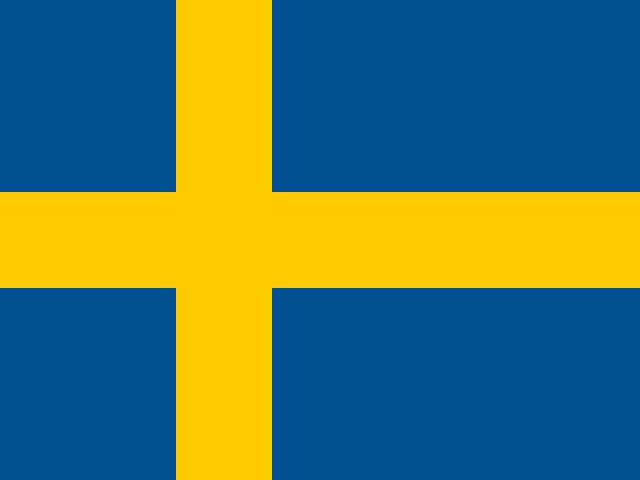
- Proportions: the rectangular flag’s height relates to its length as 10 to 16. The cross divides the flag into 5 + 2 + 9 parts along the length and 4 + 2 + 4 along the height.
- Colours: the fields are light medium blue and the cross golden yellow. The exact shades are set out in NCS in Ordinance (1983:826).
- No symbols: under section 4, the flag may not bear marks, letters or other symbols beyond what the Act specifies for the Royal House and the Swedish Armed Forces.
- Swallow-tailed flag: under the Act it is intended for the head of state and the Royal House, the Swedish Armed Forces and certain other authorities. Otherwise the rectangular flag is used.
More about the colours in the guide to flag symbolism and about the flag’s different forms in the guide to flag types.
Pennants and other flag types
A pennant often goes with the flag. The pennant adorns the pole when the flag is not flying and, according to the recommendations, may stay up around the clock. According to Riksarkivet, the pennant is between one third and one half of the pole’s height, and the blue field is at the top. Riksarkivet advises against cross pennants with a yellow cross, because they lack the flag’s statutory proportions.
Other flags that come up when buying are wall or balcony flags on a short pole and a smaller storm flag for windy days.
Consumer rights when buying
- Right of withdrawal: when buying at a distance from a business, there is normally a 14-day right of withdrawal under the Distance Contracts Act. Under the Act it does not apply to goods made to the consumer’s specifications or clearly personalised, such as a flag with the buyer’s own logo.
- Complaints: according to the Swedish Consumer Agency (Konsumentverket), the business is responsible for original defects for at least three years from the purchase, with the burden of proof on the business for the first two years.
When the flag is worn out
A flag that has faded, torn or frayed is often replaced by a new one. The Swedish National Day Foundation recommends cutting a worn-out flag into pieces of only blue and only yellow fabric that no longer form a flag, and advises against burning it. More in the guide to flag rules. A new pole is covered in the guide to buying a flagpole.
Frequently asked questions
What affects the price of a flag?
The price of a flag depends mainly on the size, the quality of the fabric, whether the cross is sewn or printed, how the edges are reinforced and how the flag is attached to the halyard. Custom-made flags, for example with a logo, are often priced separately.
Which flag size suits a particular flagpole?
According to Riksarkivet’s rule of thumb, the flag’s length is about one quarter of the flagpole’s height. A ten-metre pole therefore suits a flag about 250 centimetres long. The flag’s height relates to its length as 10 to 16.
How can a correct Swedish flag be recognised?
Under the Act on the Flag of Sweden, the rectangular flag has height and length in the ratio 10 to 16, with the cross dividing it into 5 + 2 + 9 parts along the length and 4 + 2 + 4 along the height. The colours are set out in NCS in Ordinance (1983:826). Under section 4, the flag may not bear marks, letters or other symbols.
Can anyone buy a swallow-tailed Swedish flag?
Under the Act on the Flag of Sweden, the swallow-tailed flag is intended for the head of state and the Royal House, the Swedish Armed Forces and other authorities with military operations. Otherwise the rectangular flag is used.
Can the purchase of a custom-printed flag be cancelled?
When buying at a distance from a business, a 14-day right of withdrawal normally applies. Under the Swedish Distance Contracts Act, however, the right of withdrawal does not apply to goods made to the consumer’s specifications or clearly personalised, which can include flags with the buyer’s own logo or design.
Sources
This guide is based on the following sources, most of them in Swedish:
- Lag (1982:269) om Sveriges flagga – Sveriges riksdag
- Sveriges flagga – flaggans storlek, färger och vimpel – Riksarkivet
- Flaggregler och flaggtyper – Stiftelsen Sveriges Nationaldag
- Konsumentköplagen för företag – Konsumentverket
- Lag (2005:59) om distansavtal och avtal utanför affärslokaler – Sveriges riksdag
Related guides
- Flag sizesFlag sizes and pennant lengths for flagpoles of 6–18 metres by Riksarkivet’s rule of thumb, plus the Swedish flag’s statutory proportions of 10:16.
- Flag size calculatorA calculator showing the flag and pennant size for a given pole height, following Riksarkivet’s rule of thumb and the Swedish flag’s proportions of 10:16.
- Flag types and useRectangular and swallow-tailed flags, pennants, banners, wall flags and storm flags: which flag types exist in Sweden, who may use them and when.
- Flag symbolismWhy the Swedish flag is blue and yellow, what the cross means and which exact colours the flag has under Ordinance (1983:826): NCS, Pantone and print colours.
- Buying a flagpoleBuying a flagpole in Sweden: what affects the price – height, material, halyard, base, delivery and installation – and what consumer law and planning rules say.
- Flag rulesFlying times in Sweden, lighting, the pennant and worn-out flags – and which rules are law and which are recommendations from Riksarkivet.