Flag types and their use in Sweden
Published Written by Flagpole Guides
This page is an English translation of the Swedish original. Where the two versions differ, the Swedish text is the original.
The Swedish flag comes in several forms. The Act on the Flag of Sweden distinguishes between the rectangular (tvärskuren) and the swallow-tailed (tretungad) flag, and alongside them there are the pennant, the banner and the wall flag. They have different uses, and not all of them may be used by everyone. This guide goes through the flag types and when they are used.
The rectangular flag – the ordinary flag
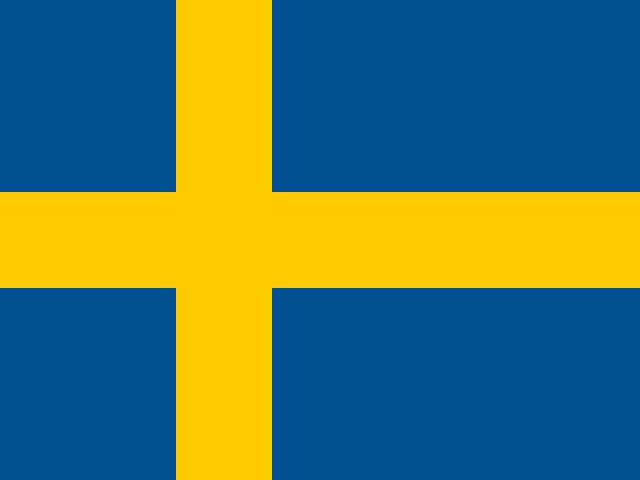
The rectangular flag is the flag most people raise. The Act describes it in detail:
- The flag’s height relates to its length as 10 to 16.
- The inner fields, nearest the pole, have height and length in the ratio 4 to 5.
- The outer fields have height and length in the ratio 4 to 9.
- The width of the cross arms is half the height of each field.
Converted, that gives 5 + 2 + 9 parts along the length and 4 + 2 + 4 parts along the height. The rectangular flag is the one used for ordinary flag flying. Sizes are described in the guide to flag sizes.
The swallow-tailed flag
The swallow-tailed flag has a split outer part with three tongues. Its height is half its length, tongues included. Under the Act it may be used by:
- the head of state and, with the head of state’s permission, other members of the Royal House, with or without the great or lesser coat of arms on a white field in the centre of the cross
- the Swedish Armed Forces as the naval ensign
- other authorities with military operations, under regulations from the government.
Otherwise, under the Act, the rectangular flag is used, which means the swallow-tailed flag is not intended for private individuals, businesses or associations.
The pennant
The Swedish pennant (vimpel) is a long streamer that tapers towards the tip and is split lengthwise into blue and yellow. It has a long tradition and was regulated in the navy as early as the beginning of the 18th century. The pennant does not replace the flag; it adorns the flagpole when the flag is not flying. It may therefore fly around the clock.
- The blue field is at the top according to Riksarkivet.
- Length: between one third and one half of the pole’s height according to Riksarkivet.
- Never at half-mast. In mourning, the pennant is swapped for the flag.
The cross pennant, with a yellow cross on a blue field, is a modern phenomenon. Riksarkivet advises against it because it lacks tradition and has the flag’s colours but not the flag’s statutory proportions.
The banner
A banner (fana) is a flag cloth fixed to a staff and carried, for example in processions and at ceremonies. The Swedish banner has set dimensions: 100 centimetres high and 160 centimetres long. Banners at ceremonies and funerals are described in the guide to flag protocol at ceremonies.
Wall and balcony flags
The wall or balcony flag is a smaller flag on a short pole that projects at an angle from a house wall or balcony railing. Riksarkivet points out that it represents Sweden and not any particular group, and that it can be used by anyone living in Sweden. According to Riksarkivet, wall flags follow the same flying times as ordinary flags as far as possible. On a wall-mounted pole, the flag is lowered to the middle of the pole at half-mast.
The storm flag
In very strong wind, a storm flag can be raised. It is a smaller flag that does not risk breaking the pole. It is an alternative to not flying the flag at all on a windy flag day.
Flag types and use in brief
| Use | Flag type |
|---|---|
| Flag days and celebrations | Rectangular flag |
| Adorning the pole on ordinary days | Pennant, split into blue and yellow |
| Flying from a balcony or wall | Wall or balcony flag |
| Windy flag day | Storm flag |
| Carrying in a procession | Banner, 100 × 160 cm |
Frequently asked questions
What is the difference between the rectangular and the swallow-tailed Swedish flag?
The rectangular flag is the ordinary flag with the proportions 10 to 16. The swallow-tailed flag has a split outer part with three tongues and is twice as long as it is high. It is used by the Swedish Armed Forces as the naval ensign and by the Royal House.
May private individuals use the swallow-tailed flag?
No. Under the Act on the Flag of Sweden, the swallow-tailed flag is used by the head of state and the Royal House, as the naval ensign by the Swedish Armed Forces and by certain other authorities with military operations. Otherwise the rectangular flag is used.
What is a cross pennant and may it be used?
A cross pennant is a pennant with a yellow cross on a blue field. It is not banned, but Riksarkivet advises against it. It has no historical basis and has the flag’s colours but not the proportions the flag law prescribes.
How long is the pennant according to the recommendations?
Riksarkivet recommends a pennant between one third and one half of the flagpole’s height. On a twelve-metre pole that means a pennant of 4–6 metres.
Sources
This guide is based on the following sources, most of them in Swedish:
- Lag (1982:269) om Sveriges flagga – Sveriges riksdag
- Sveriges flagga – vimpel, fana och fasadflagga – Riksarkivet
- Flaggregler och flaggtyper – Stiftelsen Sveriges Nationaldag
Related guides
- Flag sizesFlag sizes and pennant lengths for flagpoles of 6–18 metres by Riksarkivet’s rule of thumb, plus the Swedish flag’s statutory proportions of 10:16.
- Flag symbolismWhy the Swedish flag is blue and yellow, what the cross means and which exact colours the flag has under Ordinance (1983:826): NCS, Pantone and print colours.
- Flag rulesFlying times in Sweden, lighting, the pennant and worn-out flags – and which rules are law and which are recommendations from Riksarkivet.
- Flag size calculatorA calculator showing the flag and pennant size for a given pole height, following Riksarkivet’s rule of thumb and the Swedish flag’s proportions of 10:16.
- Buying a flagBuying a flag in Sweden: what affects the price of a Swedish flag – size, fabric, stitching and print – and what a correct flag looks like under the flag act.