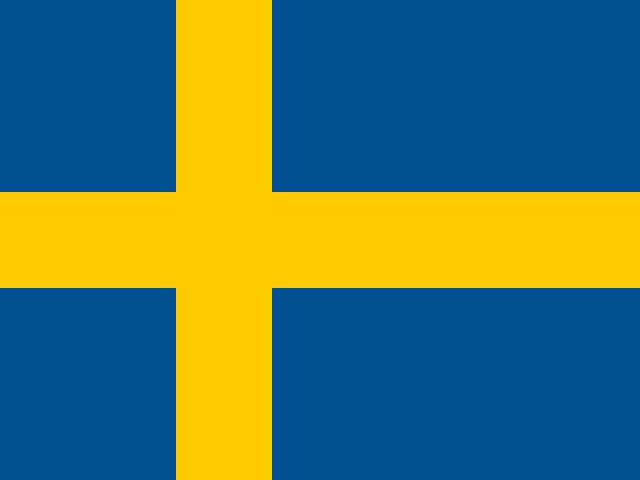
The Swedish flag’s symbolism, colours and cross
Published Written by Flagpole Guides
This page is an English translation of the Swedish original. Where the two versions differ, the Swedish text is the original.
The blue and yellow flag with its yellow cross is one of Sweden’s strongest symbols. It unites everyone who lives in the country regardless of background, and it is used in both joy and grief. But why does it look the way it does, and which colours are actually the right ones? This guide goes through the flag’s symbolism and the exact colours under Swedish law.
The colours come from the coat of arms
According to Riksarkivet, the flag’s colours come from the national coat of arms. The lesser coat of arms consists of three golden crowns on a blue field, and the great coat of arms is divided by a yellow cross into four blue fields. Blue and yellow were therefore Sweden’s colours long before the flag took its present form.
There are also popular interpretations, for example that the blue stands for the sky and the water and the yellow for the sun or the fields of grain. They are beautiful images, but they are later explanations and not the flag’s historical origin.
The cross
The cross is set at right angles to the flag’s edges, as the law puts it, and shifted towards the pole. The Swedish flag was probably created with the Danish Dannebrog as its model, with its white cross on red. The same cross shape appears today in the flags of all the Nordic countries and is called the Nordic cross, or Scandinavian cross. It makes the Nordic flags easy to recognise as a family.
The flag’s exact colours
The Act on the Flag of Sweden says that the flag is light medium blue on the fields and golden yellow on the cross. The exact shades are set out in Ordinance (1983:826):
| System | Blue | Yellow |
|---|---|---|
| NCS (the legal definition) | 4055-R95B | 0580-Y10R |
| Pantone | PMS 301 C/U | PMS 116 C (coated) / 109 U (uncoated) |
| Four-colour print (Eurocolor) | 10% yellow, 50% magenta, 100% cyan | 100% yellow, 20% magenta |
The NCS values are the legally binding ones, with a tolerance of less than ±5 NCS units for blackness, chromaticness and hue. The ordinance also gives the values in the CIE system. The Pantone and print colours come from Riksarkivet’s recommendations.
The proportions
The flag’s shape is also regulated. The ordinary rectangular flag has height and length in the ratio 10 to 16, and the cross divides it into the parts 5 + 2 + 9 along the length and 4 + 2 + 4 along the height. The swallow-tailed flag, used by the Royal House and the Swedish Armed Forces, is twice as long as it is high. More in the guide to flag types.
The flag as a shared symbol
Riksarkivet stresses that even the small wall or balcony flag represents Sweden and not any particular group, and that it can be used by everyone in Sweden regardless of origin. The flag is raised on National Day, at family celebrations, during state visits and in mourning, and it is the same in every context.
Protection of the flag
The flag has a certain legal protection:
- No additions. Under section 4 of the flag act, the flag may not bear marks, letters or other symbols beyond what the Act specifies for the Royal House and the Swedish Armed Forces.
- Trade marks. The flag may not be used in trade marks and the like without special permission. The Swedish Intellectual Property Office (Patent- och registreringsverket) examines the use of official designations.
- The colours are free. Using blue and yellow decoratively, for example in a product design, is allowed as long as it does not appear as the flag in a trade mark.
How the flag came about, from the 16th century to the present day, is described in the guide to the history of the flagpole.
Frequently asked questions
Why is the Swedish flag blue and yellow?
The colours come from the national coat of arms: the three golden crowns on a blue field in the lesser coat of arms and the yellow cross that divides the great coat of arms into four blue fields. Other interpretations, such as blue sky and yellow sun, are later popular explanations.
What are the official colours of the Swedish flag?
Ordinance (1983:826) sets out the colours in NCS: the blue 4055-R95B and the yellow 0580-Y10R. Riksarkivet gives the corresponding Pantone colours: PMS 301 for blue and PMS 116 C (coated paper) or 109 U (uncoated paper) for yellow.
Why does the Swedish flag have a cross?
The Swedish flag was probably created with the Danish flag, the Dannebrog, as its model, which has long had a white cross on red. The cross shifted towards the pole is today called the Nordic cross and appears in the flags of all the Nordic countries.
May the Swedish flag be used in a logo?
The flag may not be used in trade marks and the like without special permission. The Swedish Intellectual Property Office examines the use of official designations. Using the flag’s colours decoratively, on the other hand, is allowed.
Sources
This guide is based on the following sources, most of them in Swedish:
- Förordning (1983:826) med riktlinjer för färgnyanserna i Sveriges flagga – Sveriges riksdag
- Sveriges flagga – flaggans färger och historia – Riksarkivet
- Lag (1982:269) om Sveriges flagga – Sveriges riksdag
- Officiella beteckningar i varumärken – Patent- och registreringsverket
Related guides
- History of the flagpoleFrom blue and yellow cross flags on 16th-century ships to white glass-fibre poles at houses: the history of the flag and the flagpole in Sweden, with key dates.
- Flag types and useRectangular and swallow-tailed flags, pennants, banners, wall flags and storm flags: which flag types exist in Sweden, who may use them and when.
- Flag sizesFlag sizes and pennant lengths for flagpoles of 6–18 metres by Riksarkivet’s rule of thumb, plus the Swedish flag’s statutory proportions of 10:16.
- Flag daysAll general flag days in Sweden in 2026 and 2027 with dates and weekdays, under Ordinance (1982:270). Includes election days and Veterans’ Day.