Flagpoles for businesses and public buildings in Sweden
Published Written by Flagpole Guides
This page is an English translation of the Swedish original. Where the two versions differ, the Swedish text is the original.
For businesses, municipalities, schools and associations, flags are part of their public face. Here is an overview of what the law and Riksarkivet’s guidance say, and what many organisations include in their flag policies.
Company flags and the Swedish flag
- Company flags with a logo are allowed.
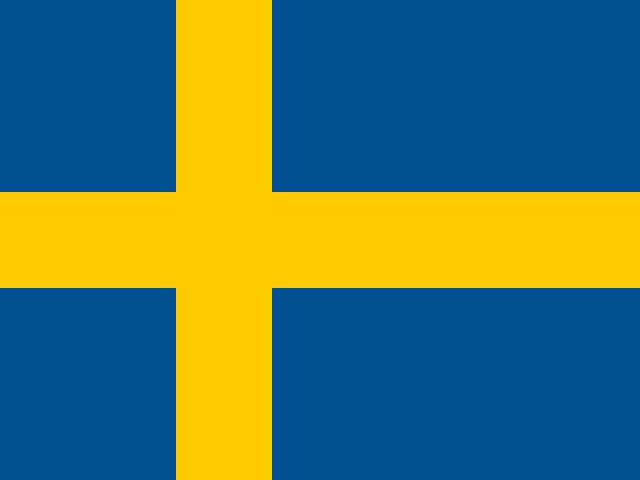
- Under section 4 of the Act on the Flag of Sweden, the Swedish flag may not bear marks, letters or other symbols beyond what the Act itself specifies for the Royal House and the Swedish Armed Forces.
- According to Riksarkivet, the flag may not be used in trade marks and the like without special permission either. Such matters are examined by the Swedish Intellectual Property Office (Patent- och registreringsverket).
- The flag’s colours may be used decoratively, according to the Swedish National Day Foundation.
Planning permission
- The flagpole is a mast under the Planning and Building Act and requires planning permission if it is taller than 20 metres or stands closer to the boundary than its own height. It is worth bearing in mind that business premises are often close to a street or a neighbouring plot.
- Advertising flags and signs: since 1 December 2025 there is no general permission requirement for signs. Signs on buildings can still require planning permission as an alteration to the façade of buildings other than one- and two-family houses within a local development plan, if the alteration is on a façade or roof facing a public place. They can also require permission at particularly valuable buildings and settings.
- The local development plan can contain its own provisions.
The municipality’s building committee can give an answer in the individual case. More about placement in the guide to flagpole installation.
Several flags
According to Riksarkivet, the Swedish flag always has the place of honour, as seen with one’s back to the building:
- Odd number of poles: the middle one.
- Even number: the pole immediately to the right of the middle.
Other national flags follow in alphabetical order of the countries’ Swedish names, alternately to the right and left. Riksarkivet gives the example of an authority with three poles raising the Swedish flag on pole no. 1, the EU flag on no. 2 and its own flag on no. 3. On the general flag days, according to Riksarkivet, the Swedish flag is raised on all poles, with flags of the same size.
Details and examples are in the guide to foreign flags in Sweden.
Mourning
According to Riksarkivet, only the Swedish flag is used in mourning. Company and association flags are not flown at half-mast, and neither are the EU flag or other international flags. Some organisations swap the company flag for the Swedish flag at half-mast when someone dies. More in the guides to half-mast and flags in mourning.
What a flag policy usually contains
A flag policy is not a legal requirement, but many organisations have one. Common elements are:
- Responsibility: who raises and lowers the flags, and who stands in during absences.
- Days: the general flag days, and sometimes other days such as Europe Day, the neighbouring countries’ national days or the minorities’ days.
- Flags: which flags are used and on which pole.
- Times: the Swedish recommendations are raising at 08:00 or 09:00 depending on the season and lowering at sunset, no later than 21:00, or lighting if the flags stay up longer.
- Mourning: when the organisation flies flags at half-mast and who decides.
- Visits: flag flying for guests from other countries.
- Upkeep: who looks after the flags and poles.
The City of Stockholm and Stockholm University are examples of organisations that publish their flag rules. Stockholm University, for example, raises the flag to the top at 15:00 on the day of a funeral if the time of the funeral is unknown.
Common equipment
- An internal halyard with a lockable hatch gives protection against theft and vandalism and a quieter pole.
- Aluminium poles of 10–12 metres are common, often with the same height for all poles in a row.
- Lighting allows the flag to stay up after sunset, see flag lighting.
- Spare flags of the same size mean a worn flag can be replaced at once.
- Foreign flags for the countries the organisation most often receives visitors from.
Work environment
It is worth bearing in mind that replacing the halyard and pulley involves work at height, and that the work environment rules apply to employers. Many organisations choose hinged poles or use a lift. More in the guide to flagpole safety.
Frequently asked questions
May a business in Sweden fly a flag with its own logo?
Yes, on its own company flag. Under section 4 of the Act on the Flag of Sweden, however, the Swedish flag may not bear marks, letters or other symbols beyond what the Act specifies, and according to Riksarkivet the flag may not be used in trade marks without special permission.
Does an advertising flag require planning permission in Sweden?
Since 1 December 2025 there is no general permission requirement for signs. The flagpole itself is, however, a mast and requires planning permission if it is taller than 20 metres or stands closer to the boundary than its height. It is worth bearing in mind that signs and façade alterations can require permission in particularly valuable settings and on certain buildings within a local development plan.
Where is the Swedish flag placed when there are several flagpoles?
According to Riksarkivet, the Swedish flag always has the place of honour. With an odd number of poles it is the middle one; with an even number, the pole immediately to the right of the middle, as seen with one’s back to the building.
Are company flags flown at half-mast in mourning?
No. According to Riksarkivet, only the Swedish flag is used in mourning, and company and association flags are not flown at half-mast.
What is a flag policy?
A flag policy is a document in which an organisation describes who flies the flags, on which days, with which flags and what applies in mourning. It is not a legal requirement, but many municipalities, universities and larger businesses have such a policy.
Sources
This guide is based on the following sources, most of them in Swedish:
- Sveriges flagga – internationell flaggning och flaggans användning – Riksarkivet
- Bygglov för mast och torn – Boverket
- Lista med PBL-ändringar som trädde i kraft den 1 december 2025 – Boverket
- Flaggning i Stockholms stad – Stockholms stad
- Policy för flaggning vid Stockholms universitet – Stockholms universitet
- Lag (1982:269) om Sveriges flagga – Sveriges riksdag
Related guides
- Foreign flags in SwedenFlying other countries’ flags in Sweden: the place of honour, the order of national flags, the EU flag and flag days for neighbouring countries and minorities.
- Flag lightingA floodlit flag may stay up after sunset in Sweden. Ways of lighting a flagpole, what electrical safety rules say and when lighting needs permission.
- Flag protocol at ceremoniesFlags and banners at ceremonies in Sweden: flag or banner, banner bearers, placement at funerals, the place of honour and raising the flag at formal occasions.
- Flagpole safetyFlagpole safety in Sweden: the Planning and Building Act on load-bearing capacity and upkeep, wind load, fall zones, power lines and work at height.