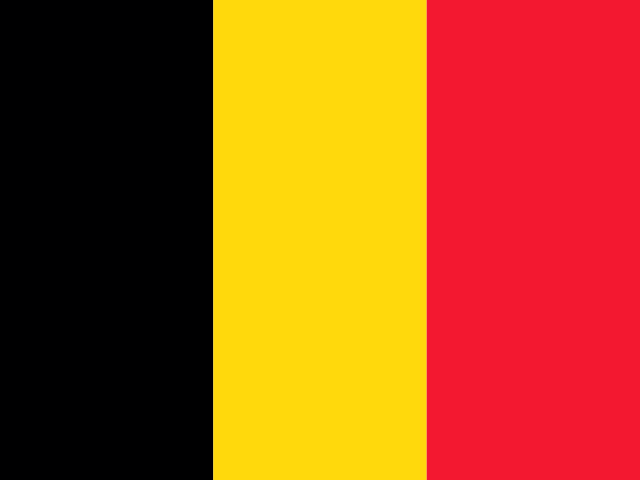
Flagpoles and flag flying in Belgium
Published Written by Flagpole Guides
This page is an English translation of the Dutch original. Where the two versions differ, the Dutch text is the original.
Flying a flag in Belgium is free, and the black, yellow and red tricolour flies at houses, club premises, businesses and public buildings. Yet more rules are involved than in most countries. The royal decree of 5 July 1974 sets the flag days for public buildings, and each community and region has its own flag and its own feast day. The permit for a flagpole is also a regional matter. This page brings together the rules and customs for flags and flagpoles in Belgium, based on Belgian legislation and the competent authorities.
The essentials
- Flag days: the royal decree of 5 July 1974 lists the days on which the Belgian and the European flag are flown on public buildings, from Queen Mathilde's birthday on 20 January to the royal couple's wedding anniversary on 4 December. All dates for 2026 and 2027 are in the guide on flag days.
- Communities and regions: the Flemish Community flies its flag on 11 July, the French Community on 27 September, the Walloon Region on the third Sunday of September and the German-speaking Community on 15 November. More on this is in the guide on flag rules.
- Half-mast: according to the protocol service of the Federal Public Service Home Affairs, a space the height of the flag stays free above it. More on this is in the guide on half-mast.
- Order: on Flemish public buildings, the Belgian flag comes first, followed by the Flemish, European, provincial and municipal flags. More on this is in the guide on flag protocol.
- Sizes: there is no legal table for flag sizes. The flag size calculator shows a common rule of thumb.
- Price: what affects the price of a flagpole and a flag is in the guides on the price of a flagpole and the price of a flag.
- Permit: Flanders, Wallonia and Brussels each have their own rules. More on this is in the guide on flagpole installation.
Laws and authorities
Belgium's colours are set out in article 193 of the Constitution: "The Belgian Nation adopts the colours red, yellow and black, and as the arms of the Kingdom the Belgian Lion with the motto UNITY MAKES STRENGTH." The Constitution does not say in which direction or proportion the bands run. In practice the flag has three vertical bands, with the black next to the pole.
The royal decree of 5 July 1974 on flag flying on public buildings lists the days on which the national and the European flag are flown on public buildings. It has been amended several times, among other things after the change of monarch in 2013 and, most recently, by the royal decree of 29 May 2015. The protocol service of the Federal Public Service (FPS) Home Affairs gives practical guidance, for example on half-mast.
Since the state reforms, the communities and regions have had their own symbols. The Flemish Community set out its arms, flag, anthem and feast day in the decree of 7 November 1990, the French Community in the decree of 3 July 1991, the Walloon Region in the decree of 23 July 1998 and the German-speaking Community in the decree of 1 October 1990. The Brussels-Capital Region has an ordinance on its flag from 1991 and an ordinance from 2003 on its feast day on 8 May. For Flemish public buildings, circular VR 2015/37 of the Flemish Government sets out the rules in more detail.
There is no separate law on flagpoles. Installing one falls under the planning rules of the region: the Flemish Spatial Planning Code and its exemption decree, the Walloon Code du Développement Territorial (CoDT) and the Brussels Planning Code (CoBAT), together with municipal regulations.
The flagpole in Belgium
Flags are flown in many ways in Belgium. Circular VR 2015/37 mentions poles on the roof, on the façade, against a window and on the pavement in front of a building. On terraced houses a façade pole is common, and in gardens, at businesses and at sports clubs a free-standing pole. More on this is in the guides on types of flagpoles and flagpole heights.
Public buildings often fly several flags side by side. According to circular VR 2015/37, all flags then have the same size, and the order of the poles depends on whether the number of flags is odd or even.
About the guides
The guides are grouped by topic. Each guide covers one defined subject, ends with frequently asked questions, lists its sources and shows the date of its latest update. This English translation follows the Dutch guides, which also exist in French with the same content. The rules apply throughout Belgium, and where the regions or communities differ, Flanders, Wallonia, Brussels and the German-speaking Community are each covered.
All guides
Flag flying and rules
When and how flags are flown in Belgium: the flag days of the royal decree, the feast days of the communities and regions, half-mast, mourning, protocol and foreign flags.
- Flag daysAll flag days in Belgium for 2026 and 2027: the days of the royal decree of 1974 and the feast days of the communities and regions, with the weekday.
- Flag rulesThe rules for flying flags in Belgium: the royal decree of 1974, the decrees of the communities and regions, and flag flying by private individuals.
- Half-mastHow a flag is flown at half-mast in Belgium according to the FPS Home Affairs, when this happens and the custom for a pole that is too short.
- Flags in mourningHow the flag is used in mourning in Belgium: national mourning, 17 February, mourning in the Royal Family, a black ribbon and flags at funerals.
- Flags on holidaysThe flag on 21 July, on the feast days of the communities and regions and on Belgium's ten public holidays, with the dates for 2026 and 2027.
- Flag protocolThe order of precedence of flags in Belgium: Belgian, Flemish, European, provincial and municipal flags, the position of the poles and the order of anthems.
- Foreign flagsForeign flags and the European flag in Belgium: their place next to the Belgian flag, state visits and flags of individuals and businesses.
The flag
The Belgian tricolour and the flags of the communities and regions: types, sizes, symbolism, what affects the price of a flag and a flag size calculator.
- Flag typesThe flags flown in Belgium: the tricolour, the flags of the communities, regions, provinces and municipalities, the European flag, theme flags and banners.
- Flag sizesCommon flag sizes in Belgium, the 2:3 and 13:15 proportions of the tricolour, the rule of thumb for a flag on a pole and flags on façade poles.
- Flag size calculatorCalculator for the flag size on a flagpole in Belgium: the standard size of a Belgian supplier, the rule of thumb and the same flag in the 13:15 proportion.
- Flag symbolismWhere black, yellow and red come from, what article 193 of the Constitution says, why the bands are vertical and what the lion, cockerel and iris stand for.
- Price of a flagWhat affects the price of a flag in Belgium: fabric, size, printing, finishing and fixings, plus the legal guarantee and the right of withdrawal.
The flagpole
Types of pole, materials, heights, accessories, mechanics, lighting and what affects the price of a flagpole, plus the history of flag flying in Belgium.
- Types of flagpolesThe types of flagpoles in Belgium: ground poles, façade poles, roof poles, banner poles, telescopic and mobile poles and internal halyards.
- Flagpole materialsAluminium, polyester, wood and steel as materials for a flagpole in Belgium: weight, maintenance and behaviour in wind and sea air.
- Flagpole heightsFlagpole heights in Belgium: common lengths for homes, associations and businesses, the link to flag size, the wind zones and the permit rules by region.
- Flagpole accessoriesAccessories for a flagpole in Belgium: finial, pulley, halyard, snap hooks, cleat, banner arm, façade bracket, ground sleeve, mourning ribbon and lighting.
- Flagpole mechanicsHow a flagpole works: external and internal halyards, pulley and revolving truck, counterweight, tilting base and why a flag wraps around the pole.
- Flag lightingLighting a flag at night in Belgium: ground or pole spotlights, solar power, the AREI inspection of the electrical installation and nuisance for neighbours.
- HistoryThe history of the flag and the flagpole in Belgium: from the first tricolour in 1830 via the royal decree of 1974 to the flags of the communities and regions.
- Price of a flagpoleWhat affects the price of a flagpole in Belgium: material, height, wind zone, halyard system, foundation and installation, plus the guarantee.
Installation, safety and maintenance
Permits in the three regions, foundations, safety, maintenance, repair, lifespan and transport, for households, associations, businesses and municipalities.
- Flagpole installationInstalling a flagpole in Flanders, Wallonia or Brussels: exemptions by region, protected heritage, KLIP and KLIM-CICC plan requests and the foundation.
- Flagpole safetySafety around a flagpole in Belgium: wind, storms, lightning, high-voltage lines, underground cables and working at height under the code on well-being at work.
- Flagpole maintenanceMaintaining a flagpole and a flag in Belgium: checking the pole and ropes, cleaning, washing, storing and replacing the flag, following the Flemish circular.
- Flagpole repairCommon faults on a flagpole: a broken or jammed halyard, a faulty pulley, a leaning pole and storm damage, and what comes into play in a repair.
- Flagpole lifespanHow long a flagpole and a flag last in the Belgian climate, what determines their lifespan, and what happens to an old pole and worn parts.
- Flagpole transportTransporting a flagpole in Belgium: how far a load may overhang under the highway code, the red and white panel, lighting and poles in sections.
- Flagpoles for businessesFlagpoles at businesses in Belgium: logo flags and the Advertising Regulation, permits by region, flag protocol, flag days and well-being at work.
Frequently asked questions
Is permission needed to fly a flag in Belgium?
No. The flag days and the order of flags set by the royal decree of 1974 and by the decrees of the communities and regions apply to public buildings. For private individuals, flying a flag is voluntary. The flagpole itself can, however, fall under the planning rules of the region and the municipality.
Which rules apply to flags on public buildings?
The royal decree of 5 July 1974 on flag flying on public buildings, last amended on 29 May 2015, sets the days on which the Belgian and the European flag are flown. The communities and regions have their own decrees and ordinances on their flag and feast day.
What are the colours of the Belgian flag?
Article 193 of the Constitution states that the Belgian Nation adopts the colours red, yellow and black. The flag has three vertical bands of black, yellow and red, with the black next to the pole. The colours come from the arms of the former Duchy of Brabant.
How is a flag flown at half-mast in Belgium?
According to the protocol service of the Federal Public Service Home Affairs, the flag is lowered so that the gap between its upper edge and the foot of the pole's finial equals the height of the flag. If the pole is too short, its top is wrapped with a black ribbon.
Is a permit needed for a flagpole?
That depends on the region and the municipality. The exemption lists of Flanders, Wallonia and Brussels do not mention flagpoles as such. In Brussels, installations for domestic, recreational or decorative use in the garden are exempt up to 3 metres. The municipal planning department can answer for a specific case.
Sources
This guide is based on the following sources, most of them in Dutch:
- Koninklijk besluit van 5 juli 1974 betreffende de bevlagging van de openbare gebouwen – Justel (FPS Justice)
- Koninklijk besluit van 29 mei 2015 tot wijziging van het koninklijk besluit van 5 juli 1974 – Belgian Official Gazette
- The Belgian Constitution, article 193 – Belgian Chamber of Representatives
- Omzendbrief VR 2015/37 over de bevlagging van de openbare gebouwen – Flemish Government
- Belgian flags – Belgium.be
- Comment mettre un drapeau en berne ? – FPS Home Affairs, Protocol Service