History of the flagpole and flag flying in Belgium
Published Written by Flagpole Guides
This page is an English translation of the Dutch original. Where the two versions differ, the Dutch text is the original.
The history of the flagpole in Belgium is above all a history of the flags that fly from it. From the first tricolour in 1830 to the flags of the communities and regions, flag flying reflects how the country developed: a young monarchy, a member state of Europe and a federal state.
1830: the first tricolour
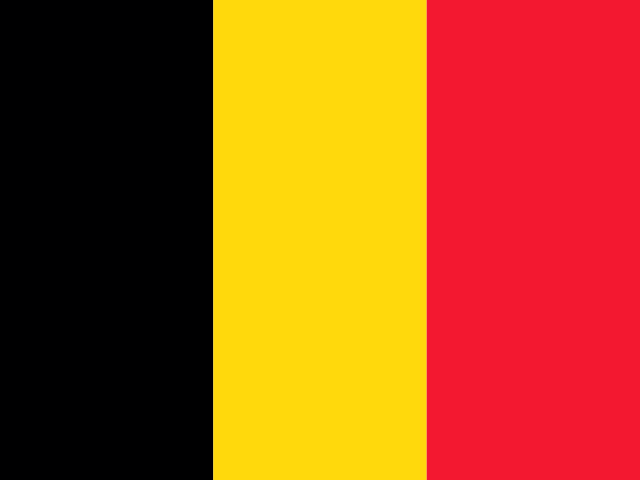
According to the public broadcaster VRT, the first Belgian flag was sewn in Brussels on 26 August 1830, in Mrs Abts's fabric shop on the Grasmarkt, at the request of two journalists. It was an alternative to the French tricolour that had appeared in the first days of the uprising. The flag had horizontal bands of black, yellow and red, the colours of the arms of the Duchy of Brabant. Later the bands became vertical.
1831: Constitution and King
The Constitution of 7 February 1831 set the colours. The current article 193 reads: "The Belgian Nation adopts the colours red, yellow and black". On 21 July 1831, Leopold I took the constitutional oath. A law of 27 May 1890 made 21 July the national holiday. According to the Belgian Monarchy, the flag flies above the Royal Palace when the King is in the country.
1974: a royal decree for public buildings
The royal decree of 5 July 1974 set the days on which the national flag is flown on public buildings. A royal decree of the same date concerns flying the flag of the Dutch Cultural Community on public buildings. The decree on the national flag has been amended several times:
- in 1983, 1989, 1993 and 1998
- in 2013, after the change of monarch from King Albert II to King Philippe, with the birthdays of Queen Mathilde (20 January) and King Philippe (15 April) and their wedding anniversary (4 December)
- in 2015, after the death of Queen Fabiola: 11 June was dropped, and all deceased members of the Royal Family have since been remembered on 17 February
1975–1998: the flags of the communities and regions
With the state reforms, the communities and regions gained their own symbols. The French Cultural Community was given its own flag and feast day by a decree of 20 July 1975. The French Community's decree of 3 July 1991 repealed that decree and set the flag with the red cockerel and the feast day on 27 September. On the Flemish side, according to circular VR 2015/37, De Vlaamse Leeuw has been the anthem of the Dutch Cultural Community since 22 September 1973, and the decree of 7 November 1990 set the arms, flag, anthem and feast day of the Flemish Community.
The German-speaking Community followed in 1990, the Brussels-Capital Region in 1991 and the Walloon Region in 1998. The Brussels flag was given a new design in 2015.
1986: the European flag in Brussels
According to the European Union, the European flag was raised for the first time in May 1986 at the Berlaymont building, the seat of the European Commission in Brussels. Since then the flag with the twelve gold stars has flown at the European institutions in Brussels and, under the royal decree of 1974, next to the Belgian flag on most flag days.
The flagpole itself
Circular VR 2015/37 shows how differently flags are flown in Belgium: from poles on the roof, on the façade, against a window and on the pavement. On older public buildings and houses, façade poles are a familiar sight, and for free-standing poles aluminium and polyester are the common materials today. More on this is in the guides on types of flagpoles and flagpole materials.
Frequently asked questions
When was the first Belgian flag made?
According to the public broadcaster VRT, on 26 August 1830, in Mrs Abts's fabric shop on the Grasmarkt in Brussels. The flag was sewn in haste and had horizontal bands of black, yellow and red.
Since when has a royal decree set the flag days?
The royal decree on flag flying on public buildings dates from 5 July 1974. It was amended in 1983, 1989, 1993, 1998, 2013 and 2015, mainly to update the birthdays and commemorations of the Royal Family.
Since when have the communities and regions had their own flags?
The French Cultural Community was given its own flag and feast day by a decree of 20 July 1975, replaced by the decree of 3 July 1991. The German-speaking Community set its flag on 1 October 1990, the Flemish Community on 7 November 1990, the Brussels-Capital Region on 16 May 1991 and the Walloon Region on 23 July 1998.
Sources
This guide is based on the following sources, most of them in Dutch:
- Ontdek het verhaal achter de eerste Belgische vlag – VRT NWS
- National holiday and holidays of the communities and regions – Belgium.be
- Koninklijk besluit van 5 juli 1974 betreffende de bevlagging van de openbare gebouwen – Justel (FPS Justice)
- Omzendbrief VR 2015/37 over de bevlagging van de openbare gebouwen – Flemish Government
- Décret du 3 juillet 1991 déterminant le jour de fête et les emblèmes propres à la Communauté française de Belgique – Parliament of the Wallonia-Brussels Federation
- The European flag – European Union
- Symbols – The Belgian Monarchy
Related guides
- Flag symbolismWhere black, yellow and red come from, what article 193 of the Constitution says, why the bands are vertical and what the lion, cockerel and iris stand for.
- Flag daysAll flag days in Belgium for 2026 and 2027: the days of the royal decree of 1974 and the feast days of the communities and regions, with the weekday.
- Flag typesThe flags flown in Belgium: the tricolour, the flags of the communities, regions, provinces and municipalities, the European flag, theme flags and banners.
- Flag rulesThe rules for flying flags in Belgium: the royal decree of 1974, the decrees of the communities and regions, and flag flying by private individuals.