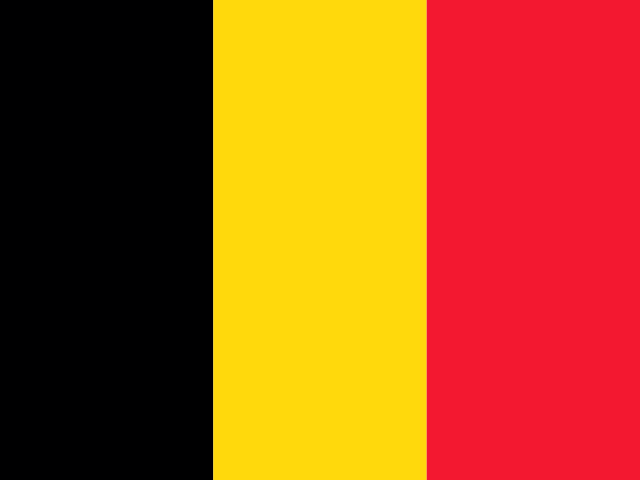
Symbolism of the Belgian tricolour
Published Written by Flagpole Guides
This page is an English translation of the Dutch original. Where the two versions differ, the Dutch text is the original.
The Belgian flag is older than the Belgian state. Its colours go back to the heraldry of Brabant, and the tricolour became a symbol of the Belgian Revolution of 1830. Since then the communities and regions have also gained their own symbols, each with its own story.
Black, yellow and red
According to Belgium.be, the colours come from the arms of the former Duchy of Brabant: a lion of gold (yellow) on a field of sable (black), clawed and tongued gules (red). The Belgian Monarchy gives the same explanation: the colours come from the arms of the Duke of Brabant.
Article 193 of the Constitution reads: "The Belgian Nation adopts the colours red, yellow and black, and as the arms of the Kingdom the Belgian Lion with the motto UNITY MAKES STRENGTH." The Constitution thus names the colours in the reverse order of how they appear on the flag, and says nothing about the direction of the bands. On the flag, black is next to the pole, yellow in the middle and red on the fly.
From horizontal to vertical
According to the public broadcaster VRT, the first Belgian flag was sewn in haste on 26 August 1830 in Brussels, in Mrs Abts's fabric shop on the Grasmarkt. That flag had horizontal bands. The bands later became vertical, partly to avoid confusion with the Dutch flag and following the example of the French tricolour.
The flag and the monarchy
According to the Belgian Monarchy, the Belgian flag flies above the Royal Palace and Laeken Castle when the King is in Belgium. When the King is on an official trip abroad, the flag is taken down for the duration of the trip. The national holiday on 21 July recalls the oath taken by Leopold I, the first King of the Belgians, on 21 July 1831.
The symbols of the communities and regions
- The Flemish lion: a black lion on a yellow background, clawed and tongued red. The feast day on 11 July commemorates, according to Belgium.be, the Battle of the Golden Spurs near Kortrijk in 1302.
- The Walloon cockerel: a red coq hardi on a yellow background, with a raised leg and a closed beak, for the Walloon Region and the French Community. The French Community's feast day on 27 September commemorates, according to Belgium.be, the patriots' victory over the Dutch troops in Brussels Park in 1830.
- The lion of the German-speaking Community: a red lion with nine blue cinquefoils on a white background. The community chose 15 November, the King's Feast, as its feast day.
- The Brussels iris: a stylised iris on a blue background. The Brussels-Capital Region celebrates its feast day on 8 May, Iris Day.
The motto
The motto Eendracht maakt macht, in French L'union fait la force, appears in the Constitution with the arms of the Kingdom and the Belgian Lion. According to the Belgian Monarchy, it was chosen after the revolution of 1830 and refers to the nine provinces then united in one country. In German it reads Einigkeit macht stark. More on the flags themselves is in the guide on flag types.
Frequently asked questions
Where do the colours of the Belgian flag come from?
According to Belgium.be, from the arms of the former Duchy of Brabant: a golden (yellow) lion on a black field, with red claws and tongue.
Why does the Constitution say red, yellow and black?
Article 193 of the Constitution reads: 'The Belgian Nation adopts the colours red, yellow and black'. The Constitution names only the colours, not their place on the flag. On the flag, black is next to the pole, followed by yellow and red.
Was the Belgian flag once horizontal?
Yes. According to the public broadcaster VRT, the first Belgian flag of August 1830 had horizontal bands. The bands later became vertical, partly to avoid confusion with the Dutch flag.
What is Belgium's motto?
Article 193 of the Constitution names as the arms of the Kingdom the Belgian Lion with the motto EENDRACHT MAAKT MACHT, in French L'UNION FAIT LA FORCE: unity makes strength.
Sources
This guide is based on the following sources, most of them in Dutch:
- The Belgian Constitution, article 193 – Belgian Chamber of Representatives
- Belgian flags – Belgium.be
- National holiday and holidays of the communities and regions – Belgium.be
- Ontdek het verhaal achter de eerste Belgische vlag – VRT NWS
- Symbols – The Belgian Monarchy
- Décret du 23 juillet 1998 déterminant le jour de fête et les emblèmes propres à la Région wallonne – Wallex (Public Service of Wallonia)
Related guides
- Flag typesThe flags flown in Belgium: the tricolour, the flags of the communities, regions, provinces and municipalities, the European flag, theme flags and banners.
- HistoryThe history of the flag and the flagpole in Belgium: from the first tricolour in 1830 via the royal decree of 1974 to the flags of the communities and regions.
- Flags on holidaysThe flag on 21 July, on the feast days of the communities and regions and on Belgium's ten public holidays, with the dates for 2026 and 2027.
- Flag rulesThe rules for flying flags in Belgium: the royal decree of 1974, the decrees of the communities and regions, and flag flying by private individuals.